Exploring Labour and Technology in ‘Rickshaw with a Cathode Ray Tube’
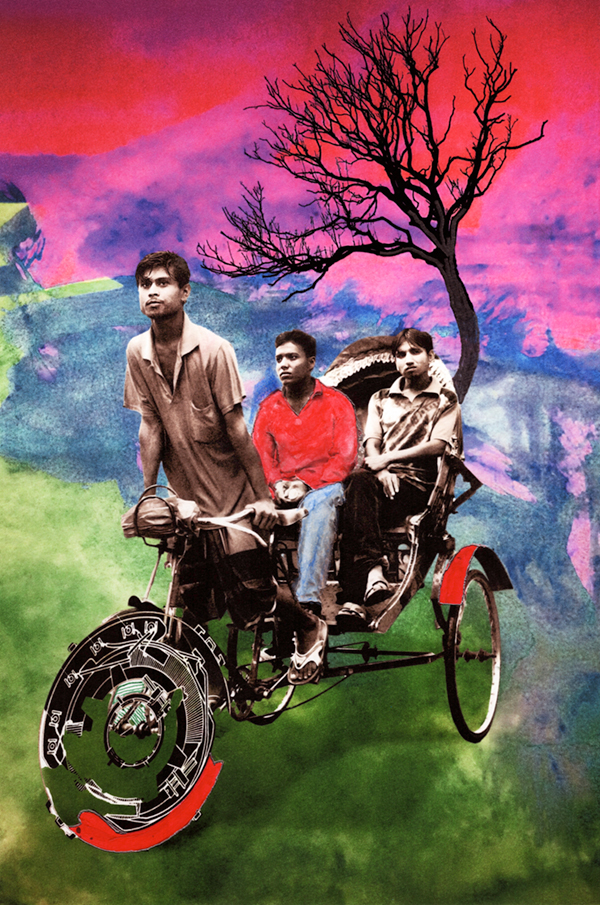
This work, centred on the cycle rickshaw, is a vehicle for thinking about labour, technology and environmental change. It brings together several very different visual languages: documentary photography, hand-drawn imagery, a saturated, painted landscape, and, most strikingly, the insertion of a cathode-ray tube (CRT) as the front wheel. I photographed the rickshaw in Dhaka in 2018.
The driver occupies the foreground and is physically larger than the two passengers, giving him a particularly strong presence. His upright body and direct gaze make him feel like the human engine of the image. Yet his body is also positioned as part of the machine: his legs, the pedals and the bicycle frame form an interconnected structure. The driver supplies the energy that moves the vehicle, while the passengers are transported by it. Embedded within this simple arrangement is a subtle economic and social relationship.
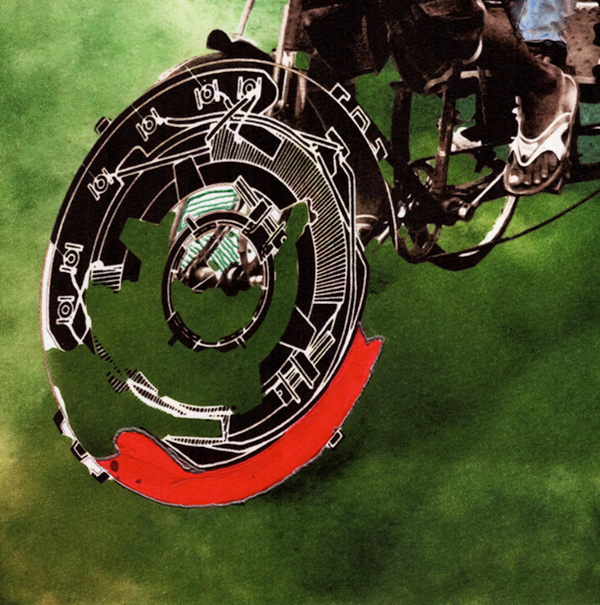
I want the viewer to look closely at the mechanics of the rickshaw — the wheels, chains, frame and pedals. I have deliberately disrupted our understanding of this familiar machine by replacing its conventional front wheel with something technologically and symbolically much stranger: a cathode-ray tube.
The CRT belongs to an earlier technological era: the world of televisions and computer monitors that has largely been superseded by flat screens and digital technologies. I remember seeing many of these discarded sets at the Coventry tip in the 1960s. As a boy, I would go there looking for loudspeakers, unscrewing them from dumped radios and televisions and using them to build my own speaker system at home. That memory connects the CRT in this work not only with technological obsolescence, but also with my own early fascination with taking things apart and finding new uses for them.
The image asks whether what we call technological progress is necessarily progress in human or environmental terms. There is a tension here between high technology and low technology. The rickshaw is an extraordinarily economical form of transport: it uses human energy rather than fossil fuel. The CRT, by contrast, represents an industrially manufactured form of electronic technology, dependent on complex materials, energy-intensive production and, ultimately, disposal. Bringing these two things together turns the wheel into a kind of visual metaphor for the technological economy itself.
The rickshaw has a relatively small direct carbon footprint. It relies on human muscle rather than an internal-combustion engine. The CRT wheel, however, introduces the problem of technological waste. Cathode-ray tubes contain materials that can be difficult and hazardous to dispose of, and obsolete electronic equipment contributes to the expanding problem of e-waste.
The wheel therefore becomes an environmental paradox: We have a machine powered by human energy, but its wheel is made conceptually from the technological waste of an industrial society.
The work does not simply celebrate traditional or apparently primitive technology over modern technology. Instead, it suggests that these two worlds are now inseparable. The supposedly simple rickshaw exists within the same global technological and economic system that produces the obsolete CRT.
The huge tree dominates the upper part of the composition, its branches spreading almost like veins or electrical circuits. It connects visually with the rickshaw and becomes a symbol of the inextricable relationship between humanity and nature. The tree is both organic and structural, a living network that echoes the mechanical and technological networks below it.
The driver introduces another dimension to the work. He carries the physical burden of moving the passengers. His body is visibly working, while the passengers appear relatively comfortable and passive. The image therefore draws attention to the unequal distribution of physical effort within society.
The rickshaw can consequently be understood as both a means of livelihood and a symbol of economic inequality. It represents ingenuity and relatively sustainable transport, but it also reminds us that human bodies can become a source of cheap energy within an unequal economy. The driver embodies both exploitation and resilience.
A human-powered rickshaw may appear technologically primitive, but in environmental terms it can be remarkably sophisticated. A cathode-ray tube, meanwhile, was once a symbol of technological advancement, but by the time it appears here it has become waste. Their juxtaposition suggests that technological progress is never simply a matter of replacing the old with the new. Every technology leaves material, environmental and human consequences behind.
For me, the CRT wheel is the key conceptual device in the work. It prevents the viewer from seeing the rickshaw simply as an ethnographic or documentary image. Instead, it transforms the entire vehicle into a metaphor for a world in which human labour, technological consumption and environmental consequence are caught in the same cycle.
The rickshaw moves because of the labour of the human body; the CRT wheel carries the history of industrial technology and its obsolescence; and the tree reminds us that both exist within the larger ecological system on which we depend. The image is therefore ultimately about cycles — of labour, technology, consumption, waste and renewal — and about the uneasy question of what kind of progress we are actually moving towards.