Street Vendors, Rickshaws and Urban Survival in Bangladesh and Indonesia
These two photographs are separated by twelve years and by a national border, but they are strikingly connected. Both depict people making a living at street level, surrounded by improvised forms of commerce and transport.
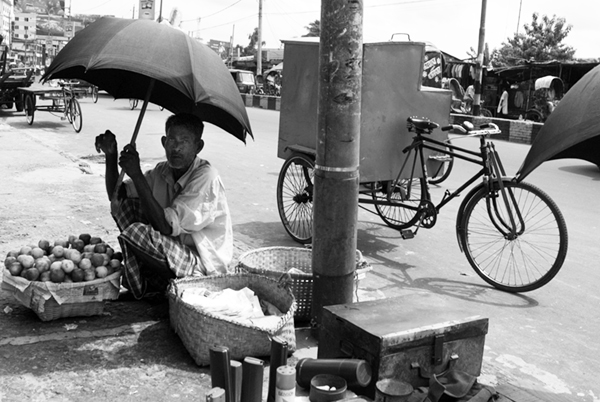
The first image has a particularly strong sense of economic informality. The man sits almost at ground level beside a small display of fruit, protected by a large umbrella. His possessions are few and portable: baskets, produce and perhaps the tools of his trade. Behind him is his bicycle fitted with a large box, a form of small-scale commercial transport.
The composition places the man at the very bottom of the urban hierarchy. The road, bicycles, utility pole and buildings belong to the formal city, whereas his stall occupies the marginal space between pavement and road. Yet this distinction is deceptive: his activity is clearly part of the functioning city. He provides a service and participates in the circulation of food and goods, even though his business has little or no physical infrastructure.
As Bangladesh’s principal port city, Chittagong (now officially Chattogram) has long attracted migrants and lower-income workers. Research on the city’s urban poor describes many of them as rural migrants working in the informal economy. Street vending is a viable livelihood for many people, while also leaving them exposed to uncertainty, lack of recognition and inadequate facilities. The photograph therefore shows the informal economy physically occupying the gaps left by formal urban planning. In 2008 I saw many hawkers occupying pavements and even stretches of roadway, sometimes with tacit permission from authorities and sometimes in conflict with them.
In 2008 the metropolitan area reportedly had around 150,000 rickshaws, although only about 35,000 were licensed. The number had increased after Cyclone Sidr as displaced people sought livelihoods as rickshaw pullers. The bicycle and rickshaw-like technologies are low-capital technologies that allow people with very little capital to enter the urban economy.
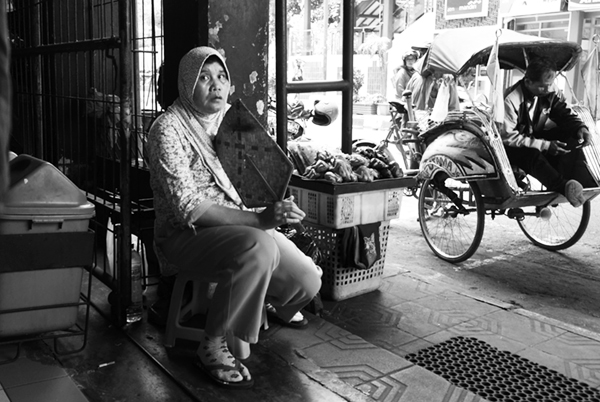
The second photograph shows a more prosperous working environment. The woman is seated on a plastic chair rather than on the pavement; she has a relatively substantial display of goods, and the setting is more developed. There is a shopfront, tiled pavement, drainage and a much denser built environment. The woman is engaged in small-scale street commerce, while immediately behind her is a traditional becak, the Indonesian cycle rickshaw. Established in Indonesia in the early twentieth century it developed into an important form of short-distance urban transport. In Java, particularly, it became deeply embedded in urban life.
There is therefore a fascinating historical irony in the photograph. The becak is simultaneously old-fashioned and remarkably resilient. It survived successive waves of motorisation, urban redevelopment and attempts by governments to regulate or eliminate informal transport. In some Indonesian cities it became a cultural symbol as well as a livelihood.
2020 is the year of COVID-19. Indonesia introduced large-scale social restrictions from March 2020, with severe consequences for urban employment and informal businesses. The World Bank reports that more than five million people lost their jobs during the first six months of the pandemic, while millions more experienced reduced working hours; informal employment actually expanded as people sought ways of replacing lost incomes. There was fairly strict social distancing in Java at this time so I was really surprised when I returned to the UK through Heathrow airport to find everything operating as normal as if there was no worldwide pandemic.
The woman and the becak driver are part of an economy particularly vulnerable to a pandemic because their livelihoods depend upon physical proximity, passing trade and mobility. The International Labour Organization noted that more than 29 million workers in Indonesia had been affected within five months of the pandemic declaration.
The people photographed are are inside the modern economy, but at its precarious end. Both photographs demonstrate the extraordinary economic importance of very simple technologies. An umbrella, basket, bicycle, plastic chair or becak can function as productive capital. There is almost no barrier between an object of everyday use and a piece of economic infrastructure. This is particularly important in poorer urban environments. A conventional shop requires rent, premises, electricity and often licences. A street trader can begin with a basket of goods. A becak driver can earn from a vehicle that embodies decades of accumulated local knowledge about repair and adaptation. Informal vehicles such as becaks survive partly because they operate at the limits of expensive, capital-intensive infrastructure.
I think both photographs are about human survival, adaptation and the persistence of informal economies.
The Chittagong man in 2008 represents an urban economy in which very little capital is required to become economically active, but in which workers have little security or institutional protection. The Java photograph shows a somewhat more developed urban environment, yet the same basic dependence upon small-scale, informal livelihoods persists. The becak is particularly powerful as a symbol: a technology with roots in the early twentieth century remains economically relevant in a rapidly modernising Southeast Asian city.
The contrast is not between tradition and modernity, but between different layers of modernity existing simultaneously.
Old and new coexist. The bicycle survives beside motor traffic; the becak survives beside motorcycles and digital platforms; the street vendor survives beside shops and supermarkets. For people with limited access to capital, the street remains a workplace, a market and a social safety net.
I think that explains the most striking similarity between the two photographs: in both, the city itself becomes the shop, the workplace and the infrastructure. The people are economically marginal in relation to the formal city, but they are simultaneously indispensable to its everyday functioning. On reflection I remember similar scenes in and around Brick Lane in East London during the 1980s.