Who Benefits from London’s Urban Transformation?
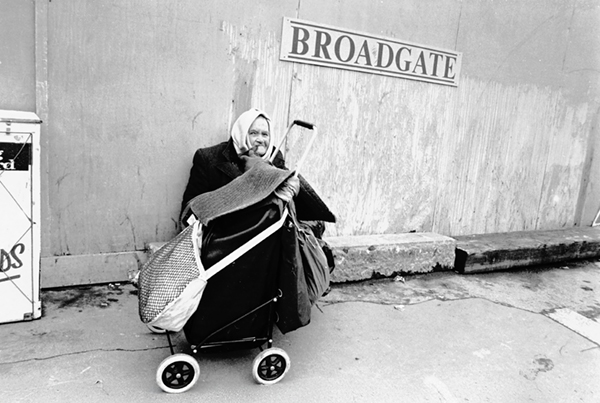
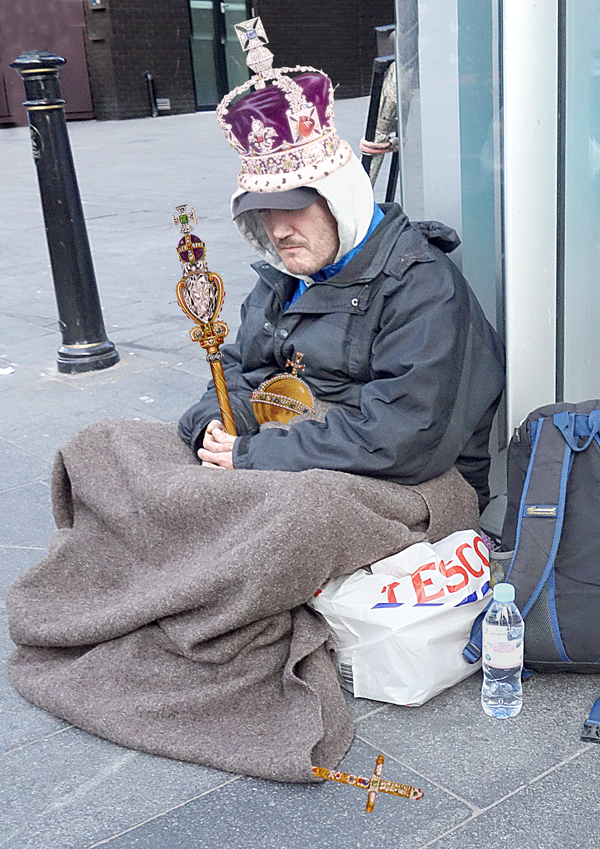
I made this photograph during the redevelopment of Liverpool Street and Bishopsgate. I would often see her along Whitechapel Road, but on this occasion she was in Bishopsgate, in the midst of the enormous changes taking place around her. It was as if she had travelled as far as she could go and had finally been stopped by the developers. Unperturbed, she had decided to use the spot to rest and take in the landscape around her.
My subject is heavily laden with possessions: a large blanket or shawl, bags and a wheeled shopping trolley. Together, they almost form a protective shell around her.
There is an extraordinary contrast between her modest, portable world and the enormous world of corporate redevelopment behind her.
The Broadgate development represented almost precisely the opposite kind of mobility and wealth: large-scale offices, finance, investment and the transformation of former railway land into one of London’s major commercial districts. The first phases were developed from the mid-1980s onwards, on and around the site of the former Broad Street station.
The sign “BROADGATE” is almost comically prominent. It sits above her head like the title of the photograph. She has little connection with the new financial City being created around her. A new city is being rebuilt around an existing population.
Broadgate became one of the great symbols of the City’s transformation during the 1980s. British Rail entered into an agreement with Rosehaugh Stanhope in 1985, and the development ultimately provided hundreds of thousands of square metres of office space. The redevelopment also helped finance the modernisation of Liverpool Street station.
The transformation involved substantial demolition. Broad Street station was demolished, parts of the historic Liverpool Street complex were removed, and new office development was constructed over railway infrastructure. Historic England describes the 1985–92 “remodelling” as a major transformation of the station and its surroundings.
I suppose that, with this image, I am asking a simple question: who is the city being rebuilt for?
Today, much of the office space built during this period is considered obsolete and difficult to let. Yet rough sleeping on the streets of London shows no sign of obsolescence.