Liverpool’s Industrial Past: A Modern Communication Paradox
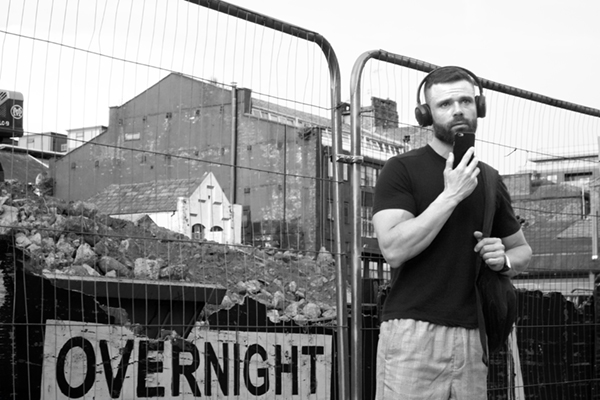
In my photograph On the Phone with Headphones. Liverpool, 2021, I was drawn to the relationship between the man and the fence. I found something compelling about the way he stands behind this tall wire construction barrier, with its grid of horizontal and vertical lines cutting across the entire image. The pattern feels quite aggressive to me, dividing the photograph into small squares and almost trapping the man within it. He is there, physically present, but somehow contained by the structure around him.
What interests me just as much is the way his headphones seem to create another kind of enclosure. The fence surrounds him physically, while the headphones enclose him psychologically. He is standing in a public space, yet he seems to have withdrawn into a private world of his own. I like this contradiction. He is alone, but communicating. He is in the middle of the city, but somehow separate from it. His attention is directed towards someone we cannot see, somewhere at the other end of the conversation. For a moment, the world around him seems to have become irrelevant.
Behind him, the buildings have been demolished. I was struck by the contrast between this landscape of industrial Liverpool, with its associations of factories, warehouses, brick and machinery, and the man with his phone and headphones. The buildings belong to a physical world shaped by labour, industry and place. The man seems to belong to a different world, one in which communication is instant and distance matters much less. He can be connected to someone miles away while standing alone among the remnants of the city’s industrial past.
I think this is what I love most about the photograph. There is something almost futuristic about him, as though he’s stepped out of another time and found himself standing among the ruins of an older world. I don’t think he is necessarily aware of this contrast; he’s simply absorbed in his conversation. But, for me, the fence, the demolished buildings and his headphones come together to suggest something about the way we live now. We can be physically present in a place while our minds and attention are somewhere else entirely.
The more I look at this photograph, the more I am drawn to that tension between being enclosed and being connected. The fence keeps the man within its grid, yet his phone allows him to reach beyond it. He is surrounded by the physical remains of Liverpool’s industrial past, but connected to an invisible world that extends far beyond the frame. I find something quietly poignant in that image of a man alone in the city, both confined by his surroundings and able to escape them.