Exploring Venice: Beyond the Tourist Experience
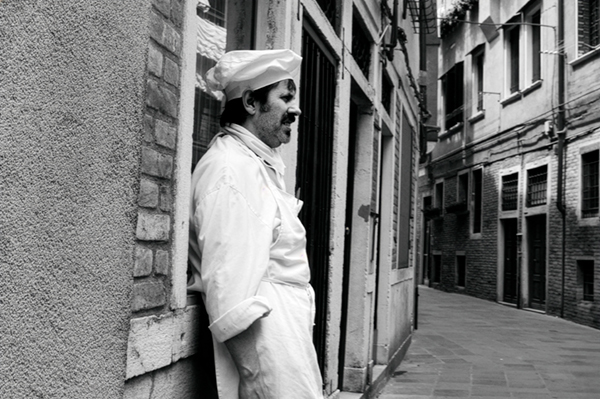
The white uniform and large chef’s hat contrast strongly with the darker doorway and surrounding brickwork in this composition. The chef acts almost as a bridge between the viewer and the street beyond. His uniform suggests cleanliness, professionalism and the traditions of the restaurant industry, while the surrounding buildings show the age of the city. I would imagine that many restaurant workers have occupied the same spot over time.
UNESCO describes Venice as a city founded in the 5th century on 118 islands, which developed into a major maritime power from the 10th century onwards. Its extraordinary historic urban structure has survived remarkably well, with the layout of its streets and buildings retaining much of its medieval and Renaissance character.
The architecture in the photograph reflects this history. The narrow street, tightly packed buildings, exposed brick and small doorways are characteristic of Venice’s historic urban environment. Here I’ve photographed a narrow calle used by local people. I’m showing the working city behind the tourist city.
Venice has an exceptionally long history as a centre of trade, commerce, craftsmanship and food culture. During the height of the Venetian Republic, the city was one of the most important commercial powers in Europe, connecting markets across the Mediterranean and further east. Its position between East and West contributed to the development of a distinctive and cosmopolitan culture.
By 2006, Venice was experiencing a major transformation. Tourism had become enormously important to the city’s economy. Contemporary reporting in 2006 estimated that around 15–18 million tourists had visited Venice during the preceding year. At the same time, the resident population of the historic centre had fallen dramatically, from a peak of about 171,000 in 1951 to fewer than 62,000 by 2006.
Taken in 2006, the image is particularly significant because Venice was already facing the consequences of mass tourism and declining numbers of permanent residents. The narrow back street becomes almost symbolic: behind the spectacular Venice presented to tourists is another Venice of workers, restaurants, homes and everyday routines.
Perhaps this photograph is not simply a portrait of a chef. It is a record of a city in transition — a place where an exceptionally ancient urban environment was increasingly being reshaped by the demands of the modern tourist economy.
Whenever I look back at the photographs I made of Venice at this time I always think of what I could have photographed but didn’t. I’m looking forward to returning!