Childhood Amid Urban Decay: Toxteth 1980
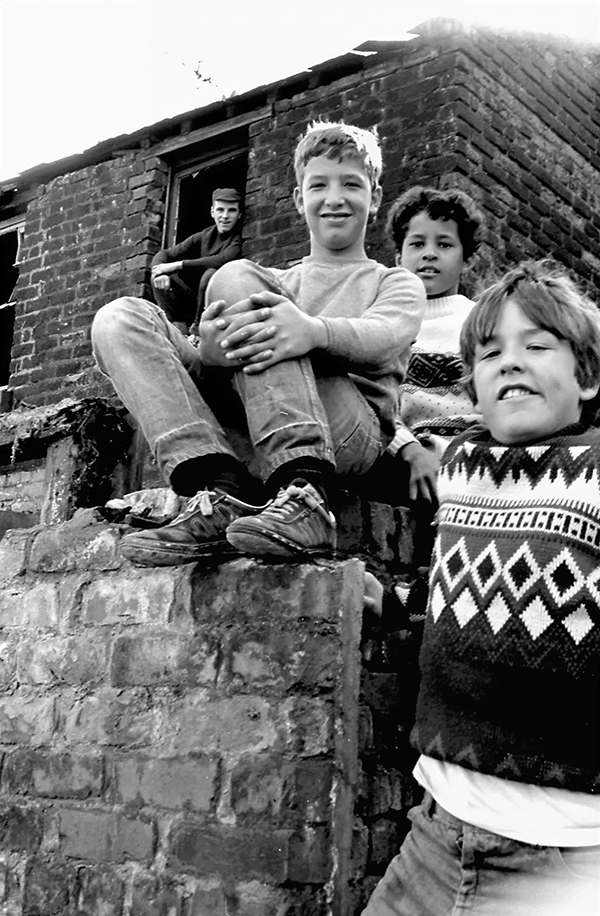
This photograph of children playing among derelict houses in Toxteth in 1980 is striking because it captures both the physical deterioration of Liverpool 8 and the continuing vitality of the community that lived there. The boys are not passive victims of poverty; they have appropriated an abandoned urban landscape and turned it into a place for play and adventure. At the same time, the ruined houses behind them provide powerful evidence of the economic and social pressures facing the area.
When I took the photograph, I was reminded of my own childhood and the hours of adventure I spent with friends exploring abandoned buildings and playing on bomb sites in Coventry. There was something exciting about these forbidden and half-forgotten spaces. Perhaps that is part of what drew me to this scene in Toxteth: despite the obvious poverty and decay, the boys appear to have found their own world of adventure among the ruins.
The photograph captures a striking contrast between childhood and dereliction. The boys are engaged in what looks like ordinary play, yet the environment around them is anything but ordinary. Broken walls, empty houses and exposed brickwork suggest a neighbourhood undergoing demolition and clearance. Houses that had once provided homes for working-class families had become unsafe, unwanted or simply abandoned.
Liverpool had suffered a long-term decline in its traditional economic base, particularly in shipping, the docks and manufacturing. During the 1970s these problems intensified, with unemployment rising and large numbers of people leaving the inner city. Research into Liverpool’s decline records that more than 100,000 people left the city during the 1971–81 decade, through a combination of slum clearance, rehousing and the search for employment elsewhere. (Springer)
The empty terraces therefore tell a story about the destruction of an urban community as much as the destruction of buildings. These houses were not simply structures; they were homes, and their disappearance disrupted established networks of neighbours, families and local businesses. Historic England’s later work on the Welsh Streets in Liverpool 8 illustrates the scale and persistence of the problem: hundreds of Victorian terraced houses eventually became vacant and derelict, demonstrating the depth of the housing crisis in this part of the city. (Historic England)
By 1980, Britain was entering a severe recession, while Liverpool was experiencing the consequences of deindustrialisation particularly intensely. Traditional employment in the docks, manufacturing and associated industries was contracting. For communities already facing economic disadvantage, there were increasingly few alternatives.
The scale of unemployment around Toxteth was enormous. The Scarman Report, which examined the disturbances that followed in 1981, recorded that unemployment registered at the nearby Leece Street employment office had remained at around 17,000–18,000 between 1976 and 1980. In the year to June 1981, it rose by roughly another 3,000, reaching more than 21,000. The report also drew attention to the particular impact of unemployment on young people, including young Black people.
The boys in this photograph belonged to a generation growing up in an environment where the transition from school to secure employment was becoming increasingly uncertain. Their apparently carefree play therefore takes place against a much more troubling economic background.
Yet I think it is important not to view the photograph simply as a document of poverty. What interests me is the way the children have taken possession of this neglected space. The adults may have seen abandoned houses, demolition and decay; the boys appear to have seen possibilities. Their presence brings life into a landscape that otherwise looks empty.
There is also an added poignancy in knowing what was to happen in Toxteth the following year. In 1981 the area became the focus of major civil disturbances, following years of unemployment, poor housing, racial discrimination and increasingly strained relations between sections of the community and the police. None of that is directly visible in this photograph, and I would not want to suggest that the image somehow predicts what happened. But, viewed with hindsight, the derelict houses and the circumstances in which these children were growing up form part of the wider social and economic landscape of the time.
For me, the central significance of the photograph lies in this juxtaposition of childhood vitality and urban abandonment. The boys are surrounded by the physical consequences of Liverpool’s economic crisis, but they are also evidence that Toxteth was a living community rather than simply the “derelict” or “problem” area that much contemporary media portrayed it as.
Perhaps that is what I remember most strongly about making photographs like this. Amid the decay, there was still life: children playing, people talking, families carrying on with their everyday lives. The buildings might have been falling apart, but the community had not disappeared.