Heads and sculptures (2)
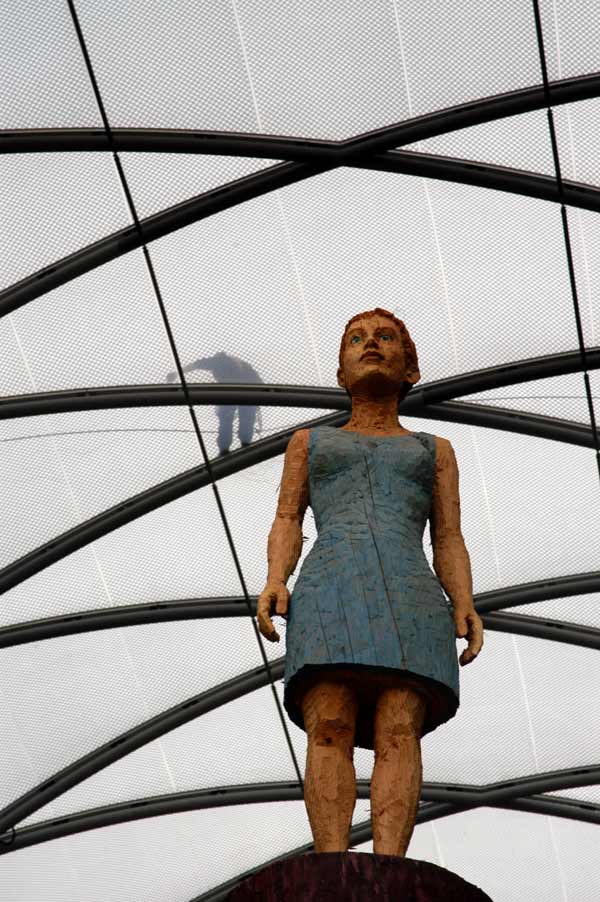 Public art, sculpture in Berlin
This public sculpture in Berlin (2002) is enhanced by a real man on the roof who is cleaning the glass.
 Silver head with a cap and daffodil
Again in Berlin a sculptured silver head is enhanced by a daffodil and cap.
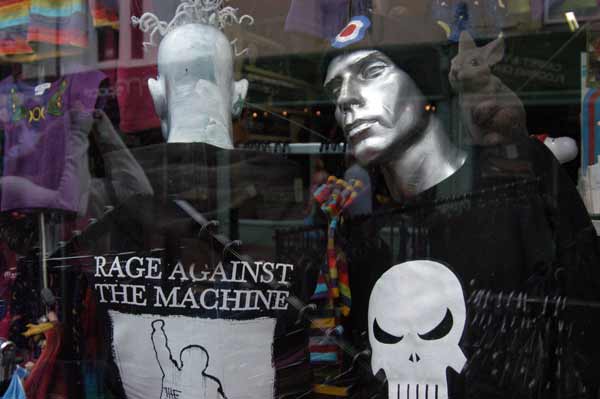 A shop window in Brighton
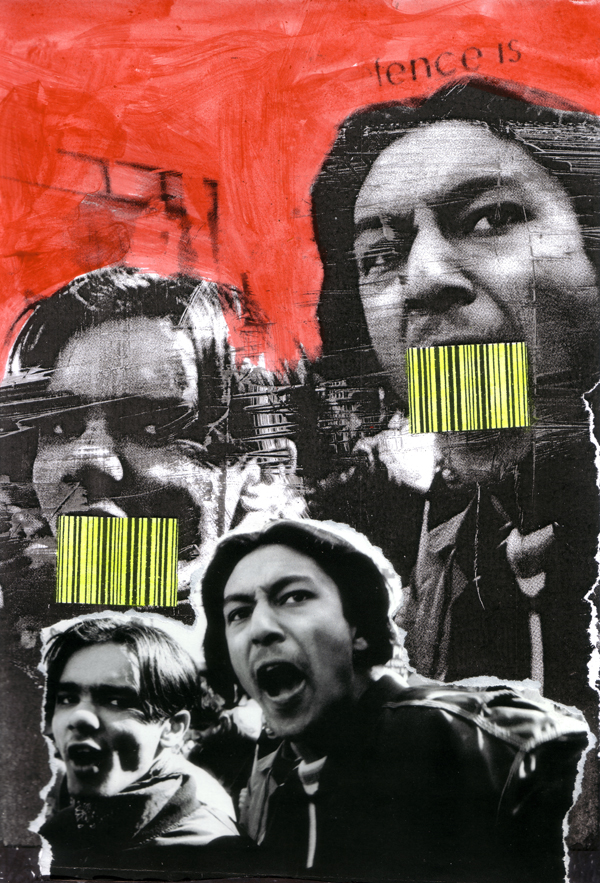
These two heads in a shop window in Brighton (2002) rage against the machine and hopefully encourage potential shoppers inside.
 Art installation on Brick Lane with Oscar
Oscar becomes part of an art installation in Brick Lane. His intelligent pose brings it all to life.
 Carving of dancers on a temple wall, Cambodia
This is one of hundreds of ancient sculptures that can be found in temples in Siem Reap in Cambodia (2009).

Shop window, Whitechapel c.1983

Portrait in a lift, Whitechapel c.1985

Demonstration on Brick Lane c.1983
1970s Liverpool (2)
 Off Smithdown Road
 Off Smithdown Road
 Near Penny Lane
 White Swan
 Liverpool
 Off Smithdown Road
 Liverpool
 Pier Head
 Pier Head

Smithdown Road c.1978

Smithdown Road c.1978

Smithdown Road c.1978

Princess Avenue c.1979

Princess Avenue c.1979

Liverpool 8 c.1978
I am not sure of the location of some of these photographs so I would be grateful for any assistance in identification!
On The Buses (2)
 Bus stop at Burdett Rd, 2009
Bus stops are great places for photographic loitering. The accumulation of a wide variety of people at a bus stop provides endless opportunities for portraits and observations of human behavior, fashion and style.
 A man with a cap on a route master bus, 1999
I’ve always regarded public transport as a moving studio set up to record people. Invariably I carry a small camera with me to record the environment I pass through. Buses can be difficult in terms of the rapidly changing light. However it’s difficult not to discover an interesting subject. A London bus will always furnish a photographer with a wide range of subjects. This passenger has emerged into the metropolis ready for the cold with his two jumpers, coat and cap.
 Man on the lower deck of the 254 bus, 2009
The human landscape is altered each time the bus collects fresh passengers at a stop. This passenger is positioned safely in a seat specially designed for disabled travelers. The routemaster bus had no facilities for disabled passengers.
 Leaving a routemaster bus on the East India Dock Road, 2003
This passenger is helped from the bus by the conductor. She steadies herself by touching the advertisement of an idealised woman. Despite the competition from the glossy lady in a swim suit our attention is held by the old lady. The routemaster was withdrawn from service in 2005 partly for health and safety reasons.
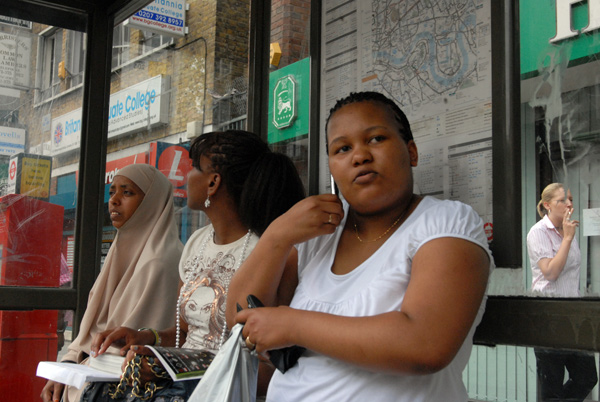 Bus stop, Whitechapel 2009
Before the invention of the mobile phone conversation between waiting passengers was usual at bus stops. At this stop there is no communication between the three women and the woman closest to the camera can’t raise anyone on her phone.
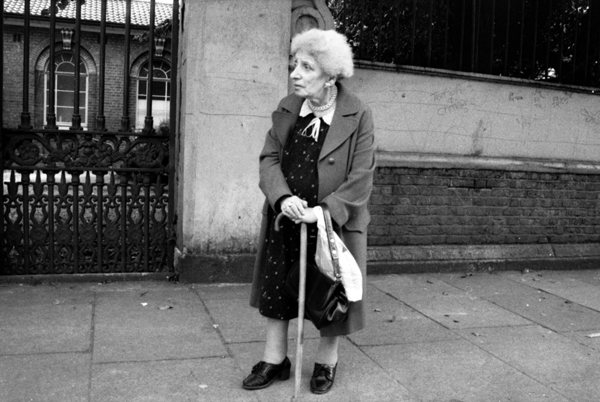
Waiting for a bus, Mile End Road c.1990

Bus Stop, Whitechapel Road 2014

Bus Stop, Whitechapel Road 2014

Bus Stop, Whitechapel Road 2014
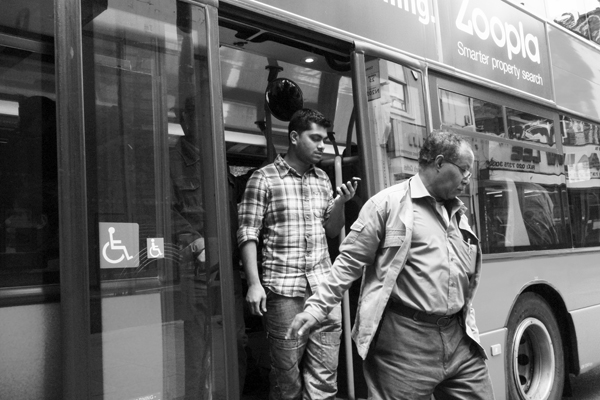
Bus Stop, Whitechapel Road 2014

Bus Stop, Whitechapel Road 2014

Bus Stop, Whitechapel Road 2014

On the 25 bus going East 2014
Mobile Streets
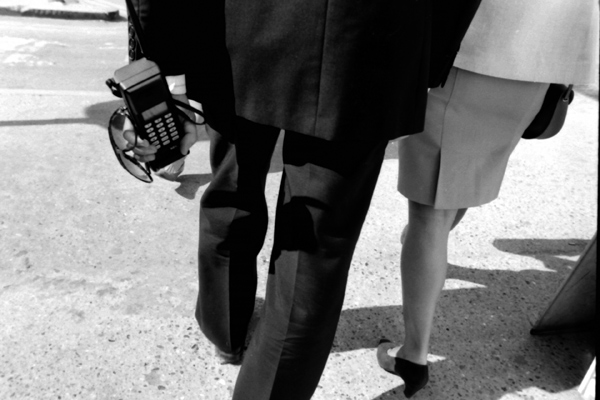 Mobile phone in the city around 1989
The photograph above was taken before mobile phones were cheap enough for nearly everyone to buy. At this time the calls were expensive and the phones were often carried around as a status symbol. They were too large to fit snugly into your pocket.
 Conversation on Commercial street, 2006
I’ve always thought of myself as a ‘street photographer’. The street is unpredictable and a unique imprint of the community of an area. It’s a place where you will find intriguing juxtapositions of people and events. Capturing a moment in time on a street can be challenging but it holds many rewards for the photographer.Where I live in Whitechapel the street is like an extension of where you live. Many families live in small overcrowded flats so public spaces become a valuable place to meet people and talk. Often you will just bump into an acquaintance or a friend you’ve not seen for a long time and strike up a conversation. I’ve noticed a change in the dynamics of the street since the invention of mobile phones. Now many people cut themselves off from the engaging environment of the street by holding a conversation on their mobile.
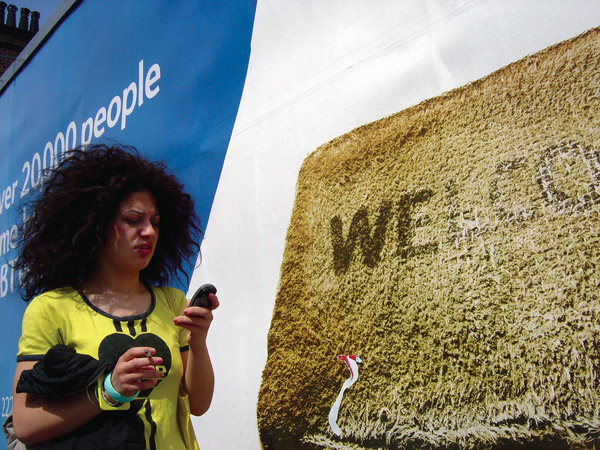 Mobile texting on Vallance Rd, 2004
It seems that some people find it difficult to simply walk and enjoy the ever changing vibe of the street. Its as if this very basic human activity of walking has now been invaded by technology. It’s a revolution that has gone almost unnoticed and even though I’m guilty of answering calls on the street I can’t help thinking that the mobile phone has invaded the pleasures of walking.
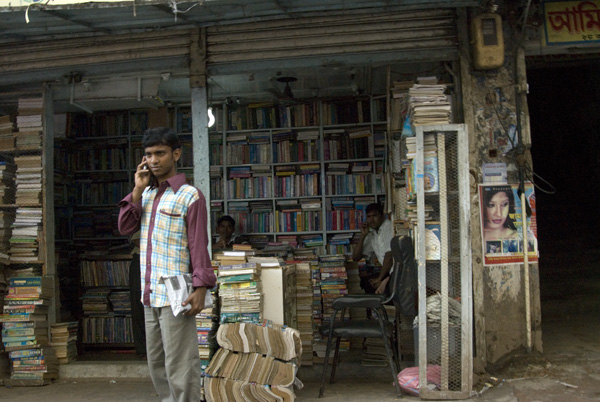 Young man outside a book shop in Dhaka, 2008

Old Montague Street 2014

Whitechapel Market 2014

Whitechapel 2014
Prams And Shopping Trolleys
 Lady pushing shopping trolley. New York, 2005.
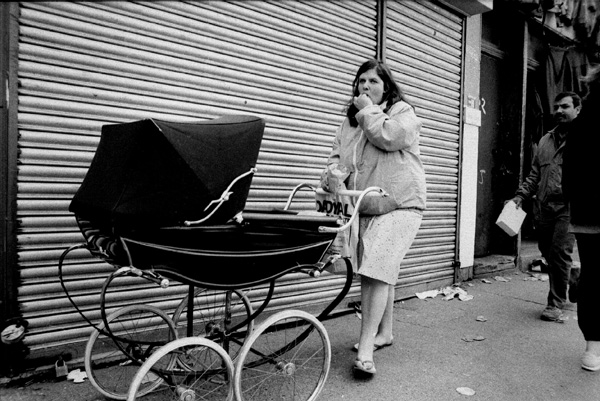 Woman with pram on Vallance Road. London 1986
 Lady pushes shopping trolley across Valance Rd. London 2006
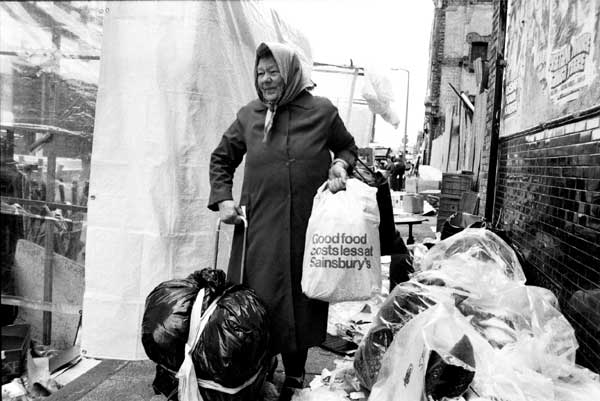
Spitalfields c.1986

Spitalfields c.1985

Spitalfields 2014