Babes in Arms
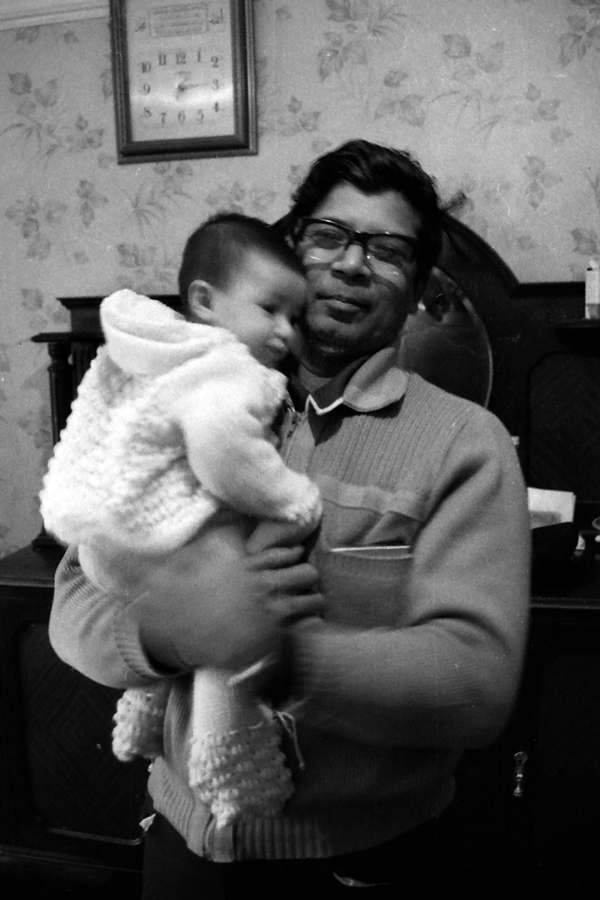
Father and daughter, Spitalfields 1986

Babies in a rickshaw, Bangladesh 1996
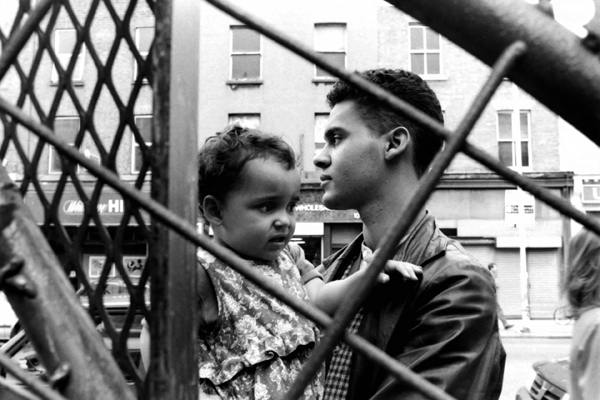
Father and daughter, Spitalfields 1997
Mobile fridges and Cucumbers
Following a number of visits to Bangladesh over the past 20 years I’ve come to the conclusion that anything can be moved around by sheer muscle power. The fridge on the bicycle platform (below) is a relatively modest cargoe but still appears to be quite a triumph of human transportation.

Bicycle with fridge, Dhaka 2008
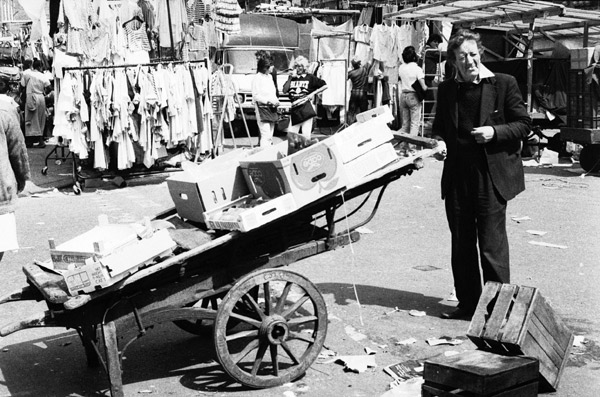
Market cart, Petticoat Lane 1984
- In contrast the hand cart (above) probably dates back to Victorian times and has no doubt been responsible for the movement of thousands of tons of vegetables in its life time. On the day I photographed the gentleman (below) it was responsible for the movement of cucumbers and apples.
-
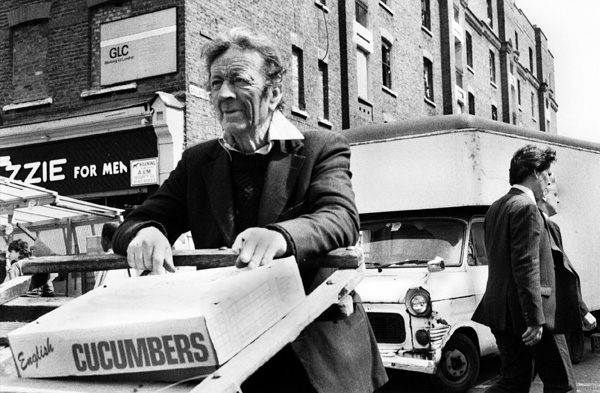
Petticoat Lane market, 1984
Flying on Brick Lane
The Biman aircraft painting (below) could be seen in the entrance to flats and a mini cab office in 1995 on Brick Lane. The painter probably learnt to paint for advertising in Bangladesh. The style is similar to many hand painted advertisements which were prolific in India and Bangladesh a few decades ago. This small example of the genre caught my eye and reminded me of Bangladesh. The image has been attacked I suspect by inebriated individuals waiting for cabs supplied by the office above. The lines across the image have most likely been scratched on with coins.
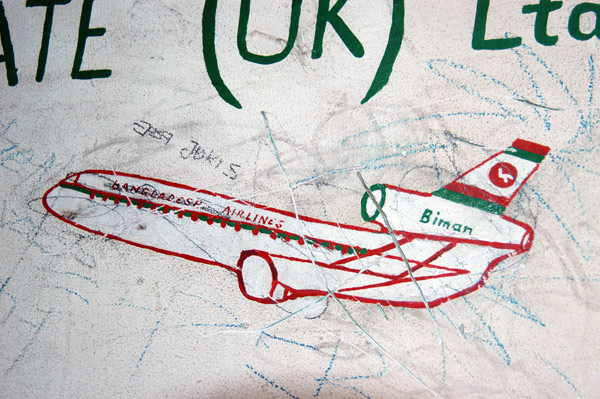
Aircraft painting on wall, Brick Lane 1995

Brick Lane, woman walking past cab office entrance, 1995
If you look carefully into the entrance the woman (above) is passing you can see the painting advertising ‘Biman’ in context under the sign ‘Surma Travels’.
Shadwell Warehouse
Thirty years ago ‘The Highway’ in Shadwell accommodated empty warehouses which overlooked the River Thames. They have since been demolished or converted into luxury flats. I recall exploring one warehouse which was opposite the Shadwell Centre (which remains as a public building). It was clear that the building had remained empty and undisturbed for decades.
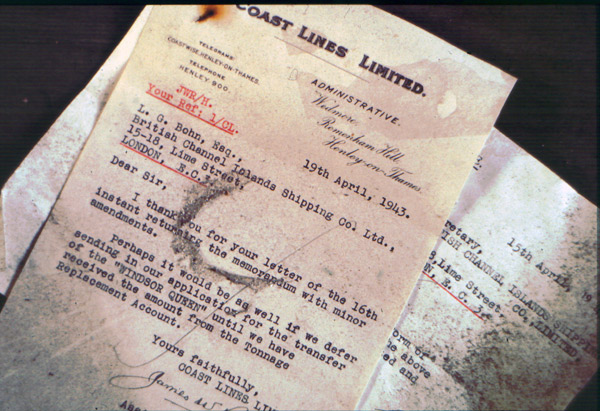
Letters on the floor of a Shadwell Warehouse, 1982
Proof of this was the letters I photographed on the floor of the warehouse dated 1943 to the British Channel Islands Shipping Co. Ltd from ‘Coast Lines Ltd’. The ship the ‘Windsor Queen’ mentioned in the letter was Captained at the time by George Colverson who was born on the 8th February 1882. According to the Knottingley and Ferrybridge local history library Captain Colverson concluded his maritime career on the Windsor Queen: “To complete the record of the ships commanded by Captain Colverson, we will jump to 1943, to find him at the helm of the ’S.S. Windsor Queen’ 1,390 tons deadweight, just delivered from Burntisland. The ’Windsor Queen’ came in for her share of attacks from aircraft and E-boats (motor torpedo boats) while on the east coast run, to feed the fires of southern England with Tyneside coal, and in addition, was in the port of London during a particularly venomous attack by flying bombs. A large proportion of these missiles fell in the Thames Estuary and dock areas, and on this occasion several landed in uncomfortable proximity. The ’Windsor Queen’ however, continued on her voyages unharmed to the end of the war. Captain Colverson was awarded the M.B.E. for his wartime service, and no man’s record in the Merchant Navy can more worthily have merited this recognition.”

View from the roof of a warehouse, 'The Highway' Shadwell 1982
Looking west (above) a frugal collection of buildings punctuate the horizon compared to today’s skyline. On the right of the photograph are the remains of the lift shaft. The shafts stripped down dereliction hints at a gallows construction which in turn speaks of the end of an era.
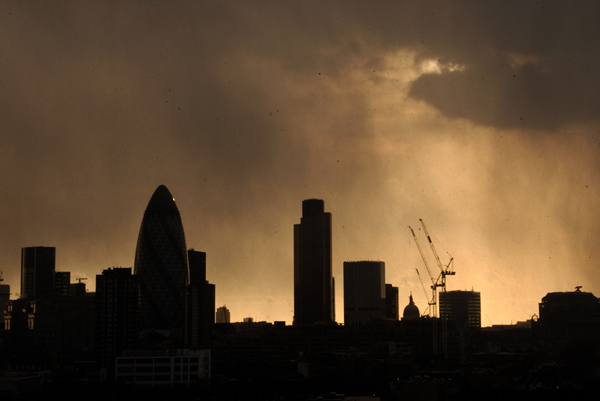
The City viewed from Spitalfields, 2006
The photograph (above) shows how the City has grown since 1982. A contemporary photograph from the same spot would reveal the frenetic building of towers which has occurred in recent years.

View of a Council tower block on The Highway, 1982
The opening (above) allowed goods to be hauled in or out. It reveals two types of housing that characterised Tower Hamlets for many years: older terraced housing and newer municipal Council blocks.
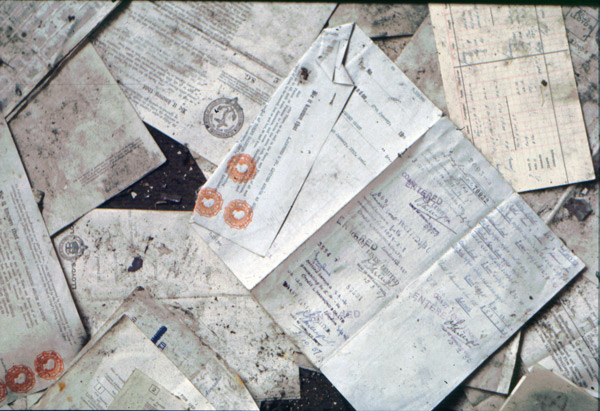
Scattered documents on the floor of a warehouse, 1982
I wonder now what stories might have been revealed by the myriad of abandoned documentation. All of it would have disappeared in the demolition or refurbishment into luxury apartments.
Christopher Lane
Up until a few years ago Christopher Lane was my next door neighbour in the studio I occupied. I can still remember the smell of turpentine and oil paint which would drift over into my studio. From time to time I would be invited in to see some of his latest work. I was always amazed at the different techniques he would employ to get a final result. Softly spoken and colourfully dressed Christopher’s dedication and industry as an artist is underpinned by impeccable manners.

Christopher Lane in his studio, Whitechapel 2005
I miss my invitations to see his latest painting now that I have moved across the road!