Bangladesh Trains
Trains were running in the sub-continent 142 years ago. Bangladesh Railways is state owned, employs 34,168 people and covers a length of 2,855 route kilometers.

Tea cup and saucer in first class carriage, 2008
Tea is served in China cups with complimentary sandwiches in first class carriages. The photograph (above) was taken on a journey from Chittagong to Dhaka.

Boy running next to a train, Bangladesh 1992
Bangladesh train fairs work out cheaper than bus fairs. As well as supporting the economy by providing economic travel for students and the movement of goods many people, not employed by the railway, make a living from selling food to passengers and carrying luggage.

Man walking next to railway track, 2008
Passengers will see many people walking next to the tracks as well as shanty towns close to the railway as it enters urban areas.

Railway workers maintaining track in Sylhet, 1992
Some 42 million passengers are transported each year by the railway.

Boy with his head sricking out of a train, 1992

Queuing for tickets at Chittagong station, 2009

Chittagong Station, 2009
Cardboard
Cardboard is everywhere. Used mainly for packaging it owes a debt to nature and trees for its existence.

Cardboard on the move, Whitechapel market 2007
The man above is transporting two filled cardboard boxes together with boxes that have been flattened; these will no doubt be filled with goods later on in the day.

Full cardboard boxes on the move in Whitechapel market, 2007
The boxes (above) will be used until they are exhausted at which point they will be recycled.

Children on a landfill site in Dhaka, Bangladesh 2008
Cardboard is usually made from paper pulp but it can also be made from straw, old cardboard and old newspapers. Whatever it is made of these children (above) know it has a small value to them. If they collect enough of it together with other materials they will be able to sell it on for a few Taka.

Cardboard and a sleeping man, Whitechapel 1985
Cinema of Bangladesh
The cinema of Bangladesh is sometimes called ‘Dhallywood’ since the film industry is based in Dhaka. The popular cinema (below) is one of many in the capital. However cinemas are currently facing fierce competition from satellite TV and cheap illicit DVD’s. The majority of the audience arrives for films by rickshaw.
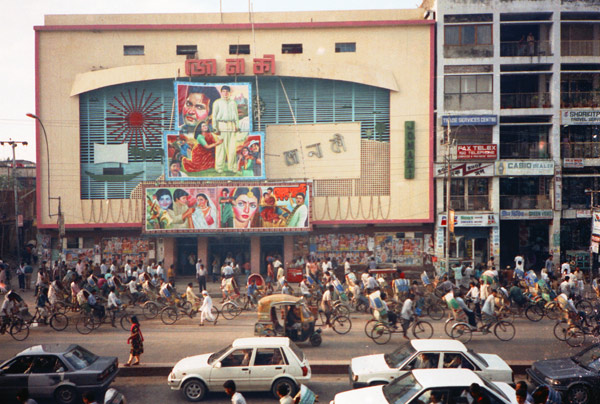
Dhaka cinema with rickshaws waiting outside, 1995
Everywhere you go in Bangladesh you will find advertising for films. Even the shower room (below) for Chittagong beach reminded people of what was available at the local cinema.
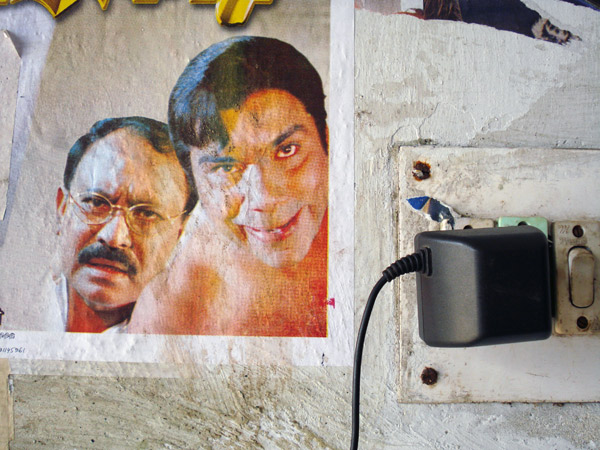
Mobile phone plug and cinema poster remnants, Chittagong 2009
The mobile cinema advertising display was a horse and carriage also used to carry passengers (below).
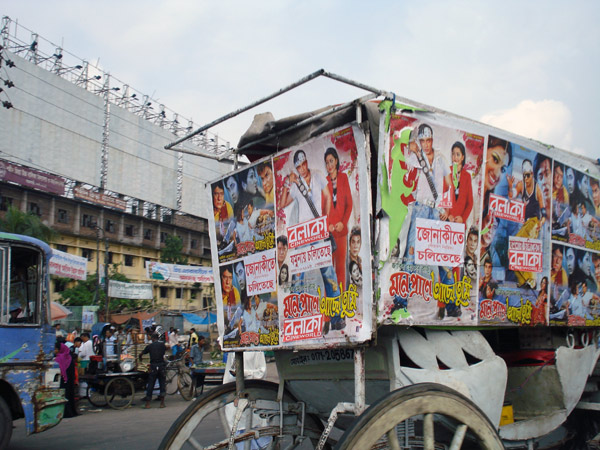
A horse and carriage carrying cinema advertising, Dhaka 2009
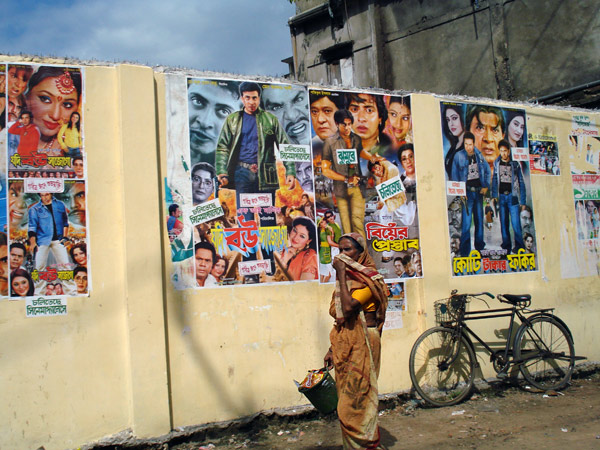
A woman walks past a wall plastered with cinema posters, Chittagong 2009
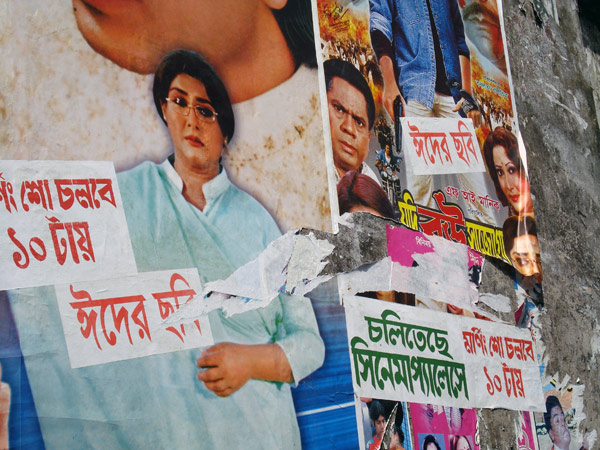
Cinema posters on a wall in Chittagong 2009
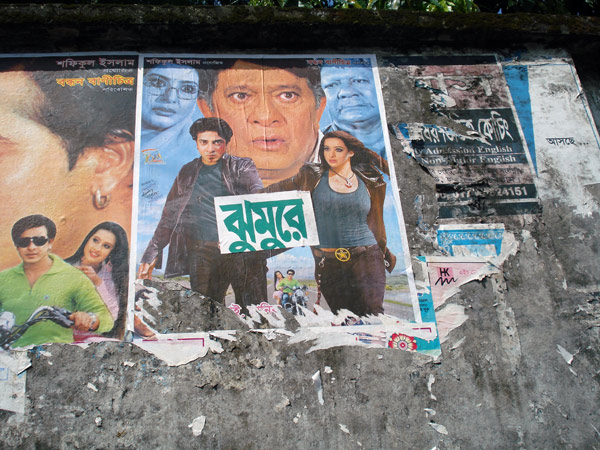
Cinema posters on a wall in Chittagong 2009
Alternative Headlines
On Saturday 500,000 attended the largest protest march in central London since the march against war in Iraq in 2003. In addition to the many trade union banners carried at the demonstration, hundreds of individual and mass produced posters called for an alternative to the present attack on the poor and an economy designed to protect and satiate the rich.

No Cuts. TUC March Central London 2011

No Cuts. TUC March Central London 2011
The Egyptian Sphinx on the Embankment provides an excellent resting place for this No Cuts banner. The statue is a copy of the Sphinx from ancient Egypt comprising a Lions body with the head of the Pharaoh Chephren. Essentially a symbol of the vanity of Chephren built with the Labour of his workers.

'Death by a thousand cuts'. TUC demonstration, March 2011

'We won't pay for their crisis'. TUC demonstration, March 2011
The crisis was created by the banks. The bankers continue to receive millionaire bonuses and we are told their is no alternative to the cuts. The large banner (below) embracing the bridge over the Embankment provides part of the answer.

Tax the rich. TUC demonstration, March 2011

'Liverpool Remembers', TUC demonstration March 2011
An intelligent piece of photomontage (above) is customised with the words ‘Liverpool Remembers’; the transition from Thatcher to Cameron is really effective. Below is a photograph of Liverpool during the Thatcher era.

Liverpool housing, 1978

Protestors on Cleopatra's needle, TUC March London 2011

'Why make the poor pay?', TUC March London 2011

'Cut war not welfare', TUC March London 2011

'Cut Trident', TUC March London 2011

'Tory cuts medicine', TUC March London 2011

'Tory cuts', TUC March London 2011

Birmingham teachers, TUC March London 2011

'Long live the welfare state', TUC March London 2011

'Death by a thousand cuts', TUC March London 2011
Fleet Street Hill
Fleet Street Hill was a small cobbled road joining Allen Gardens with Cheshire Street. The Victorian railway bridge and arch had the ability to immediately conjure up an atmosphere suggesting Victorian London, danger and darkness. The railway arch, much abused by car thieves, film makers, prostitutes, and heroin addicts, even had its own acoustic.

Concrete structure adjacent to the Railway line from the East into Liverpool Street, 2003
The concrete structure on four legs had become an iconic marker on the Spitalfields horizon before it was demolished a few years ago.

Tree & Railway structure viewed from Spitalfields Farm, 1987
The Great Eastern Railway Company built the viaduct to the right of this railway arch (below). It was once a haven for vagrants and I do believe that Don McCullin photographed there in the 1960’s. As you walk under the bridge you feel as if you are walking into a time tunnel; moving towards the other side always felt like a bit of a mystery. This was not related to the possibility of being mugged or disturbing a couple engaged in sex on the steps up the bridge. If I was ever to be transported somewhere by aliens or a Tower Hamlets Council enforcement officer then it would happen here.

Hazuan approaches Fleet Street Hill bridge at night, 2003
This image formed part of a tryptic which hangs on our studio wall waiting for another home.
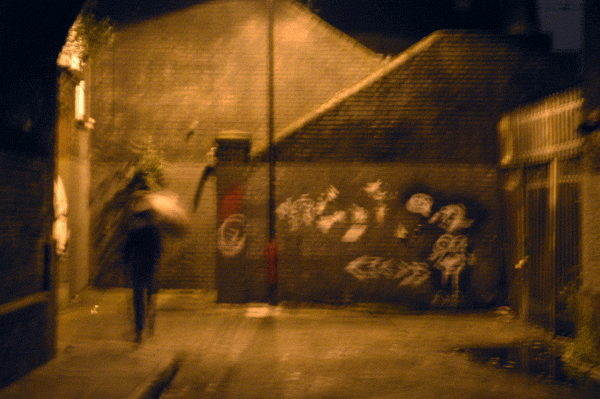
Hazuan approaches the stairs at Fleet Street Hill, 2003
The stoned digital ambiance of darkness (above) gives way to Hazuan captured on stoical black and white film (below) in 1998.

Hazuan approaching the steps of the bridge at Fleet Street Hill, 1997
Looking back towards the imposing concrete structure (below) a boy walks towards the photographer as he approaches Cheshire Street via the bridge.

Boy walks over bridge, Spitalfields 1988

Three people cross a bridge, Spitalfields 1984
Looking down from the bridge towards Cheshire Street (below) traders of second hand goods and their stalls are visible.

View from the top of a bridge, Spitalfields 1984