Through the Window
Taking a photograph through a window may at times be a necessity or a deliberate ploy to frame a composition. Often it is not possible to get closer to the subject without peering through a window or having a layer of glass between the camera lens and the subject.
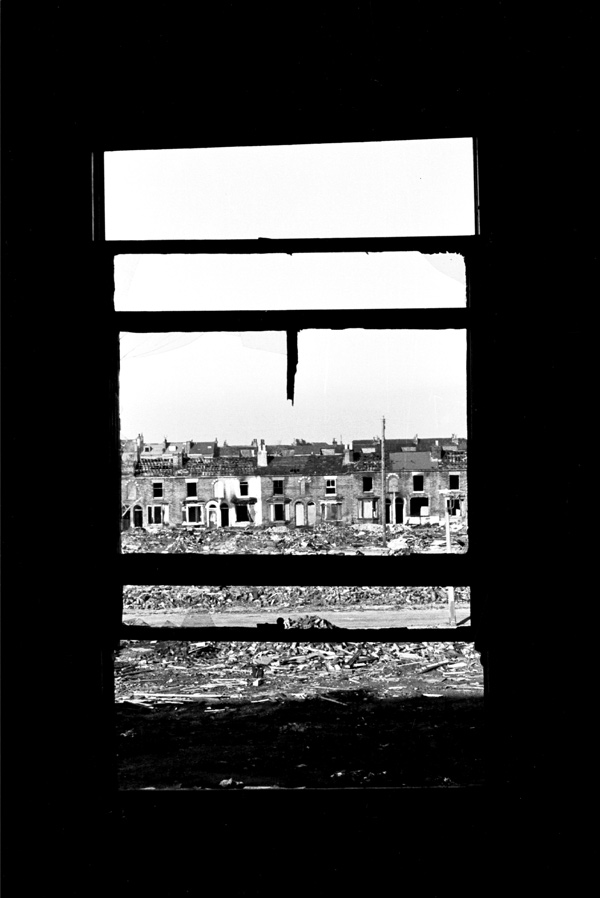
An empty street inner city Liverpool, 1981
The broken window frame in this photograph (above) was used to emphasize the dereliction of the empty houses outside. This photograph was taken in an abandoned house – one of hundreds in Liverpool 8. The house seemed to resonate with reminders of its former inhabitants and although I was alone as I wandered around I could sense the former lives that once occupied the front room I was peering out from.

Liverpool Anglican Cathedral in the distance, 1981
The Anglican Cathedral could be seen at some point from every empty house I visited on this particular day in 1981. Somehow it provided an ordered reference point to the small broken terraced streets. The magnificent masonary of the Cathedral might as well have been a million miles away from the crumbling brick work of the terraces; I felt compelled to compose this shot (above) through the broken window; this might have been out of respect for the former inhabitants who would have stared into the street thousands of times through the same window.
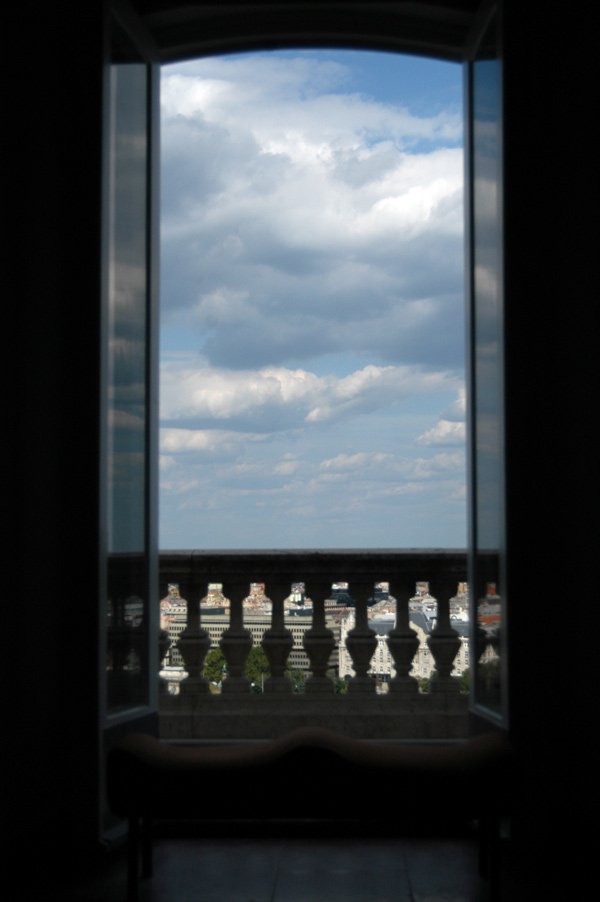
Window of the national art gallery Budapest, 2002
The view from the first floor of this house (below), once occupied by the philanthropist Mary Hughes reveals Pauline House in Old Montague Street.

View from a Vallance Road window, 1998
The Old China Cafe in Kuala Lumpur retains echoes of the Chinese community’s old social life. This magnificent window (below) dates from the early part of the last century and blocks out the chaotic construction close buy driven by the steady growth of land prices.

Window in the Old China Cafe, Kuala Lumpur 2004
Umbrellas
UK residents regard umbrellas as handy protectors against rain or as a fashion accessory.

Boy with umbrella, Bangladesh 1992
In tropical climates they have an additional use: to protect the owner against the fierce heat of the sun.

Two men in conversation in Hanbury Street, 1985
It would appear the only use for the umbrella (above) in East London is as a protection from the sun or perhaps to prevent the conversation from being overheard by random photographers.

Umbrella in Chittagong, 2008

Woman with umbrella, Melaka 2008
Bangladesh Trains
Trains were running in the sub-continent 142 years ago. Bangladesh Railways is state owned, employs 34,168 people and covers a length of 2,855 route kilometers.

Tea cup and saucer in first class carriage, 2008
Tea is served in China cups with complimentary sandwiches in first class carriages. The photograph (above) was taken on a journey from Chittagong to Dhaka.

Boy running next to a train, Bangladesh 1992
Bangladesh train fairs work out cheaper than bus fairs. As well as supporting the economy by providing economic travel for students and the movement of goods many people, not employed by the railway, make a living from selling food to passengers and carrying luggage.

Man walking next to railway track, 2008
Passengers will see many people walking next to the tracks as well as shanty towns close to the railway as it enters urban areas.

Railway workers maintaining track in Sylhet, 1992
Some 42 million passengers are transported each year by the railway.

Boy with his head sricking out of a train, 1992

Queuing for tickets at Chittagong station, 2009

Chittagong Station, 2009
Cardboard
Cardboard is everywhere. Used mainly for packaging it owes a debt to nature and trees for its existence.

Cardboard on the move, Whitechapel market 2007
The man above is transporting two filled cardboard boxes together with boxes that have been flattened; these will no doubt be filled with goods later on in the day.

Full cardboard boxes on the move in Whitechapel market, 2007
The boxes (above) will be used until they are exhausted at which point they will be recycled.

Children on a landfill site in Dhaka, Bangladesh 2008
Cardboard is usually made from paper pulp but it can also be made from straw, old cardboard and old newspapers. Whatever it is made of these children (above) know it has a small value to them. If they collect enough of it together with other materials they will be able to sell it on for a few Taka.

Cardboard and a sleeping man, Whitechapel 1985
Cinema of Bangladesh
The cinema of Bangladesh is sometimes called ‘Dhallywood’ since the film industry is based in Dhaka. The popular cinema (below) is one of many in the capital. However cinemas are currently facing fierce competition from satellite TV and cheap illicit DVD’s. The majority of the audience arrives for films by rickshaw.
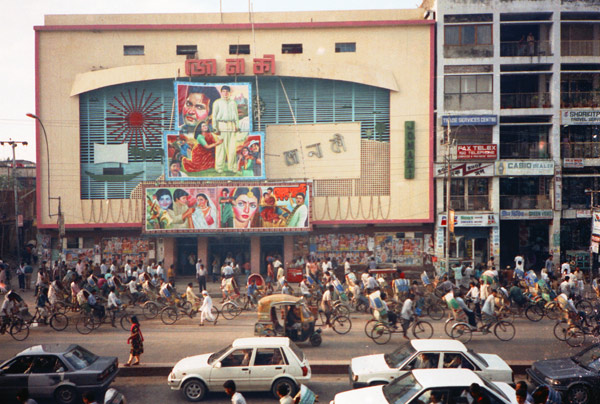
Dhaka cinema with rickshaws waiting outside, 1995
Everywhere you go in Bangladesh you will find advertising for films. Even the shower room (below) for Chittagong beach reminded people of what was available at the local cinema.
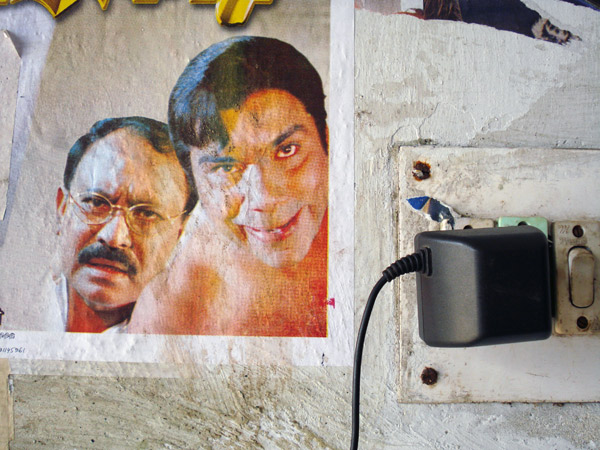
Mobile phone plug and cinema poster remnants, Chittagong 2009
The mobile cinema advertising display was a horse and carriage also used to carry passengers (below).
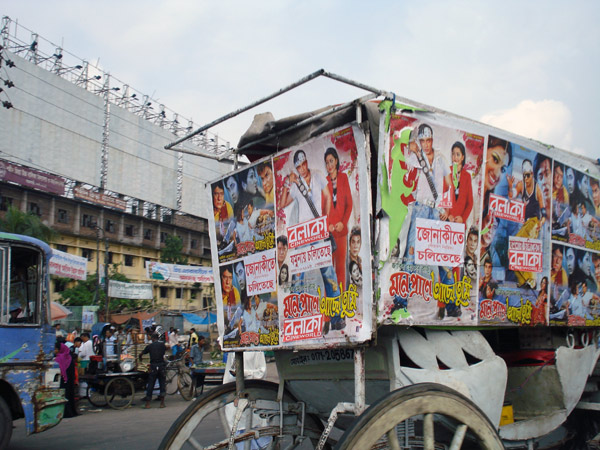
A horse and carriage carrying cinema advertising, Dhaka 2009
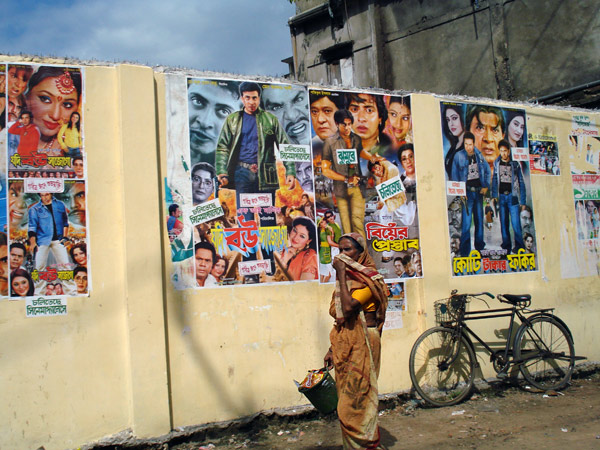
A woman walks past a wall plastered with cinema posters, Chittagong 2009
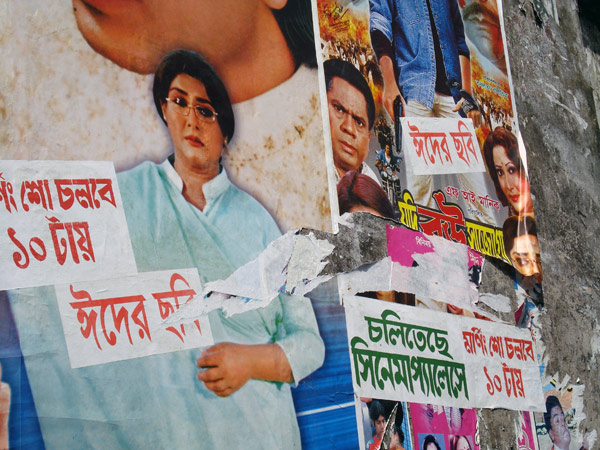
Cinema posters on a wall in Chittagong 2009
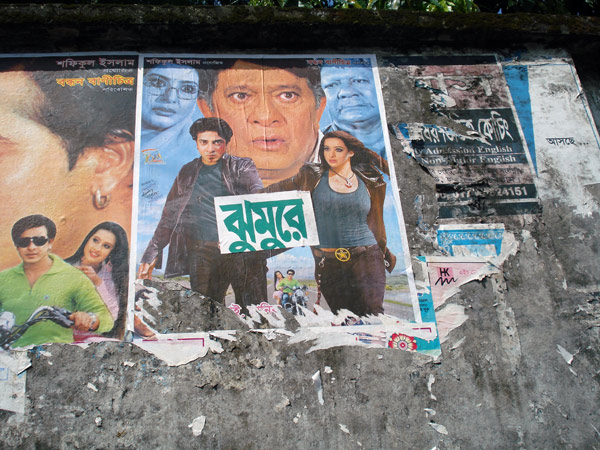
Cinema posters on a wall in Chittagong 2009