Bishopsgate Surrealism
Before the completion of the Crossrail Line the Victorian arched spaces supporting former railway lines were claimed on Sundays by sundry traders of junk.
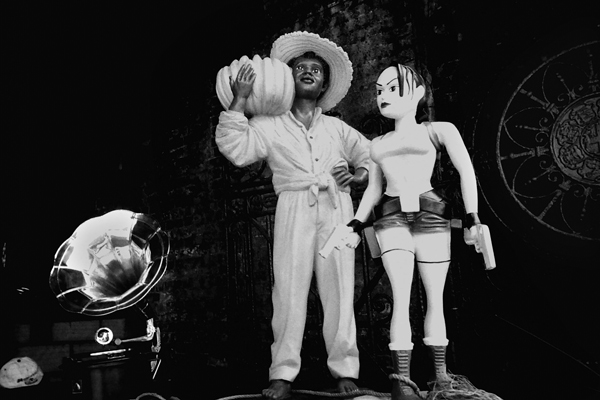
Second hand goods for sale at Shoreditch High Street and Broadgate, 2001
The wind up gramophone was made during the era of surrealism (unless it is a discarded modern replica) and provides a musical fanfare for the unlikely couple sporting bananas and guns. They gaze out to the pavement at the junction of Shoreditch High Street and Broadgate.

Street sale of second hand goods, 2001
A man stands guard (above) over a pavement sale of clothes, paint, sandals and magazines at the junction of Shoreditch High Street and Broadgate. A few supermarket trolleys also provide goods of a quality to high to be displayed on the pavement.

Discarded food debris at the junction of Shoreditch High Street and Broadgate, 2002
The discarded food debris (above) and the other photographs together summarise aspects of Sundays in Spitalfields.
Drag Queens
Photographed in the former Spitz bar these three drag queens (below) also performed an impressive dance routine to a Bollywood song. It’s a great shame the ‘Spitz’ has closed in Spitalfields. It was a fantastic venue with some amazing acts.

Three drag queens at the Spitz on Commercial Street, 1997
These two (below) were photographed in the Brick House in Brick Lane in 2003.

Two drag queens in the Brick House, Brick Lane 2003
Mile End Underground
I’ve always regarded underground stations lit entirely by artificial light as alternative photographic studios.
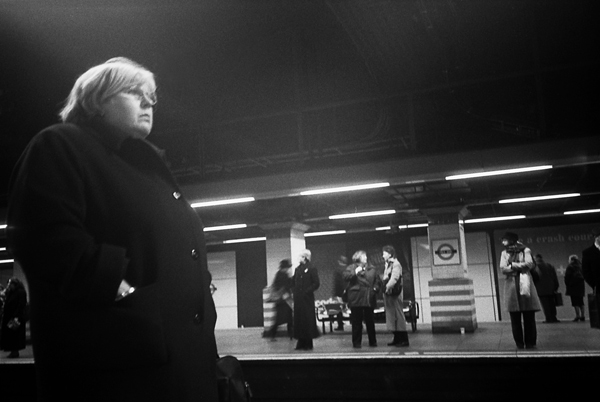
Passenger waiting for her train, Mile End Station 2001
For me Mile End Station was the most engaging from a lighting point of view when these photographs were taken in 2001. Dark spaces were complimented by intense brightness from fluorescent strip lights.

Two passengers wait for their train, Mile End Tube Station 2001
These images are from the first sheet of negatives that have been scanned for the Bishopsgate Institute archive. I am delighted the Institute has shown such a commitment to my work and look forward to editing the digital photographs they scan for many years to come.
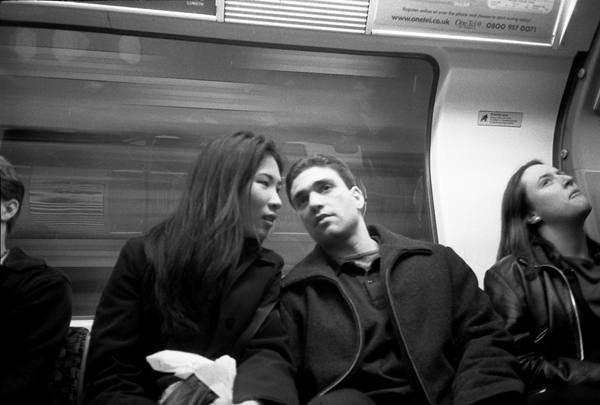
The District Line train in motion, 2001
The rich lighting environment inside an underground train carriage is embellished with slow shutter speeds and movement.

The District Line train in motion, 2001
Plugged In
As a small boy one of my prize purchases was a set of headphones bought from an army surplus shop. Despite their ‘mad max’ appearance they were customised for use with a home made stereo system constructed from old valve amplifiers. The rubber cased headphones enabled me to isolate myself from the rest of the household with the help of a vinyl record and valve volume. I can remember the smell of dust burning and sparking from the heat of the valves.

Dj entertaining London & Barth's hospital workers, 2004
I was considered odd because of the time I spent listening to music through headphones in my box room with a bed and glowing valves.
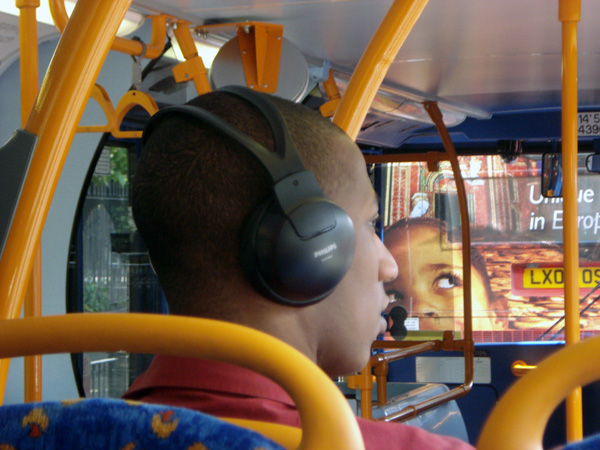
A young man wearing headphones on the 25 bus, 2005
My first headphones were made of bakelite and were designed for use with a 1920’s crystal set I was given when I was 12. The apparatus worked with the back up of a substantial ariel. The headphones and small biscuit like crystal case with a variable condenser was earthed to a radiator next to my bed and the aerial was a piece of wire stretching from my bedroom to the top of a cherry tree in the back garden. It sounded magnificent despite, or probably because of, the crackles. You could argue we’ve come a long way with digital radio. Alternatively the sheer random behaviour of the crystal set puts it at the top of the gadget pantheon. It requires no energy and offers a playlist largely determined by climatic conditions. Perhaps the young man (above) knows exactly where I’m coming from. He has no time for flimsy ear pieces and has sensibly wrapped himself in practical high fidelity rather than skeletal ear plugs.

Rickshaw driver with 'ipod' earplugs, Dhaka 2009
NHS Cuts
A recent demonstration outside the London hospital highlighted the damage this government will visit on the NHS. Before the election we were assured that the NHS would be protected from public sector cuts. This was a lie.
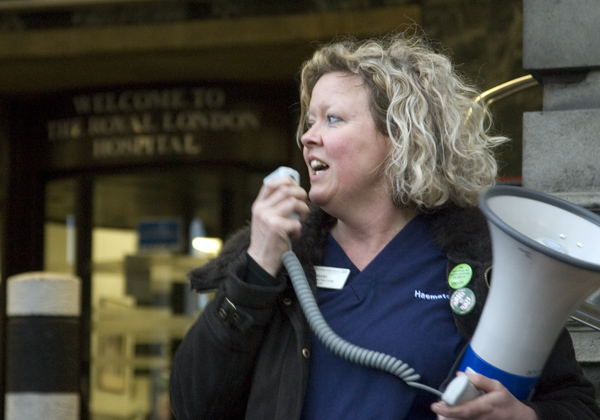
Nurse demonstrating outside the London Hospital, 09/03/2011
Local health trusts are now struggling to save £20bn from their budgets. More than 50,000 jobs are disappearing from the NHS.

Demonstrator outside the London Hospital, 09/03/2011
All this reminds me of the NHS and Community Care Act of 1990 which introduced the so called ‘internal market’ which facilitated privatisation and the establishment of Health Trusts in 1991.

Demonstration against Health Trusts. Tower Hamlets 1990

Demonstration outside the London Hospital, 1991
We have to keep fighting for the NHS and keep it out of the hands of those who see it as a way to make money rather than save lives.