Headwear
The headwear to be seen around the world can be functional, spontaneous, hierarchical, outrageous or driven by fashion. Here are a few examples mainly from East London:

Man with woolen hat, Brick Lane 2009
In contrast with the functional woolen hat that keeps the man on Brick Lane warm, Solly (below) has a more fashionable fedorah hat. He is staring out across the bottom of Hanbury Street.

Solly wearing a fedorah hat, East London 1984

Woman wearing a Burka, Whitechapel 2004
The man and woman (below) would probably consider themselves undressed if they went out without their hats. No doubt the woman above would feel undressed without her Burka.

Man and woman wearing hats on Whitechapel Road 1983
The two women crossing Vallance Road in Whitechapel are wearing the Jilbab which is a cloak worn in public. The cloak continues into a head scarfe.

Three women crossing Vallance Road in Whitechapel, 2007
Headwear with a splash of leaf design at the entrance of Whitechapel station.

Two women outside Whitechapel Station, 1998

Man wearing a woolen hat with a red shawl, Roman Road 2010
The characters above and below add a mark of eccentricity to the collection. The red shawl seems slightly out of place as does the attire of the boater hat on the old lady crossing Vallance Road; it’s as if she has been transported from the Whitechapel of the 1920’s.

Lady crossing Valllance Road, Whitechapel 1983
Below we have a man wearing a turban buying tobacco from a man wearing a cap.

Two men in Sclater Street, 1985
The lady below is wearing a functional plastic head scarf, popular a few decades ago. They could be wrapped into a small ball and used for raining emegencies.

Woman in Cheshire Street, 1987

Hazuan in Budapest, 2010
Barbican at night
I’ve always been impressed by the Barbican Estate. I had to interview and film Mavin Khoo in a Barbican flat a few years ago so I have experienced the housing as well as the arts and music offered by the estate. In an ideal world all social housing should reflect elements of the Barbican: a mix of safe public space, high quality housing and the arts. Additionally rents should be fair and within reach of people who work in London. We now have the shameful situation where key workers such as ambulance drivers and firefighters are sleeping in vans over night or commuting many miles in order to get to work in London.
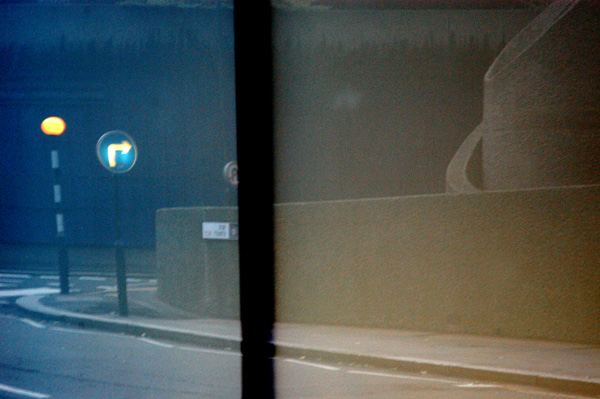
The Barbican reflected in a window early evening, 2003
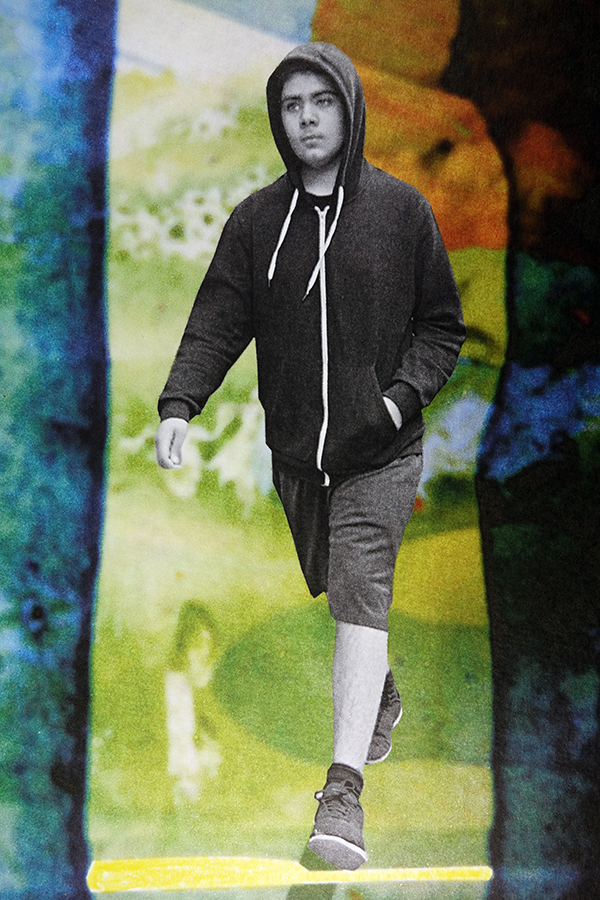
Pedestrians are guided into the Barbican complex by a series of yellow lines on the ground. I’ve always thought that this gave the place a touch of the ‘Wizard of Ozz’.
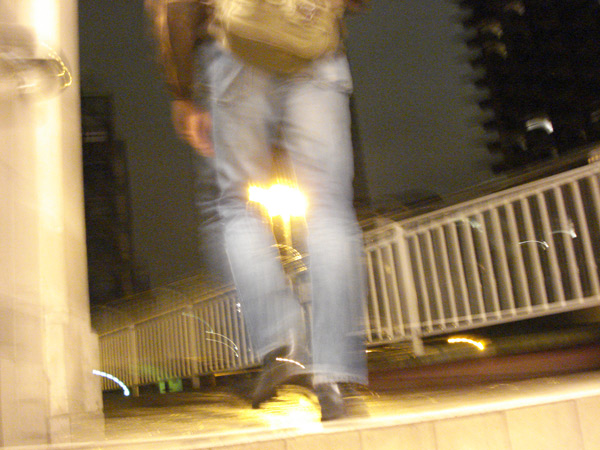
Walking in the Barbican complex, 2009
A combination of movement, slow exposures and subdued lighting combine to produce these moody images.
Walking in the Barbican complex, 2009
Walking in the Barbican complex, 2009

Walking in the Barbican complex, 2009
Bagel Paint
The wall ‘painting’ illustrated in these photographs could be found at the top of Hanbury Street for a few days before it was removed. My only interest in it was the interplay between the painted wall and passers by.

Man passing bagel illustration, Hanbury Street 2010

Man and woman passing bagel illustration, Hanbury Street 2010

People passing bagel illustration, Hanbury Street 2010

People passing bagel illustration, Hanbury Street 2010

Woman passing bagel illustration, Hanbury Street 2010

Woman passing bagel illustration, Hanbury Street 2010
Street Talk
The street is a perfect place for private conversation. No one else will hear the exchange so it is possible to discuss issues that might be avoided in a house where voices can be overheard. All the conversations photographed here would be spontaneous. They have started because of a chance encounter on the street.

Two men in conversation. Junction of Whitechapel and Vallance Roads, 1988
I used a roll of film to photograph these two gentlemen (above). The 36 images will at some point be put into a sequence and used in a film. This was the final frame. Previously they were standing where I took this shot from and they are standing where I shot most of the film. They were so pleased to see each other and engrossed in conversation that they were oblivious to everything around them. Black and white images were edited together for the experimental film ‘East End 1‘ with music by Lola Perrin. Many of the images used were taken in the 1980’s. Digital photography has enabled me to experiment more but the rules are just the same. With film I think you consciously take more notice of light and speed and aperture settings. As imaging was never instant you had to take more notice of the lighting environment you were working in. I think using film, processing it and printing in a darkroom is the best way to learn photography. The whole process facilitates an intimate understanding of exposure and technique.

Men in conversation in Old Town Marrakech, 2006
Just like the men in Whitechapel these two men (above) are engrossed in their conversational encounter. The public space of a street is paradoxically probably the most private for conversation.

Two ladies having a conversation on a market stall. Middlesex Street 1986
In all of these images there are many similarities. For me the most obvious is the way hands orchestrate and underpin the conversation.
Cheshire Street Warehouse
These photographs were taken a few weeks before this warehouse was demolished and the space used for a luxury housing development. There used to be a number of warehouses on Cheshire Street which facilitated a rich variety of stalls catering for a wide range of tastes. You could by a restored valve radio, cameras, tools, CD’s, clothes and old photographs and paintings. It was a delight to simply walk through the warehouse just to view the stalls. The man sitting behind the jewelery appears to be looking around in a way that suggests he doesn’t want certain people to see the contents of his glass case.

Man viewing jewelery in a glass case, Cheshire Street warehouse 2010
Although the cabinet is partially held up by an empty coke tin the demeanour of the owner of the wood and glass cabinet adds an air of urgency to any potential sale. His body language is communicating: “everything in the case is for sale at well below the market value but you had better buy quickly as I will be leaving soon.”

Man viewing watches in a glass case, Cheshire Street warehouse 2010
Sadly there are no warehouses left on Cheshire Street that sustain men with glass cases full of jewelery and watches. It is no longer possible to buy a restored valve radio or old watch. The place has become gated and organic.

Cheshire Street, 1983