Market Forces
All markets depend on Labour. I’ve always been impressed and amazed at the daily cycle of labour required to operate a street market. Each day the shop has to be unloaded, moved to a stall, laid out and moved back to storage.

Man moving a market stall, Whitechapel 2008
Before any stall can be arranged on Whitechapel market the stall itself has to be moved into place from its over night resting place in a side street off the main road.

Young man moving goods near Time Square, New York 2005
I have no idea what the young man (above) is pushing with his trolley or if the goods are destined for a street market. Nevertheless a good deal of skill and strength is needed to weave the goods between pedestrians. He achieves this unnoticed by everyone else. It is thanks to the daily efforts of people like himself that a city such as New York ticks on with an apparent effortless ease.

Man moving goods in Chittagong railway station, 2008
The assorted blankets and cloths have come from trains arriving at the Chittagong railway terminal in Bangladesh. Once cleaned they will probably be returned to new journeys around Bangladesh or into India. Without the strength of the barefooted man (above) for this short journey they would be going nowhere.
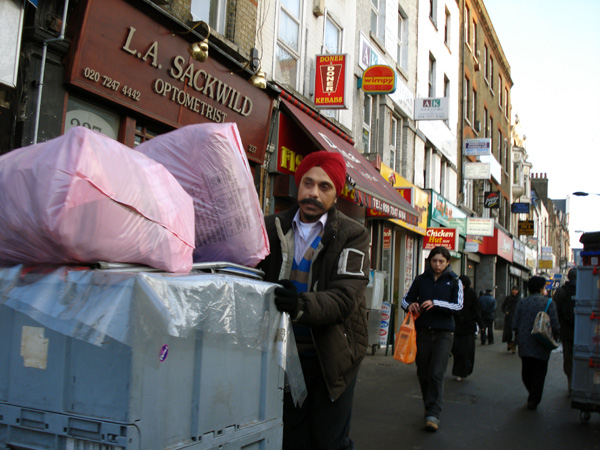
Market trader pushing goods to his stall, Whitechapel market 2007
Although the majority of stalls are set out early in the morning goods can be seen moving at any time in Whitechapel market. Traders will shout ahead to warn pedestrians of their approach. As I have been known to ‘day dream’ whilst walking through the market I’ve grown to appreciate the cry of ‘mind your backs’.
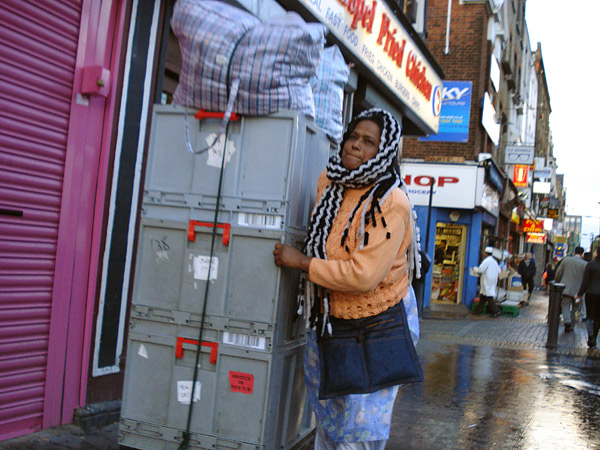
Market trader pushing goods on Whitechapel market, 2007
This market trader (above) combines strength and balance to move her stock down Whitechapel Road. The bag around her waist is her bank, money float and office.

Rickshaw driver transporting a fence in Chittagong, 2008
Rickshaws are not just for the movement of passengers. They are also the carriers of a multitude of items which at first you might think were unlikely candidates for a rickshaw ride. The driver is looking through the fence resting on his head and the top of the rickshaw in order to navigate his journey. Rickshaw drivers exude inventiveness when it comes to moving almost anything on their machines.

Spitalfields market trader pushing goods under the the gaze of Christchurch Spitalfields, 1990
Market Children

Boy selling vegetables on Brick Lane, 1985

Girl selling toilet rolls in Cheshire Street, 1984

Boy looking after vegetable stall, Chittagong 2008

Boy selling fruit, Cheshire Street 1986

Boy selling cigarettes in Dhaka, 1994

Boy selling vegetables, Brick Lane 1985
Mobile in Stepney, Cambodia and Spitalfields
This lady with her walking stick and bags brings some order to the hostile environment plastered with graffiti. At first you can be forgiven for thinking she is some how at risk of being attacked. However she seems to strike a pose which exudes confidence; this in turn renders the menacing graffiti harmless.

Woman using a mobile phone in Stepney, 2008

Young man using a mobile phone in a boat, Cambodia 2009
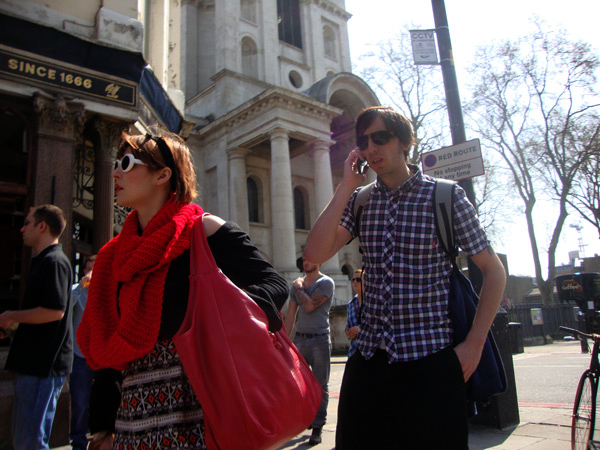
Man with a mobile phone, Spitalfields 2010
Canary Wharf
1 Canada Square was the first building to dominate the skyline in East London in the new ‘Enterprise Zone’ established in the 1980’s. Following its completion in 1991 it became the UK’s tallest building.

Canary Wharf, 1989
Intended as a powerful symbol of the regeneration of Docklands it stood alone for some time and seemed an unlikely challenger to the City of London. During its first two decades it was to reflect the travails of capitalism as its ownership changed following the collapse and rebirth of the property market and finally the international banking crisis.

Canary Wharf, 1991
The new enterprise zone got off to a rocky start. Local residents were unconvinced by talk of jobs and opportunities. In May 1992 Olympia and York, Canary Wharf Limited filed for bankruptcy.

Canary Wharf under construction, 1990
In December 1995 an international consortium, backed by the former owners and other investors, bought the scheme. The new company was called Canary Wharf Limited, and later became Canary Wharf Group.

Canary Wharf demonstration, 1992
In the end the homeless were not housed at Canary Wharf.

Canary Wharf, 2008
Street Clothes
The advertisement on the plastic carrier bag held by this lady seems oddly out of place. She is collecting clothes rather than food. Her shopping trolley hosts two black plastic bags containing clothes collected off the road next to stalls selling second hand clothes.

Woman with shopping trolley, Sclater Street 1983
The smile (below) could be the result of the satisfying knowledge that she has collected a wardrobe of clothes for nothing. I wonder if the clothes are for her or is she going to wash and repair them to sell them on?

- Woman with shopping trolley, Sclater Street 1983

Woman with shopping trolley, Sclater Street 1983
The gentleman below shares the knowledge of where to find clothes left in the wake of the Sunday market. I can sense the excitement of collecting clothes off the street. There will be some collectible items. Each one will carry its own history and have a story to tell.

Man looking through discarded clothes, Bishopsgate 1999