Bikes on Brick Lane

Man with his bike, Grimsby street 1988
This gentleman is about to enter Brick Lane from Grimsby Street. He has just bought some second hand clothes from one of the many make shift stalls which appeared on Sundays. The inner tube he is holding suggests a puncture which might account for his forlorn expression.

Young woman on a bike, Brick Lane 2009
This trendy cyclist is going the wrong way down Brick Lane.

Man passes locked bike on Brick Lane, 2006

Bicycles on Brick Lane, 1982
The police officer is hurrying up Brick Lane to join colleagues at the start of a demonstration organised to stop the deportation of Afia Begum to Bangladesh. After her husband was killed in a fire she was deported despite protests. The children on their bikes joined the back of the demonstration which eventually ended outside the small police station next to Heneage Street.

Bicycles and lights on Brick Lane 2002
An accidental juxtaposition of coloured lights and bikes outside a shop in Brick Lane.
Candle portrait

Portrait of Hazuan by candle light, 2010
I love taking photographs in low light. These portraits of Hazuan Hashim were taken in the kitchen of our flat in Whitechapel.

Portrait of Hazuan by candle light, 2010

Portrait of Hazuan by candle light, 2010

Hazuan on the District line, 2004
Without candles on the District Line.
Bicycle freedom

Boy riding a bicycle in Liverpool, 1979
Many of my childhood memories are coloured by bicycle adventures. I treasure the experience of speed and freedom that was initiated when I got a brand new bike for Christmas in the early 1960’s. The boy riding his bike around inner city Liverpool breathes life into the derelict landscape. I am reminded of the observations of Liverpool resident John Lennon: “As a kid I had a dream – I wanted to own my own bicycle. When I got he bike I must have been the happiest boy in Liverpool, maybe the world. I lived for that bike. Most kids left their bike in the backyard at night. Not me. I insisted on taking mine indoors and the first night I even kept it in my bed.”

Boy riding a bike on Brick Lane, 1983
In 1983 Brick Lane had a quiet personality compared to its current manifestation as a stylish leisure destination and urban heritage trail. The haberdashery the boy is cycling past has been replaced by a restaurant and evidence of the rag trade has almost completely disappeared. Brick Lane is a great place to cycle through but I envy the boy in the photograph who didn’t have to contend with heavy traffic and pedestrians with a propensity to walk in the middle of the road.
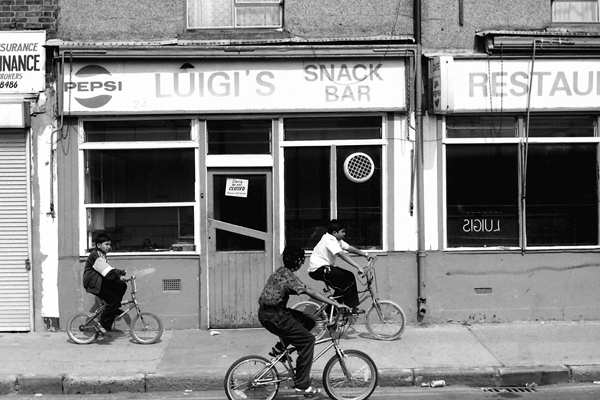
Three bicycles on Vallance road, 1987
I’ve often thought that the solution to car gridlock and pollution is staring us in the face. We could learn a lot from the cyclists in these photographs. It is likely that the three cyclists on Vallance Road have exchanged their bikes for cars. Bicycling has to be a big part of the future if we are to have cleaner city air and a healthier population. Looking at these photographs I am struck by the absence of cars.
Bishopsgate portraits
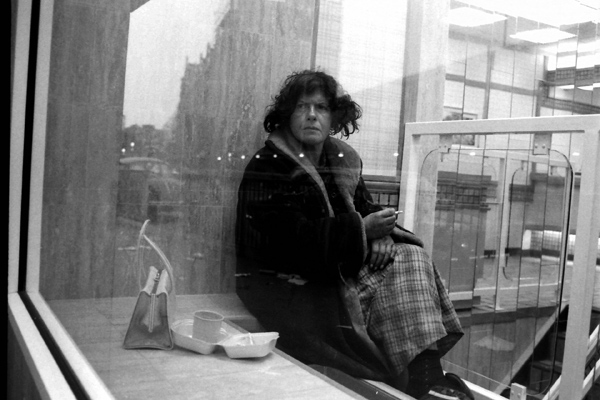
Lady resting in a fast food restaurant, 1989
This lady caught my eye after I emerged from Liverpool Street station early one evening in 1989. Her gaze appeared to be fixed on buildings accross Bishopsgate which are reflected by the glass of the restaurant. Her handbag next to the discarded burger container and cup is an accidental still life that perhaps hints at her precarious life. Bishopsgate was originally the location of many coaching inns which accommodated passengers setting out on the Old North Road.
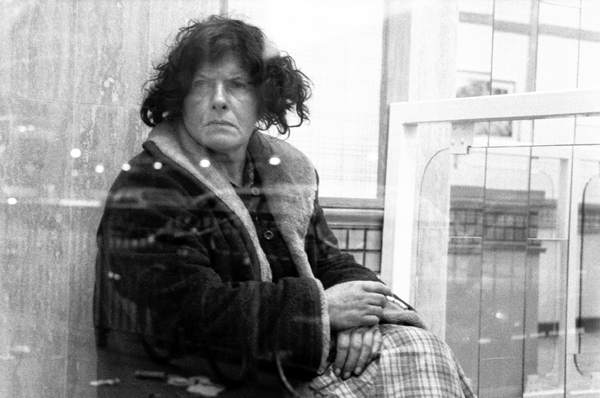
Portrait of a lady, 1989
Bishopsgate is characterised by people rushing to and from work and home. My subject sits gracefully apart from the world of work and deadlines. She is most likely pleased with the warmth provided by her window seat. A closer examination of her right hand reveals a cigarette that has been allowed to burn undisturbed for some time. Is she really studying the street or is her mind somewhere else?

Bishopsgate reflection, 1998
A brass plate advertising what is available in a coffee shop opposite Liverpool Street station. Combined with the reflections we have a fusion which heralds the fact that we are now in cappucino land. Since 1998 coffee shops have sprung up on Whitechapel Road and Brick Lane.
Brick Lane bridge

Lady walking under Brick Lane bridge, 1986
The bridge that spans Brick Lane now carries the crossrail line after many years of redundancy. This lady photographed pulling a shopping trolley looks quite majestic. Her imposing figure transcends the busy surroundings of the bridge.

Brick Lane bridge, 2002
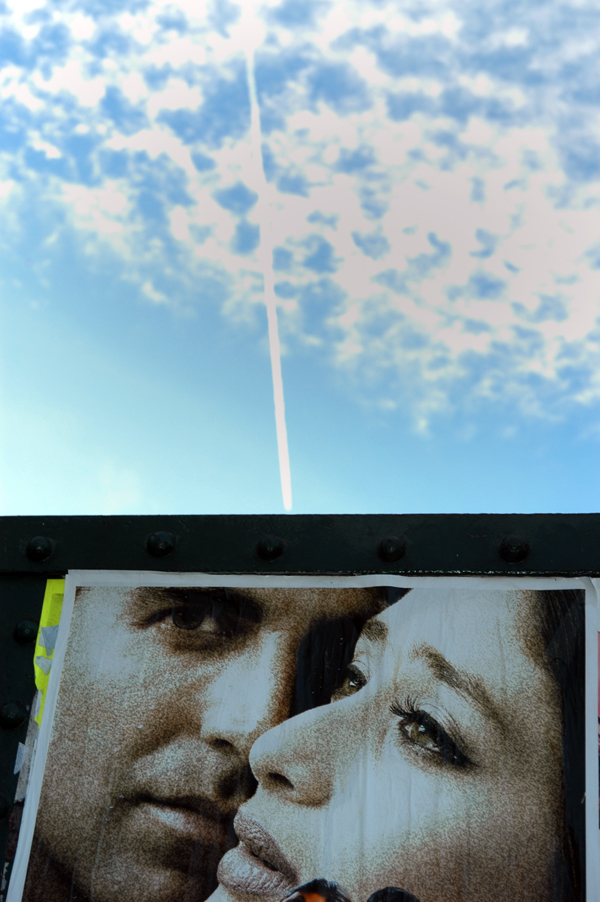
Brick Lane also spans the main railway line into Liverpool street station. The splendid iron bridge over this artery has hosted thousands of fly posters that have changed on a weekly basis. I’ve always regarded this part of the lane as quite special because of the dominance of the tall iron surrounds and absence of buildings. The neatly sectioned compartments of the bridge have proved to be a natural resting place for posters of all kinds. Attempts to remove this organic free gallery have added to its appeal as different images and words end up colliding with each other to produce accidental collage of the highest order.

Posters urging support for the miners strike, 1984
As well as being a visual thermometer of events and music away from the mainstream it has proved itself as a welcome resting place for agitprop.