On the buses

Bus stop at Burdett Rd, 2009
Bus stops are great places for photographic loitering. The accumulation of a wide variety of people at a bus stop provides endless opportunities for portraits and observations of human behavior, fashion and style.

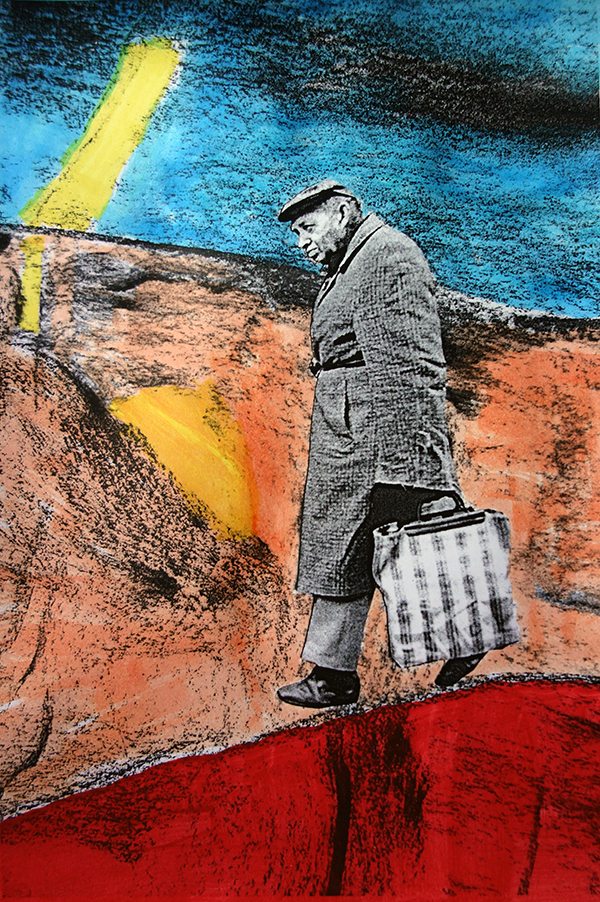
A man with a cap on a route master bus, 1999
I’ve always regarded public transport as a moving studio set up to record people. Invariably I carry a small camera with me to record the environment I pass through. Buses can be difficult in terms of the rapidly changing light. However it’s difficult not to discover an interesting subject. A London bus will always furnish a photographer with a wide range of subjects. This passenger has emerged into the metropolis ready for the cold with his two jumpers, coat and cap.

Man on the lower deck of the 254 bus, 2009
The human landscape is altered each time the bus collects fresh passengers at a stop. This passenger is positioned safely in a seat specially designed for disabled travelers. The routemaster bus had no facilities for disabled passengers.

Leaving a routemaster bus on the East India Dock Road, 2003
This passenger is helped from the bus by the conductor. She steadies herself by touching the advertisement of an idealised woman. Despite the competition from the glossy lady in a swim suit our attention is held by the old lady. The routemaster was withdrawn from service in 2005 partly for health and safety reasons.
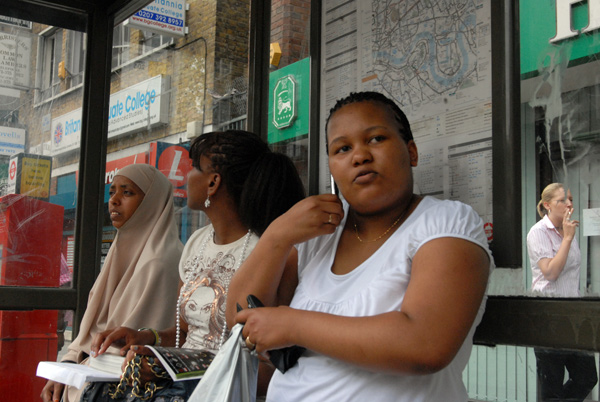
Bus stop, Whitechapel 2009
Before the invention of the mobile phone conversation between waiting passengers was usual at bus stops. At this stop there is no communication between the three women and the woman closest to the camera can’t raise anyone on her phone.
Cat lady of Spitalfields

Cat lady on Brick Lane. Late 1980's.
The woman in this photograph was always dressed in a head scarf and large coat. Usually she would pull a shopping bag on wheels behind her. She was the cat lady of Spitalfields. She knew where every cat and kitten lived in the wild and made it her task to feed them every day. Her bag was full of cat food which she would serve on newspaper at designated spots around Spitalfields.

Cat lady on Brick Lane near the Seven Stars pub
The cat lady pauses for a second near the Seven Stars pub on Brick Lane. She has just left some food in the ‘private road’ for some cats.

Cat lady near Christchurch school on Brick Lane
The cat lady floats past Christchurch school on Brick Lane. With her eyes closed she contemplates the next cat awaiting a delivery.

Cat lady on Cheshire Street with her shopping trolley
The cat lady waits outside her favourite cafe in Cheshire street. Now a trendy boutique, in the 1980’s you could buy a cup of tea and a sandwich for less than a pound at this establishment.

Cat lady in Cheshire street cafe
The cat lady ‘kept herself to herself’ and avoided the company of others.

Cat lady sits alone in her Cheshire Street cafe
It must be about twenty years since I last saw the cat lady of Spitalfields. She devoted her life to feeding the stray cats of the area. I have no idea where she lived and I never saw her talking to another person. She seemed to live in her own separate cat world. Even though I was sitting opposite her when I took this photograph I felt that she had created a barrier and would be reluctant to engage in conversation. It was impossible to make eye contact. I’m pleased I photographed her on the streets and in her Cheshire street cafe. She would not recognise Cheshire street and Brick Lane today.
Liverpool Cathedral

Liverpool cathedral
The Liverpool skyline is dominated by two cathedrals. The Anglican cathedral designed by Giles Gilbert Scott eclipses the modern design of the Catholic cathedral a short distance away. This may be partly due to its position on St James’ Mount which overlooks the city and the river Mersey. Perhaps also the Gothic revival style of the building plus the fact that it is the largest Cathedral in Britain assures its dominance of the skyline.

During the early 1980’s the cathedral was surrounded by urban dereliction. As I photographed inner city Liverpool at this time the building became an anchor for many shots. The juxtaposition of the imposing Gothic structure against acres of urban decay provided an irresistably surreal composition for the photographer.
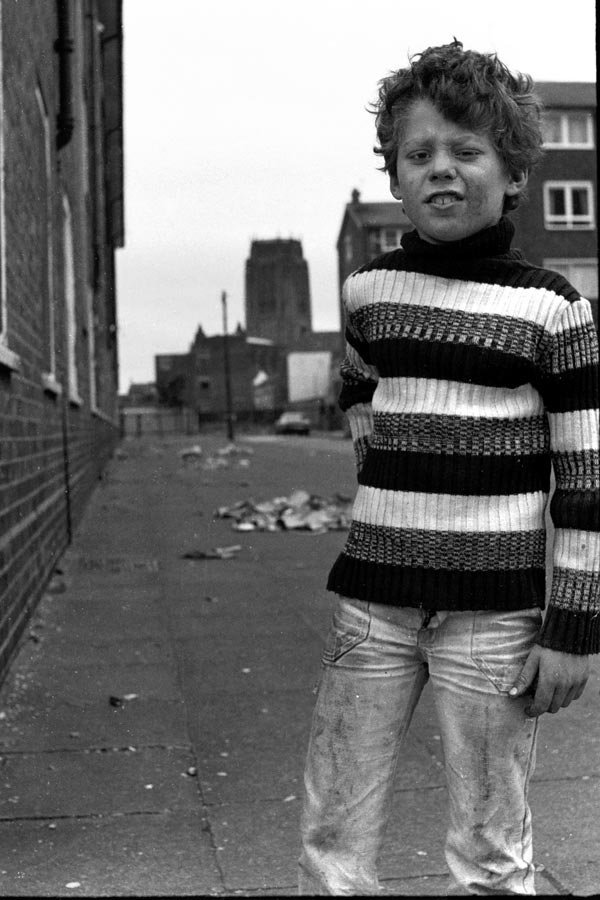
Today the landscape around the cathedral has completely changed following various regeneration schemes.
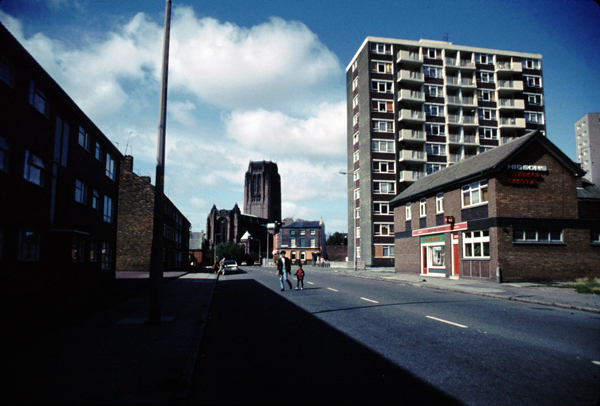
For me the relationship of Scotts iconic design with the old Liverpool captured here had a special resonance which has now disappeared.

Nuclear Protest
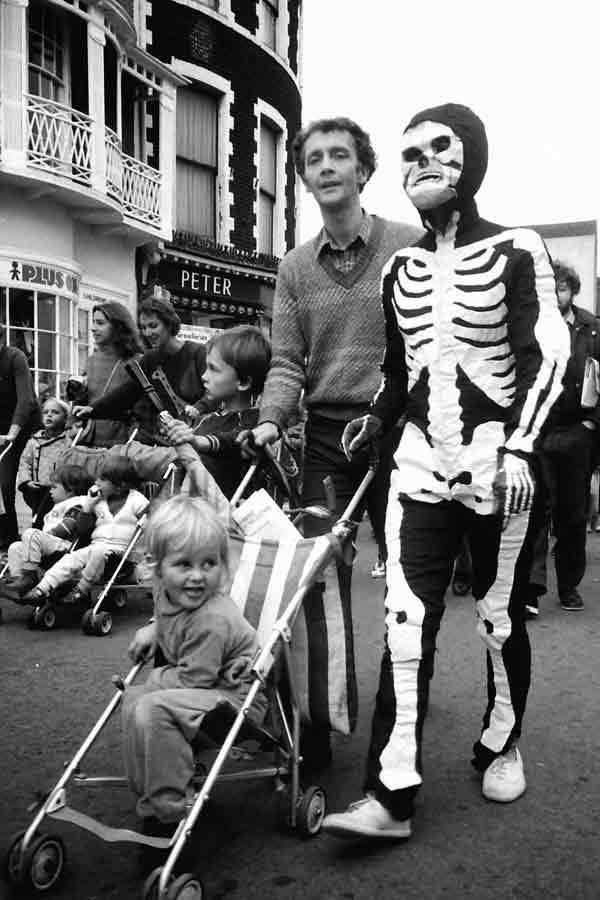
Anti nuclear weapons protest in Brighton
This photograph was taken in Brighton in the early 1980’s when the Labour Party was holding its annual conference. The protesters are calling for an end to nuclear weapons. The juxtaposition of the skeleton next to the child in the push chair makes a powerful point.

A message for the Labour Party conference
Despite pressure for a nuclear free defence policy from the Unions and party membership Labour governments have always maintained a nuclear arsenal. Motions agreed at conferences are simply ignored.
Heads and sculptures
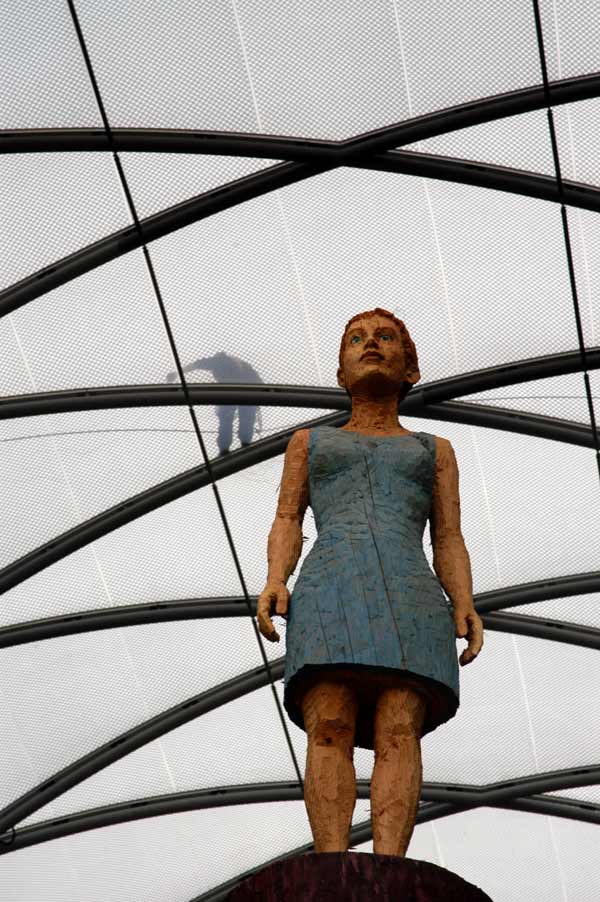
Public art, sculpture in Berlin
This public sculpture in Berlin (2002) is enhanced by a real man on the roof who is cleaning the glass.

Silver head with a cap and daffodil
Again in Berlin a sculptured silver head is enhanced by a daffodil and cap.
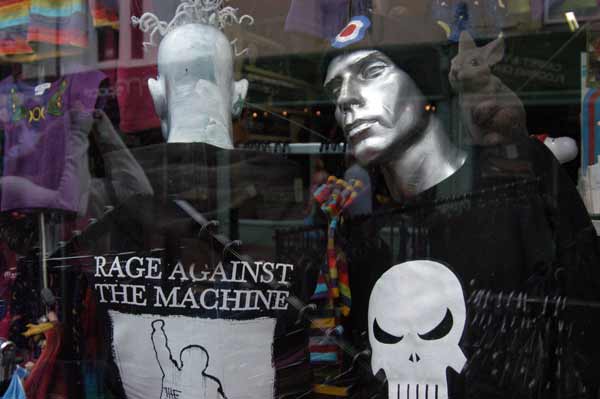
A shop window in Brighton
These two heads in a shop window in Brighton (2002) rage against the machine and hopefully encourage potential shoppers inside.

Art installation on Brick Lane with Oscar
Oscar becomes part of an art installation in Brick Lane. His intelligent pose brings it all to life.

Carving of dancers on a temple wall, Cambodia
This is one of hundreds of ancient sculptures that can be found in temples in Siem Reap in Cambodia (2009).