East London: A Street Out of Time
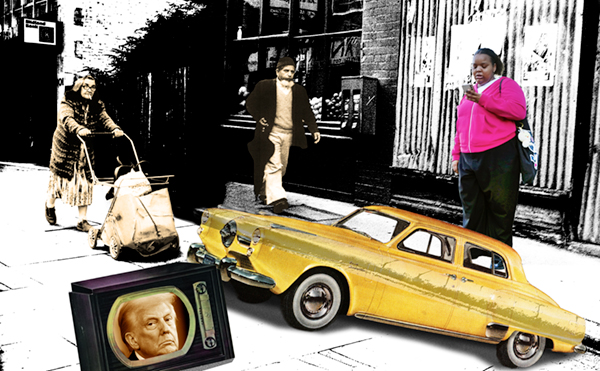
This photomontage brings together different moments in East London’s history to explore time, social change, technology and political power. By combining photographs taken decades apart, I’ve transformed familiar urban street scenes into something surreal, where the past and present collide and different realities occupy the same space.
The image draws on three distinct periods: two people I photographed on Whitechapel Road and Brick Lane in the 1980s, a woman I photographed using her phone in Hackney this month, and an image of Donald Trump. By bringing these separate moments together, I’ve created an imaginary East London street that could never have existed quite like this, yet contains elements of a world I recognise.
For me, the pleasure of photomontage lies in the freedom to move beyond what a photograph originally recorded. I can take images made years apart, remove them from their original context and allow them to tell a different story. Time becomes fluid. Different periods coexist, overlap and influence how we understand the present. Photography, in this instance, is not simply a way of documenting reality; it becomes a way of questioning and reimagining it.
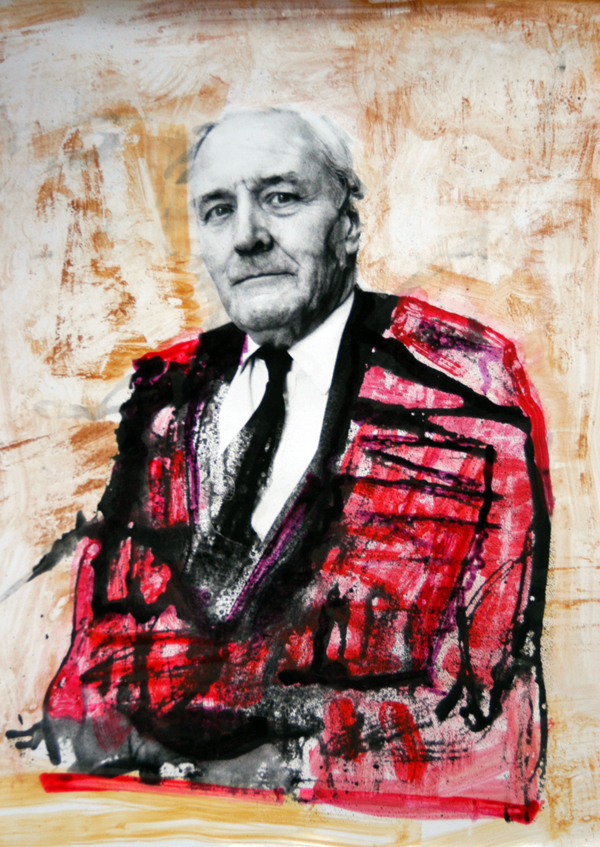
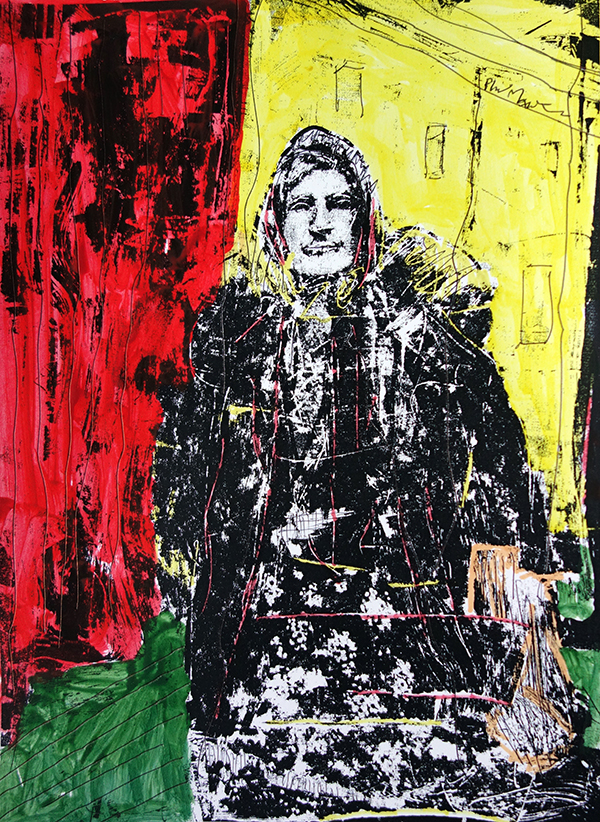
The older woman pushing her shopping trolley and the man walking along the street take me back to an earlier East End. Their presence evokes a more familiar, everyday rhythm of street life, when shopping, walking and stopping for a conversation were integral to the experience of being out and about. I remember how you would almost always meet someone you knew on the street, and a conversation would follow. The street was not simply somewhere to pass through; it was a place to encounter people, exchange news and feel part of a community.
East London has changed enormously since those photographs were taken. Its buildings, businesses, population and social character have all been transformed. Yet, when I walk its streets today, I still recognise something enduring in the way people occupy these shared spaces. Different generations continue to live, work and pass one another, even as the world around them changes.
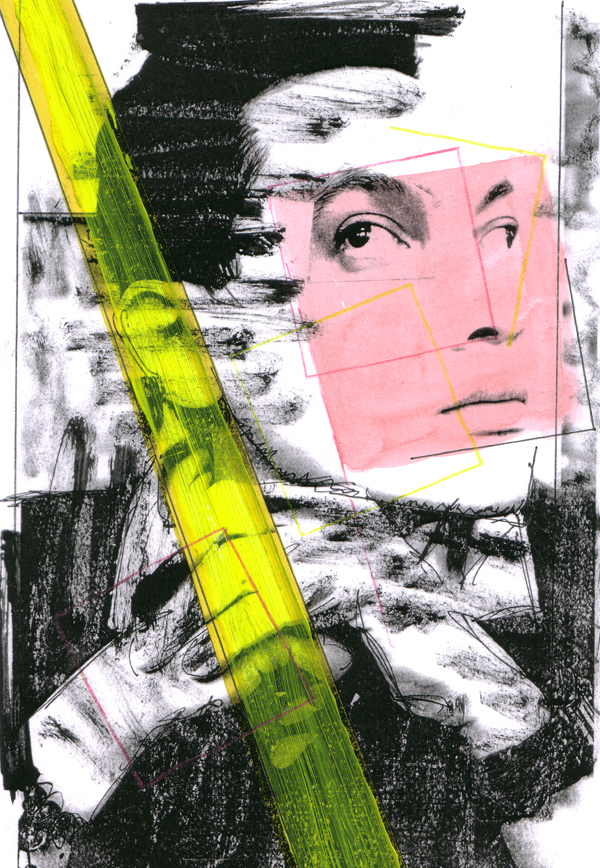
The woman in the bright pink top introduces a distinctly contemporary presence into this historical setting. Her attention is absorbed by her phone, creating an intriguing contrast with the older figures, whose activities connect them directly to the physical world around them. I’m interested in what this small difference reveals about how everyday life has changed.
The smartphone has transformed the way we communicate, access information and experience public space. We can be physically present on a busy street while mentally somewhere else entirely, connected to an invisible network of people, images and information. The woman’s phone becomes a symbol of this shift: the street remains much the same in principle, but our experience of being in it has changed. I find myself wondering what we have gained through this constant connectivity, and what we might have lost along the way.
The brightly coloured car is another deliberate interruption. Its vivid presence immediately draws the eye, while its position across the lower part of the composition disrupts the recognisable street scene. I took the image from a 1950 issue of National Geographic, which featured a luxury Studebaker Land Cruiser advertised as combining luxury with “an almost unbelievable low cost per mile.”
I was drawn to the image partly for its colour and visual impact, but also for what the car represents. For decades, the motor car has been associated with freedom, status, progress and modernity. At the same time, cars occupy public space, shape our cities and influence how streets are designed and used. Placing this particular vehicle alongside pedestrians and shopping trolleys creates a tension between private mobility and shared urban life. The car belongs to another era, yet the questions it raises about progress, consumption and our relationship with the street remain relevant today.
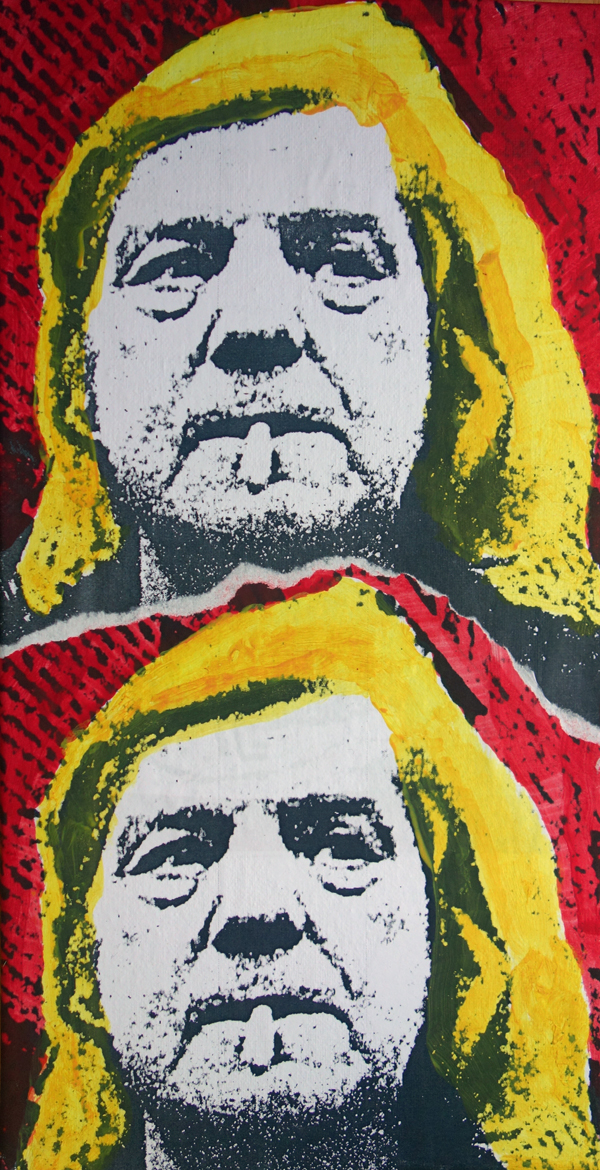
Then there is Donald Trump, encased in an old television set that appears to have been discarded in the road. His presence introduces a more explicitly political dimension to the montage. I associate Trump with the promotion of fossil fuels and an oil-based economy, making him an uneasy fit within a street assembled from different periods of urban life. The television adds another layer: a familiar medium of mass communication, now seemingly abandoned and reduced to rubbish.
I’ve deliberately left this element open to interpretation. Why is Trump in a discarded television? Has he been thrown out with the old technology, or is he still broadcasting his influence from the roadside? Perhaps the image suggests something else entirely. I’m happy to leave those questions with the viewer rather than provide a definitive answer.
Ultimately, this photomontage reflects my continuing fascination with East London and the way its streets hold traces of different times. The photographs are rooted in real places and experiences, but bringing them together allows me to explore something that a single photograph cannot easily express: the coexistence of memory, change and the present moment.
For me, the imaginary street becomes a meeting place where personal memories, technological shifts, consumer culture and political power collide. By rearranging these fragments of time, I hope to encourage the viewer to look again at the familiar and consider what progress really means, what has been lost or gained, and how the images we encounter shape our understanding of the world.
Perhaps the past is never quite as far behind us as we imagine. Sometimes, all it takes is a different way of looking to bring it back onto the street.