Exploring Budapest’s Underground & Graffiti
Whenever I visit a city for the first time I’m always looking for something unusual to photograph; here in Budapest I’m working from the level of the pedestrian rather than the tourist: not the grand Budapest of the Danube and historic façades, but the transitional, slightly rough spaces underneath it. I’ve always been fascinated by the lighting of underground spaces and there atmospheric effects.
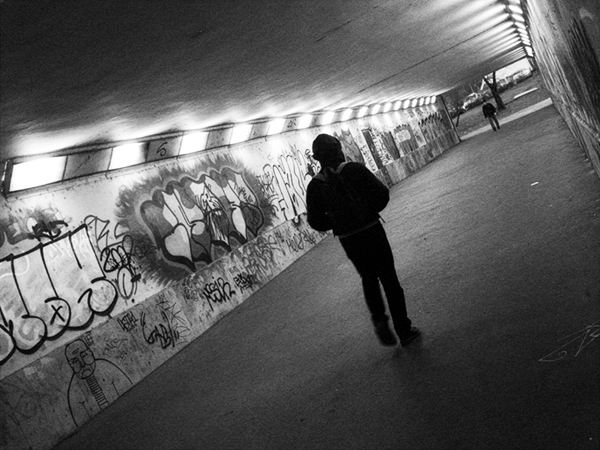
The photograph is deliberately off-kilter. The horizon isn’t horizontal; the whole passage seems to lean. That gives an ordinary pedestrian tunnel a surprisingly unstable, almost cinematic quality.
The large figure in the middle (my partner Hazuan Hashim) is the anchor. He’s walking away from us and almost swallowed by the tunnel. Then, right at the far end, another tiny figure is visible. The eye naturally follows the first person toward the second.
The graffiti is a crucial part of the composition. It isn’t simply background decoration; it reveals a lot about the character of the city. The subway can be imagined as a lighted gallery for ever changing graffiti. Importantly it’s a gallery without gatekeepers.
The walls are covered with layers of tags and larger pieces, some apparently painted over and repainted. In black and white they become almost as important as the architecture. There’s a particularly interesting contrast and tension between the formal repetition of the tunnel—the windows, lights, concrete panels—and the uncontrolled marks of the graffiti.
It’s almost a collision between two kinds of urban language:
- the city authority: concrete, lighting, circulation, numbered/marked panels;
- the individual: names, tags, drawings and territorial marks.
And the two are literally occupying the same surface.
There is historical substance behind that. Budapest’s metro infrastructure became an important part of the city’s graffiti culture during the 1990s. One account of Budapest’s M3 graffiti scene records work appearing at the Fehér úti depot in 1994 and subsequently at the K?ér Street depot; some work by the graffiti artist known as “Dise” survived until 2003.
It was cold and wet when we visited Budapest in 2003 and there was melting snow outside the subway. It’s really a memory of being in that city. I’ve visited it many times since. Budapest is a place that draws you back because there’s always something new to see and experience.