Exploring Memory in ‘Whitechapel Night’
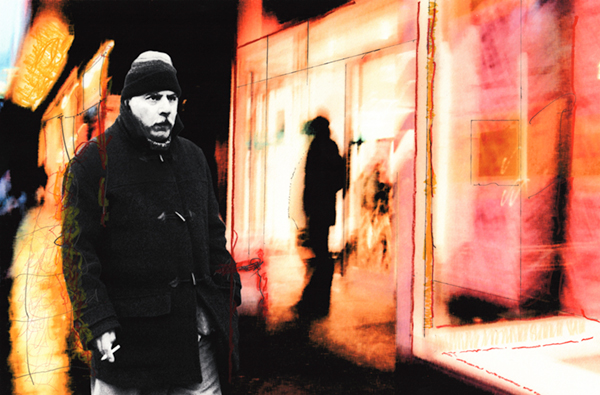
Whitechapel Night is an example of my work moving beyond straight documentary photography into something more painterly, psychological and dreamlike. I’m interested in taking an ordinary urban moment and allowing it to become something less certain; a place that exists somewhere between observation, memory and imagination.
I often return to my archive of photographs from the East End and find myself looking at places that I photographed years ago with very different eyes. Buildings have changed, streets have been redeveloped, and some of the places I remember have disappeared altogether. By reworking these photographs, I can bring those fragments of the past back into the present, but not necessarily as they really were. Instead, they become part of an imagined landscape, a kind of personal dreamscape constructed from memory.
For me, this is where the photograph begins to move away from documentary. Memory is rarely precise. It shifts, fragments and exaggerates. A familiar street can become strangely unfamiliar; colours become more intense, distances change and different moments seem to occupy the same space. I want my mixed-media work to reflect that feeling; to create images that are recognisable as places I have known, but which also feel slightly elusive, as though they belong to a half-remembered dream.
In Whitechapel Night, the photograph of the man with the cigarette is embraced by the colours of night generated by neon and sodium street lighting. Yet the image seems to exist simultaneously in day and night. The saturated oranges, reds and pinks almost overwhelm the architecture, causing Whitechapel to feel unstable, as though the street itself is melting or dissolving into colour.
Against this shifting environment, the man on the left appears reassuringly solid and purposeful. His presence anchors the image. I imagine him having just emerged from the comfort and warmth of a pub, perhaps after a few drinks, and finding himself suddenly in an alien world. He seems completely at home in his own journey, while everything around him has become strange.
That contrast is important to me. The figure belongs to the real, physical world, while the street around him increasingly belongs to memory and imagination. The shadowy figure further into the image almost becomes another version of the same experience—a fleeting presence, already dissolving into the dream.
Perhaps this is what draws me back to the East End archive. I’m not simply trying to preserve the places I photographed; I’m trying to preserve the feeling of them. By transforming the photographs, I can revisit a London that is partly real and partly remembered, allowing the past and present to exist together. Whitechapel Night therefore becomes less a record of a particular street than a portrait of how a place survives in memory—fragmented, atmospheric and constantly changing.