From Ropewalks to Cafés: Bold Street’s Evolution
I’ve walked through Bold Street many times since I first came to Liverpool in 1972.
Bold Street had an interesting history before it became the fashionable commercial street it is today. The area was associated with rope-making. Its long, relatively straight form was suitable for laying out rope, and the wider neighbourhood consequently became known as the Ropewalks. The street was subsequently developed for housing from around the 1780s and was named after Jonas Bold, a wealthy merchant, banker and later Lord Mayor of Liverpool.
Jonas Bold was involved in the sugar trade and in businesses connected with the slave trade; Historic England records his connections with the trade in enslaved Africans. The ropeworks that preceded the development of the street were also associated with merchants involved in slavery.
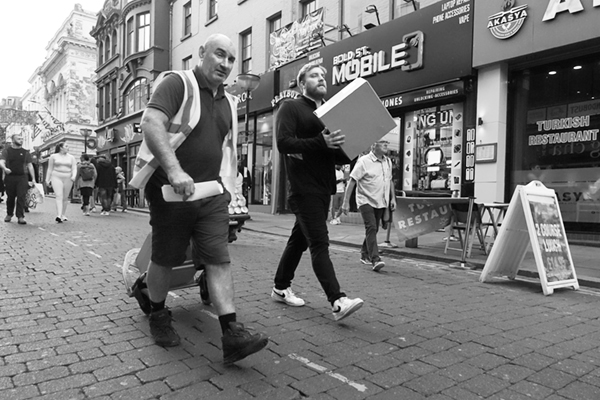
I’m reminded that apparently ordinary streets can contain histories of wealth, exploitation and global trade that are no longer immediately visible. The men carrying equipment in the foreground are contemporary workers, but they occupy a street whose physical development was closely connected with the labour and commerce of the port. The photograph connects present-day urban work with Liverpool’s industrial and maritime past.
It’s an apparently ordinary moment, but I think the image becomes a study of work, movement, commerce, migration, architecture and Liverpool’s layered history. The large man walking towards the camera dominates the left-hand side of the frame. His heavy build, dark clothing and work equipment give him a physical presence that contrasts with the slimmer man behind him, who is carrying a parcel. Both are clearly engaged in work, and both are caught mid-stride. Their bodies and legs create a strong sense of movement across the otherwise static street. No doubt it’s a moment that has been created many times before in the history of the street.
Bold Street today is particularly associated with independent shops, cafés and restaurants and is largely pedestrianised, making it an unusually good setting for observing people. I wouldn’t dream of walking there without my camera!
The ropewalk has disappeared, the merchants and their houses have changed function, and today’s workers carry parcels and supplies for restaurants and shops serving a global city. I hope my black-and-white image freezes one instant in that continuing process of change, making the familiar street appear both contemporary and deeply historical.