River East & West
The history of the river Thames is the history of London. Looking at old photographs and engravings of the river I am struck by how it has become virtually empty compared to the past.

Barge passes the London Eye. River Thames 2005
Most traffic on the Thames now relates to leisure activities and tourism. The barge (above) is removing London’s waste to a landfill site further east and is one of the few remaining commercial activities on river.

Rowing boats on the Buriganga River in Dhaka, 2009
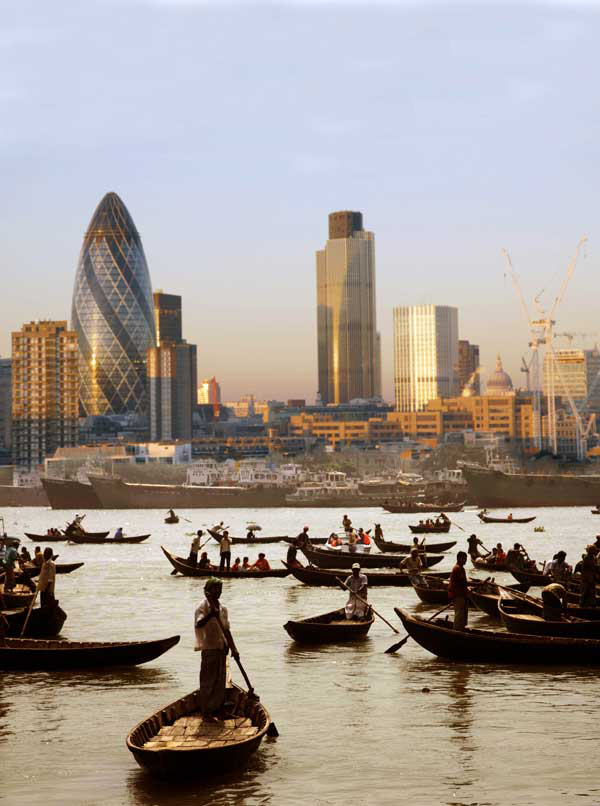
When I was last in Bangladesh I couldn’t help reflecting that the myriad activity on the Buriaganda river reminded me of the photographs I’d seen of the 19th century river Thames.

Boy on a boat, Buriganga river 1992
The boy I photographed (above) worked on a passenger boat and is seen here taking a reflective rest. No doubt many children were employed on ships entering the Thames during Victorian times.

Three disused cranes, Isle of Dogs 1989
The three cranes (above) are among a few industrial monuments which are testimony to the Thames as the world’s former centre of commerce.

River Thames looking East from Shadwell, 1982
Photographed from Shadwell, this view of the river looking East (above) resonates desolation and gives no hint of the future growth of Canary Wharf.

Canary Wharf from the River Thames, 2006

Passengers transferring from a rowing to a larger passenger boat, Buriganda river 2009
Bicycle Power
As a boy I cycled everywhere. Sometimes I would be adventurous and cycle up the feeder road to the motorway and take a turning off into the rural area surrounding Coventry where I lived as a child.

Young woman cycling on the pavement, Aldgate East 2007
I find pavement cyclists really annoying; however, as a teenager I moved freely from the road to the pavement and no doubt annoyed many adults.

Man with bicycle, Sclater Street market 1986
Cycling is the most energy efficient form of transport. This cyclist is engaged in the most economically efficient form of shopping. Keeping a close eye on the floor as he pushes his bike around the market it is likely that he will discover free and discarded items to add to the collection overflowing from his basket.

Man with bicycle, Sclater Street market 1986
These photographs (above) were taken as the market was closing; the best time for searching for free shopping.

A bicycle and a car at a New York Junction, 2005
As steam is pumped up from beneath the street at this New York City junction it is worth considering the fundamental differences between a car and a bicycle.
Bishopsgate Surrealism
Before the completion of the Crossrail Line the Victorian arched spaces supporting former railway lines were claimed on Sundays by sundry traders of junk.
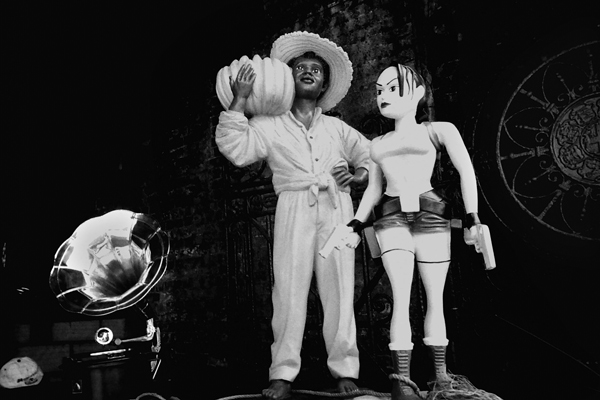
Second hand goods for sale at Shoreditch High Street and Broadgate, 2001
The wind up gramophone was made during the era of surrealism (unless it is a discarded modern replica) and provides a musical fanfare for the unlikely couple sporting bananas and guns. They gaze out to the pavement at the junction of Shoreditch High Street and Broadgate.

Street sale of second hand goods, 2001
A man stands guard (above) over a pavement sale of clothes, paint, sandals and magazines at the junction of Shoreditch High Street and Broadgate. A few supermarket trolleys also provide goods of a quality to high to be displayed on the pavement.

Discarded food debris at the junction of Shoreditch High Street and Broadgate, 2002
The discarded food debris (above) and the other photographs together summarise aspects of Sundays in Spitalfields.
Drag Queens
Photographed in the former Spitz bar these three drag queens (below) also performed an impressive dance routine to a Bollywood song. It’s a great shame the ‘Spitz’ has closed in Spitalfields. It was a fantastic venue with some amazing acts.

Three drag queens at the Spitz on Commercial Street, 1997
These two (below) were photographed in the Brick House in Brick Lane in 2003.

Two drag queens in the Brick House, Brick Lane 2003
Mile End Underground
I’ve always regarded underground stations lit entirely by artificial light as alternative photographic studios.
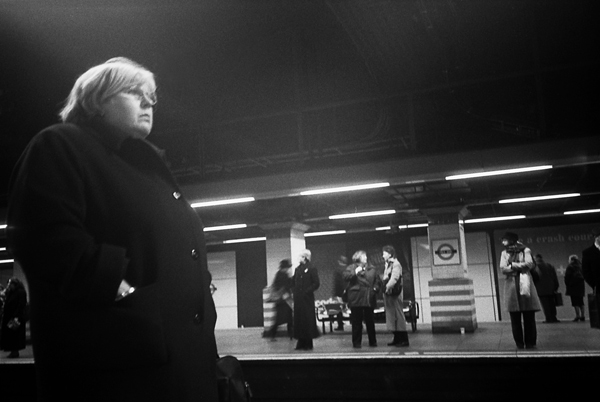
Passenger waiting for her train, Mile End Station 2001
For me Mile End Station was the most engaging from a lighting point of view when these photographs were taken in 2001. Dark spaces were complimented by intense brightness from fluorescent strip lights.

Two passengers wait for their train, Mile End Tube Station 2001
These images are from the first sheet of negatives that have been scanned for the Bishopsgate Institute archive. I am delighted the Institute has shown such a commitment to my work and look forward to editing the digital photographs they scan for many years to come.
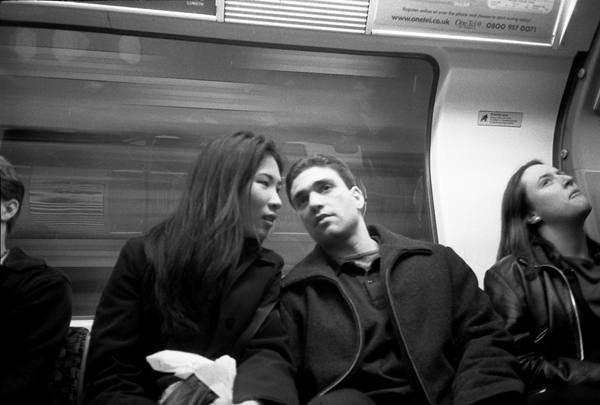
The District Line train in motion, 2001
The rich lighting environment inside an underground train carriage is embellished with slow shutter speeds and movement.

The District Line train in motion, 2001