Plugged In
As a small boy one of my prize purchases was a set of headphones bought from an army surplus shop. Despite their ‘mad max’ appearance they were customised for use with a home made stereo system constructed from old valve amplifiers. The rubber cased headphones enabled me to isolate myself from the rest of the household with the help of a vinyl record and valve volume. I can remember the smell of dust burning and sparking from the heat of the valves.

Dj entertaining London & Barth's hospital workers, 2004
I was considered odd because of the time I spent listening to music through headphones in my box room with a bed and glowing valves.
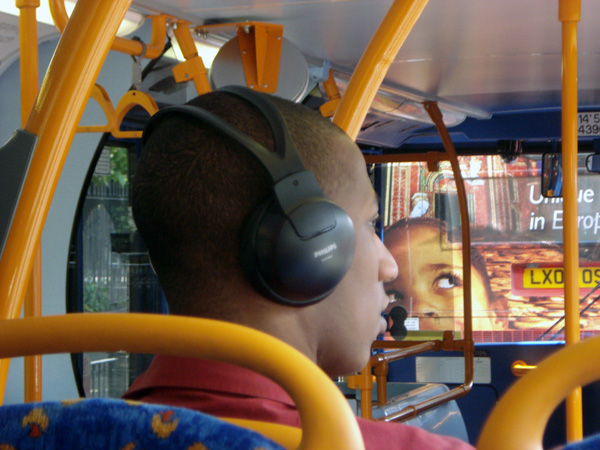
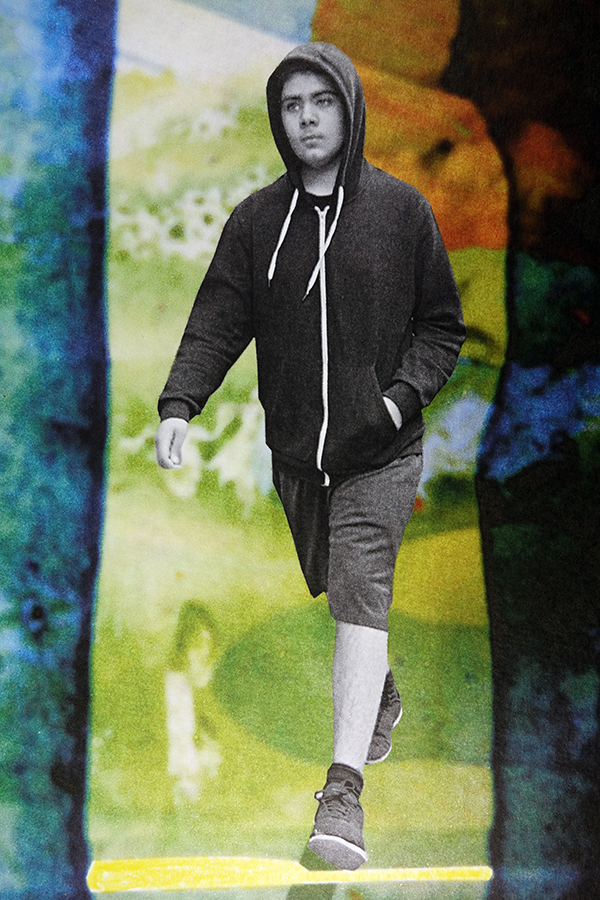
A young man wearing headphones on the 25 bus, 2005
My first headphones were made of bakelite and were designed for use with a 1920’s crystal set I was given when I was 12. The apparatus worked with the back up of a substantial ariel. The headphones and small biscuit like crystal case with a variable condenser was earthed to a radiator next to my bed and the aerial was a piece of wire stretching from my bedroom to the top of a cherry tree in the back garden. It sounded magnificent despite, or probably because of, the crackles. You could argue we’ve come a long way with digital radio. Alternatively the sheer random behaviour of the crystal set puts it at the top of the gadget pantheon. It requires no energy and offers a playlist largely determined by climatic conditions. Perhaps the young man (above) knows exactly where I’m coming from. He has no time for flimsy ear pieces and has sensibly wrapped himself in practical high fidelity rather than skeletal ear plugs.

Rickshaw driver with 'ipod' earplugs, Dhaka 2009
NHS Cuts
A recent demonstration outside the London hospital highlighted the damage this government will visit on the NHS. Before the election we were assured that the NHS would be protected from public sector cuts. This was a lie.
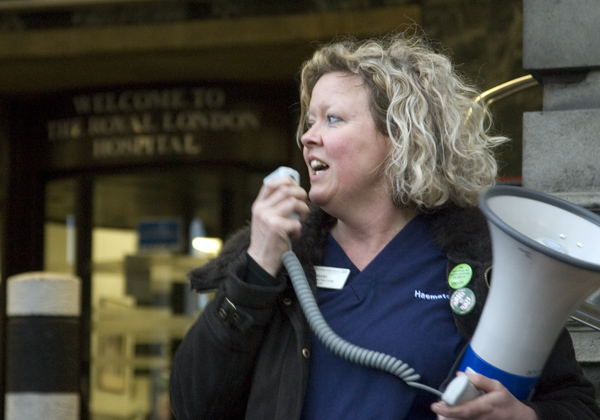
Nurse demonstrating outside the London Hospital, 09/03/2011
Local health trusts are now struggling to save £20bn from their budgets. More than 50,000 jobs are disappearing from the NHS.

Demonstrator outside the London Hospital, 09/03/2011
All this reminds me of the NHS and Community Care Act of 1990 which introduced the so called ‘internal market’ which facilitated privatisation and the establishment of Health Trusts in 1991.

Demonstration against Health Trusts. Tower Hamlets 1990

Demonstration outside the London Hospital, 1991
We have to keep fighting for the NHS and keep it out of the hands of those who see it as a way to make money rather than save lives.
Bollards
Bollards are in plentiful supply around the streets of East London. They are designed to prevent cars from moving onto pavements to protect the free flow of pedestrians.

Three men surround Brick Lane bollard, 1998
Although they are designed to control traffic and protect pedestrians they have assumed another use. Bollards have become magnets which gather people in conversation around them.

Four boys gather around a bollard outside Christ Church, Spitalfields 1983
The bollard (above) is a former canon which has concluded its life pointing to the sky and, in this case, facilitating the writing of a note. This unlikely 20th century street desk was captured during the Napoleonic wars but has since been removed by Tower Hamlets Council.

A boy secures himself around a bollard in Hanbury Street, 1985

Oscar and a bollard on Brick Lane, 2002
It’s in the Bag
What would we do without bags! Many of us wouldn’t dream of going out without one ‘just in case’. In case of what I sometimes ask myself.
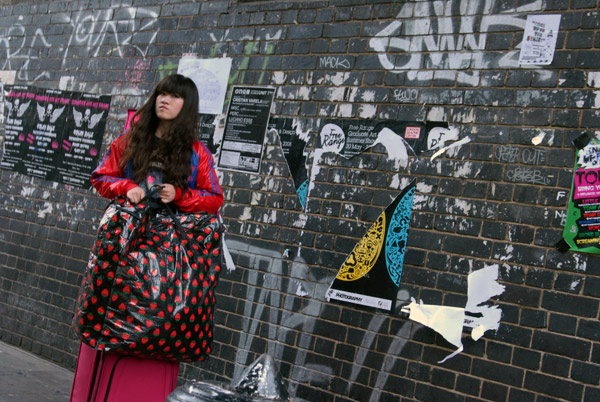
Lady with a large bag on Brick Lane, 2010
Art direction here (above) is by Brick Lane and a range of accidents on the brick wall in Brick Lane.
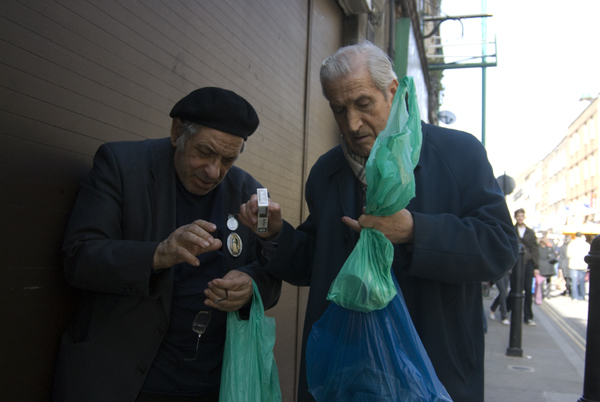
Two men exchanging stuff from their plastic shopping bags on Cheshire Street, 2010

A man carrying plastic bags on old Montague Street, 2010
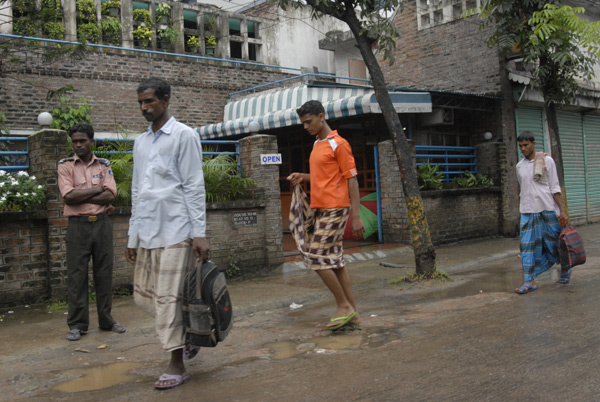
Some pedestrians with bags Dhaka Bangladesh, 2009
For environmental reasons plastic bags have been eradicated through thoughtful legislation in Bangladesh.
Tower 42
For thirty years the National Westminster Tower was the tallest building in the City of London. From Spitalfields it dominated the skyline of the City.

The Nat West Tower viewed from the Chicksand Estate, 1985
Opened by the Queen in 1981 it cost £72 million (approximately £230 million today). Although it dominated the skyline from the Chicksand Estate it might as well have been a million miles away as no one from the Estate actually worked in the Tower in the 1980’s. The people from the Estate who work in the City now are mostly those who have bought the flats of residents who have moved out or are renting from former tenants.
Despite the iconic shadow of the tower over Spitalfields it has never been a symbol of opportunity for young people living on the estates in its shadow.
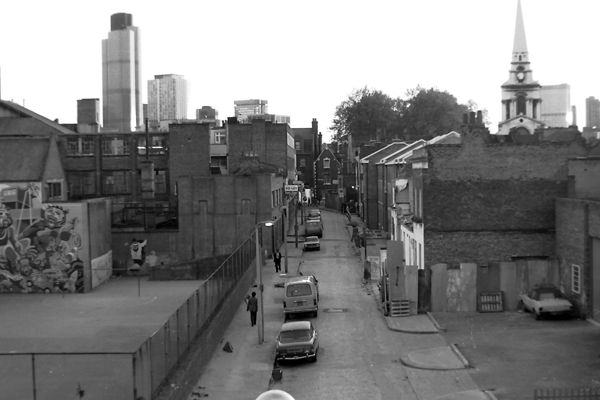
Heneage Street with the City on the horizon viewed from the Chicksand Estate, 1985
The sparse horizon (above) is very different today following the expansion of the City and the consequent explosion in land and property prices in Spitalfelds.
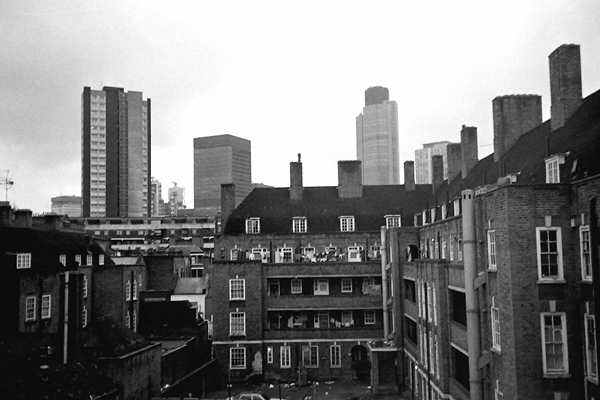
The Chicksand Estate with the City in the distance, 1985
When Richard Seifert designed the Tower (now called Tower 42) he could not have imagined the rapid change to the City skyline that was to occur in a few decades.

The City viewed from Spitalfields, 1987
Over the years St Paul’s disappeared and surfaced again according to the status of surrounding developments. Currently it is hidden and unlikely to resurface for this view for decades.

The City with St Pauls viewed from Spitalfields, 1985
Taken from Spitalfields Market this photograph shows the dereliction which surrounded the market up to the City itself. This space is now populated by banks, law firms and retailers.

A sweeper in the shadow of the 'Nat West' Tower, 1983
Tower 42 was the tallest building in the City for 30 years until it was surpassed by the Heron Tower in 2009.