Man on a Suitcase
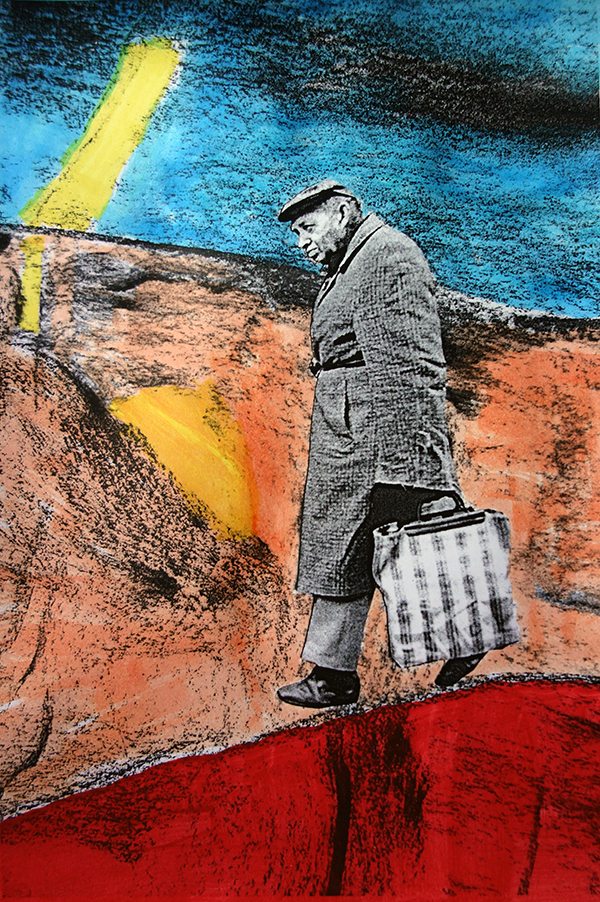
Resting on a suitcase in Cheshire Street this man raises some questions for me. Does the suitcase contain stuff he’s been selling or does it contain all his worldly goods?

Man on a suitcase in Cheshire Street, 1985

Man on a suitcase, Cheshire Street 1985

Man on a suitcase, Cheshire Street 1985
Brick Lane and Dhaka cobbler

Cobblers shop on Brick Lane, 1983
The man seated in front of the shop is the proprietor of the Cobblers shop.

Cobblers shop on Brick Lane, 1983

Street cobbler, Dhaka 2009
Vinyl Heaven
Spitalfields markets were once a haven for record collectors. Even today you can find second hand records for sale at the Sunday market in and around Brick Lane.

Turntable playing an LP, 1983
Forgive me for the photograph of the record playing but it was with some amazement that I had to explain recently to a teenager what a record player was and how it worked. I love records with their analogue sound and covers with comprehensive notes and innovative art work. Seeing a record moving on a turntable is far more engaging than the flash of a digital light.

Record stall in Cheshire Street, 1985
The gentleman behind the man in the beret is Mr Spicer who, with his wife, ran a record stall every Sunday in Cheshire Street for decades. It catered for every musical taste and offered extraordinary bargains. Practically my entire collection was built from my Sunday browsing in Cheshire Street.

Record stall in Cheshire Street, 1985
The young girl reminds me of my own habit of looking at the box next to the one I was browsing. For some reason the adjoining box always seemed more interesting.
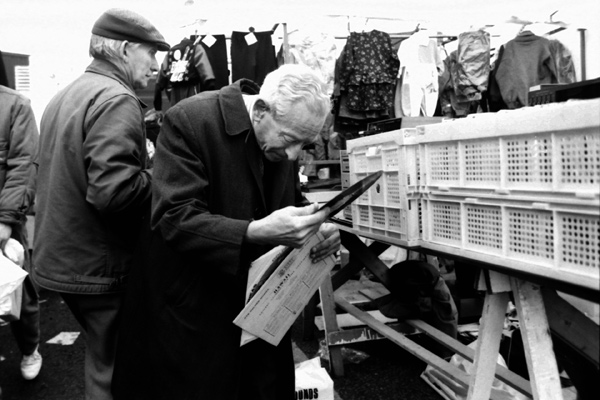
A man examining the condition of a LP. Sclater Street market, 1986
Has this man just found a deleted record which he’s been looking for for years? He went on to purchase the record for 20p and walked away with a smile of satisfaction.
Bangladesh Bus Tales
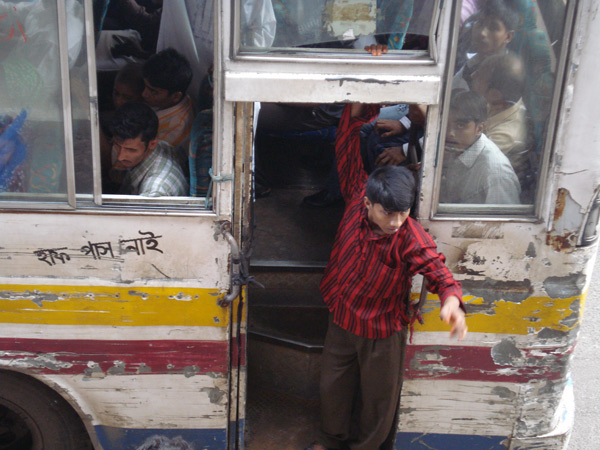
Conductor on passenger Bus in Dhaka, 2009
As a small child if we went anywhere with my mother it would be on a bus. Some of my earliest memories are of me sitting with my sister behind the drivers cab which was isolated from the rest of the bus. We loved watching the driver steering the bus in his small cabin. For me it might as well have been the capsule of a Vostok spacecraft. Second in command of this wonderful vehicle was the conductor. He or she could fly about the bus and hang off the platform in a way that inspired awe from younger passengers. In addition to their gymnastic passage through the bus they could also entertain, comment on international affairs, recite poetry and evict handfuls of yobs from the upper saloon without violence. It was such a shame when conducters were ‘phased out’ from buses in pursuit of higher profits.

Passengers boarding bus on Bethnal Green Road, 1983
I was amazed last year when I got on a bus in Bow to find it half full but strangely silent. I wondered if everyone had been drugged or if they were in a transitional process on the way to becoming zombies. As I sat down I noticed large video screens showing live images of passengers in various parts of the bus sequenced in a way that would assure the transmission of their image every 30 seconds. These omnibus portraits were interspersed with advertising for garden centres and other interesting places you might want to visit on the bus route. For a moment I thought I was watching Fox News – perhaps I was. Anyway it was at this point that I understood how boring the present day ‘digital bus’ in London is compared to its ‘analogue’ parent.
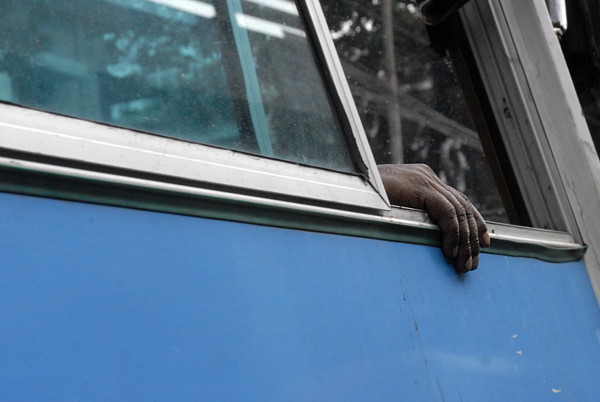
Bus in Dhaka with a hand out of the window, 2009
It was with some satisfaction that on my last visit to Bangadesh in 2009 I was able to indulge my affection for older buses. I can confirm that in Bangladesh the conductors are able to fly about with great ease in order to keep this important service moving.
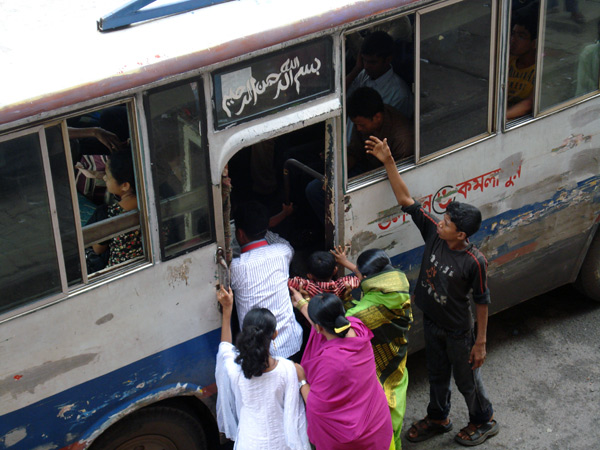
Bus in Dhaka, 2009
The eloquent gesture of the conductors right hand (above) guides new passengers onto his bus. The gesture has a reassuring welcoming quality about it that suggests imminent luxury; it’s all part of the service.
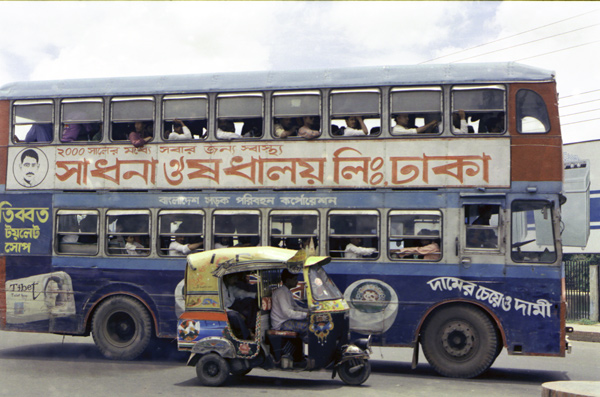
Baby taxi and bus in Dhaka, 1992
The older bus (above) dwarfs the accompanying baby taxi. No longer in service the drivers cab is isolated from the passengers.

A Rickshaw and bus in Dhaka, 2009
Rickshaws compliment the public transport system and are ideal for shorter journeys. In recent years congestion on roads has reached gridlock proportions. This is mainly because of the increase in car use. However it is often the poor rickshaw drivers who get the blame for the congestion.

Car in Chittagong, 2009
Brick Lane Reflections

Brick Lane reflection in a window, 2010
Sometimes reflections in a window reveal something you would not normally observe.

Brick Lane reflection in a window, 2010
This window of an off license in Brick Lane (below) is a metaphor for the direction in which the Lane has traveled in the last decade. I suspect we have reached the stage where all the champagne has been consumed. The sparkle has evaporated and the off license now has a less ostentatious display.
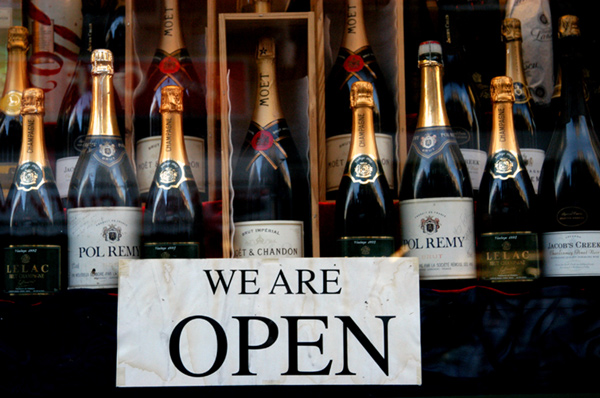
Brick Lane off license window, 2002
Going back in time the Lady walking on Brick Lane in 1982 is about to pass the former Taj Store shop displaying a healthy window of fruit. Many of the shops further down the street have been boarded up with corrugated iron. In a few years time they will disappear completely.

Lady walking down Brick Lane, 1982
Further up Brick Lane we see a wider view of boarded up buildings leading all the way to the bridge. With the election of Margaret Thatcher’s Conservative Party in the 1970’s the UK became a laboratory for economic experimentation. The doctrine of Monetarism had a brief life under Thatcher but was at its end in 1982 when this photograph was taken. It was a time characterised by social unrest, unemployment and poverty for millions of families. The fabric of Brick Lane reflects the state of the economy at this time as well as the mood of depression.

Brick Lane, 1982
The Brick Lane of 2011 is entirely different from the depression above and caters for those with cash to spend. The former local shop (below) has become an Estate Agents.

Estate Agents, Brick Lane 2009
I wonder what the lady below thinks about all of this?
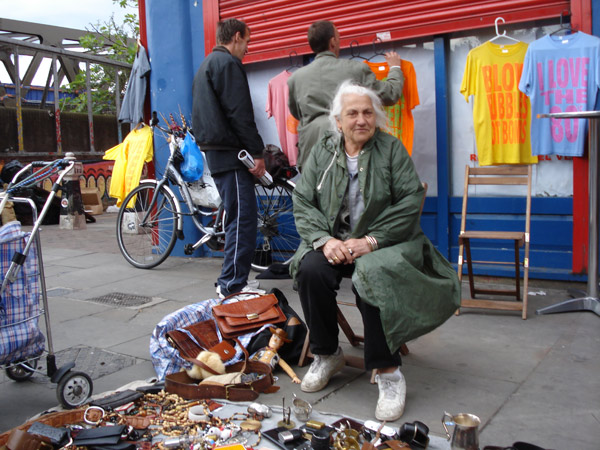
Lady selling second hand goods on Brick Lane, 2007

Window reflection, Brick Lane 2010