Bishopsgate portraits
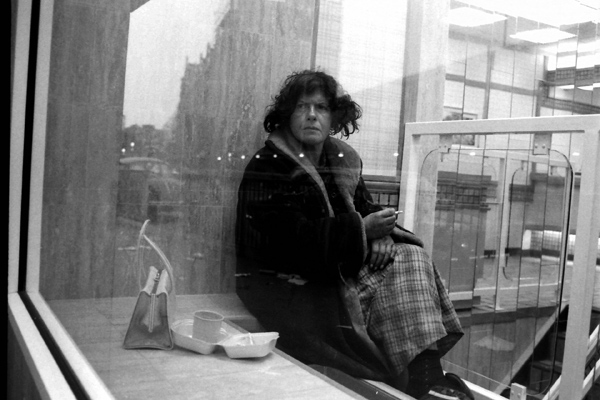
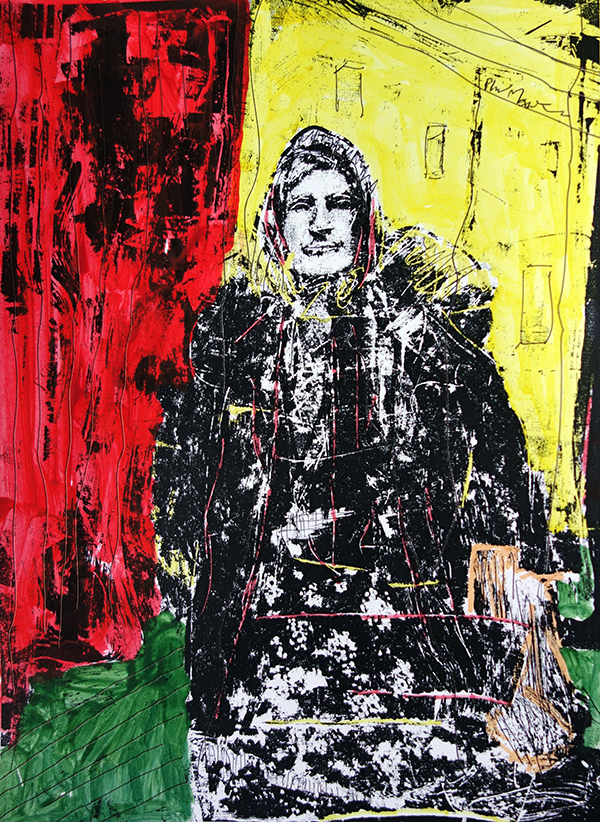
Lady resting in a fast food restaurant, 1989
This lady caught my eye after I emerged from Liverpool Street station early one evening in 1989. Her gaze appeared to be fixed on buildings accross Bishopsgate which are reflected by the glass of the restaurant. Her handbag next to the discarded burger container and cup is an accidental still life that perhaps hints at her precarious life. Bishopsgate was originally the location of many coaching inns which accommodated passengers setting out on the Old North Road.
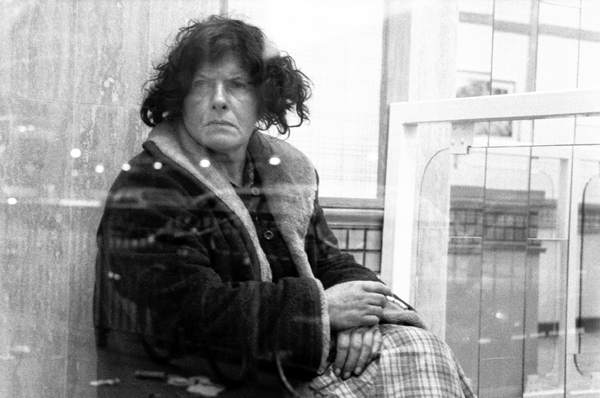
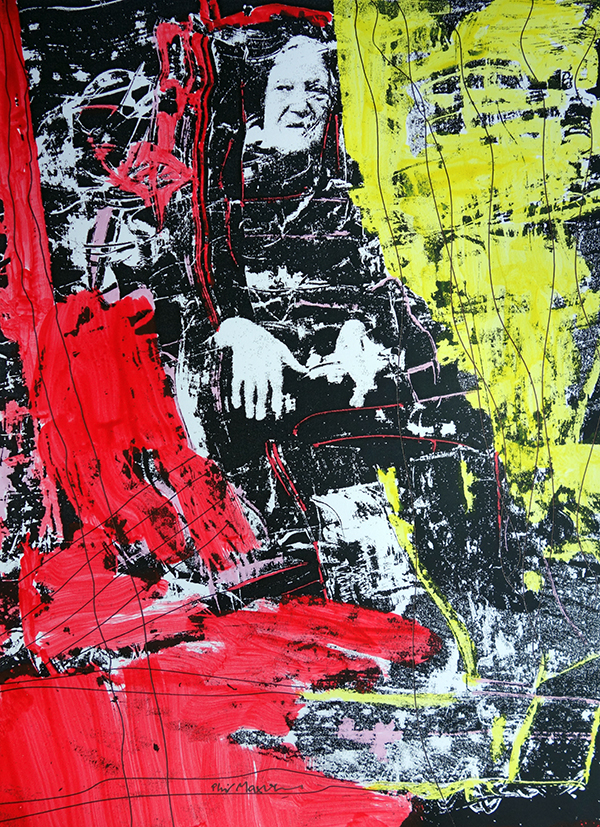
Portrait of a lady, 1989
Bishopsgate is characterised by people rushing to and from work and home. My subject sits gracefully apart from the world of work and deadlines. She is most likely pleased with the warmth provided by her window seat. A closer examination of her right hand reveals a cigarette that has been allowed to burn undisturbed for some time. Is she really studying the street or is her mind somewhere else?

Bishopsgate reflection, 1998
A brass plate advertising what is available in a coffee shop opposite Liverpool Street station. Combined with the reflections we have a fusion which heralds the fact that we are now in cappucino land. Since 1998 coffee shops have sprung up on Whitechapel Road and Brick Lane.
Brick Lane bridge

Lady walking under Brick Lane bridge, 1986
The bridge that spans Brick Lane now carries the crossrail line after many years of redundancy. This lady photographed pulling a shopping trolley looks quite majestic. Her imposing figure transcends the busy surroundings of the bridge.

Brick Lane bridge, 2002
Brick Lane also spans the main railway line into Liverpool street station. The splendid iron bridge over this artery has hosted thousands of fly posters that have changed on a weekly basis. I’ve always regarded this part of the lane as quite special because of the dominance of the tall iron surrounds and absence of buildings. The neatly sectioned compartments of the bridge have proved to be a natural resting place for posters of all kinds. Attempts to remove this organic free gallery have added to its appeal as different images and words end up colliding with each other to produce accidental collage of the highest order.

Posters urging support for the miners strike, 1984
As well as being a visual thermometer of events and music away from the mainstream it has proved itself as a welcome resting place for agitprop.
Richard Hickox at the Spitalfields festival

Christ Church Spitalfields, 2010
Each year Christ Church Spitalfields hosts a music festival. The church, designed by Nicholas Hawksmoor and built between the years 1714 and 1729, is a marvellous venue for music making. In the early 1990’s I photographed a rehearsal for a performance of Bach’s Mass in B minor conducted by Richard Hickox who died suddenly in 2008.

Richard Hickox, Christ Church Spitalfields early 1990's
I recently digitised the negatives of the rehearsal and remembered the warm relationship between Hickox and the orchestra, choir and soloists.

Soloist rehearsing for an evening performance of the B minor Mass by Bach
The afternoon rehearsal for the evening performance enabled me to move around and get a variety of shots.

Richard Hickox rehearsing at Christ Church early 1990's
I watched the evening performance from the balcony at the back of the church.

Rehearsal at Christ Church early 1990's
Rickshaw art

Rickshaw in flooded road, 1994
Rickshaws are the most popular means of transportation in Bangladesh. In the capital Dhaka there are over 600,000 competing for passengers.

Rickshaw with passenger in Sylhet 1996
Rickshaws are covered with paintings of rural scenes, animals, film stars, the rich and the famous, great monuments and religious symbols. The dress of the passenger above compliments the art work on the rickshaw.

Celebrity rickshaw portraits, 2009
Rickshaws have become mobile works of art. Scores of people are employed to paint and decorate this popular form of human powered transport. In recent years computer generated images have joined hand painted patterns. The main aim of rickshaw art is to attract the attention of potential passengers.

River scene on a rickshaw, 2009
Rural scenes are a popular motif. The river scene above adorns the backboard of the rickshaw. Rickshaws are a cheap and popular mode of transport over short distances. Currently there is a battle between rickshaws and cars in Dhaka. Rickshaws are blamed for traffic congestion. However, rickshaws are safe, environmentally friendly and do not rely on fossil fuels. Many people rely on rickshaws. The industry employs people from 38 different professions.

Rickshaw art, Dhaka 2009
The weather project
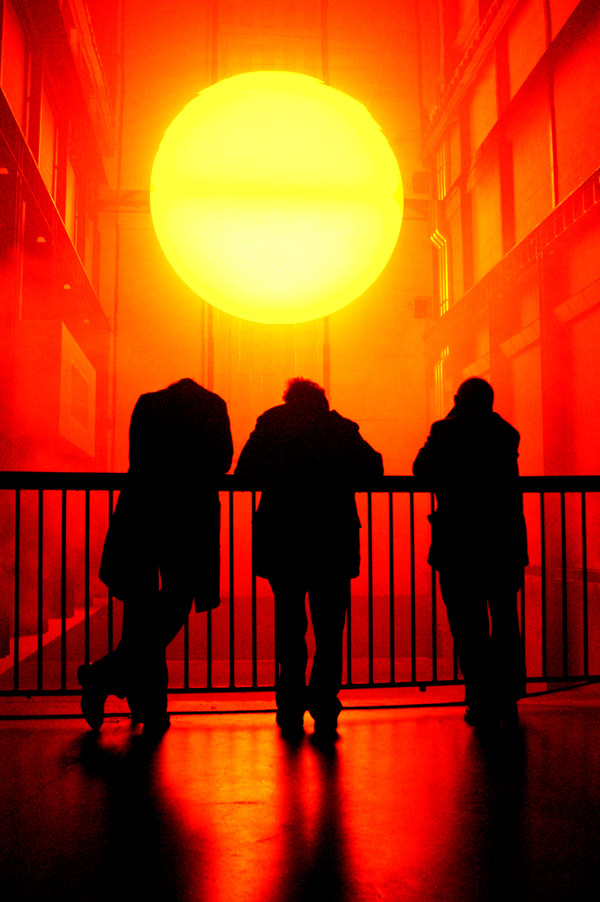
The sun in the Tate gallery, 2004
One of the most impressive exhibitions I have ever seen was the sun installation by Olafur Eliasson in the turbine hall at the Tate gallery in 2004.
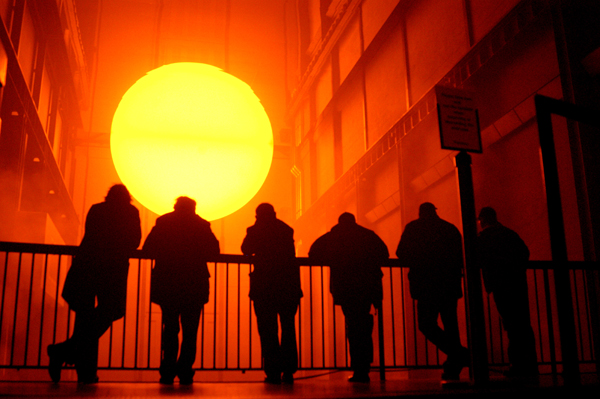
The sun at the Tate gallery, 2004
These photographs utilise silhouettes of people against the sun and provoke a conversation about our relationship with the elements.

Silhouette of the city, 2007
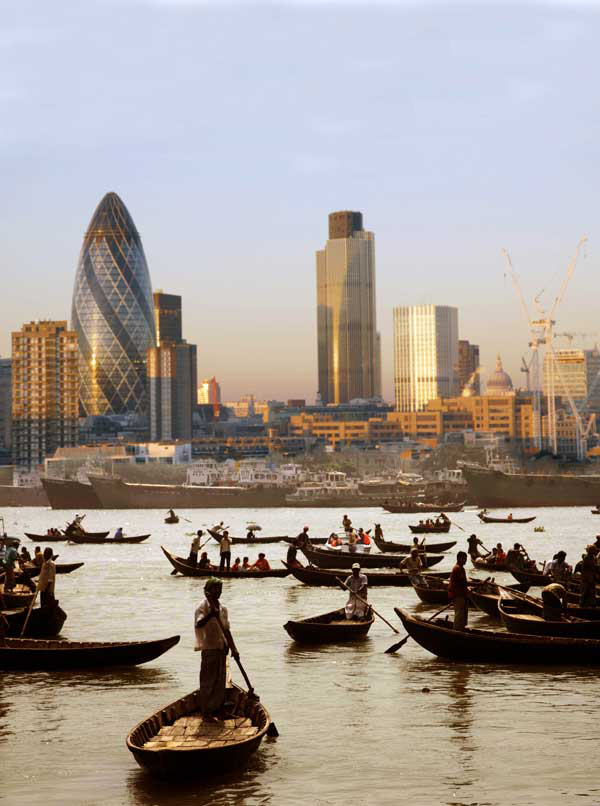
Here the sun creates a silhouette of the City. Over the past 30 years I have watched this sky line change dramatically as new buildings are built and older ones demolished.