Mobile streets
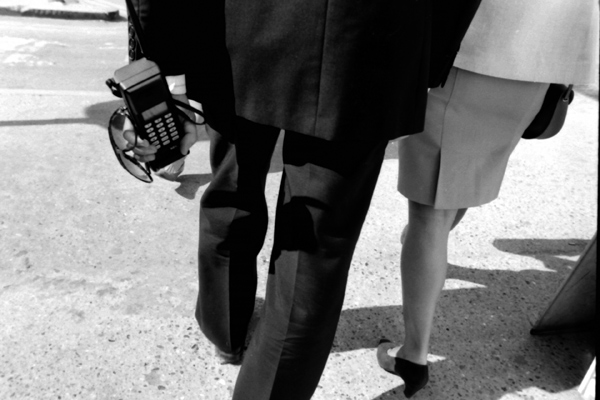
Mobile phone in the city around 1989
The photograph above was taken before mobile phones were cheap enough for nearly everyone to buy. At this time the calls were expensive and the phones were often carried around as a status symbol. They were too large fit smugly into your pocket.

Conversation on Commercial street, 2006
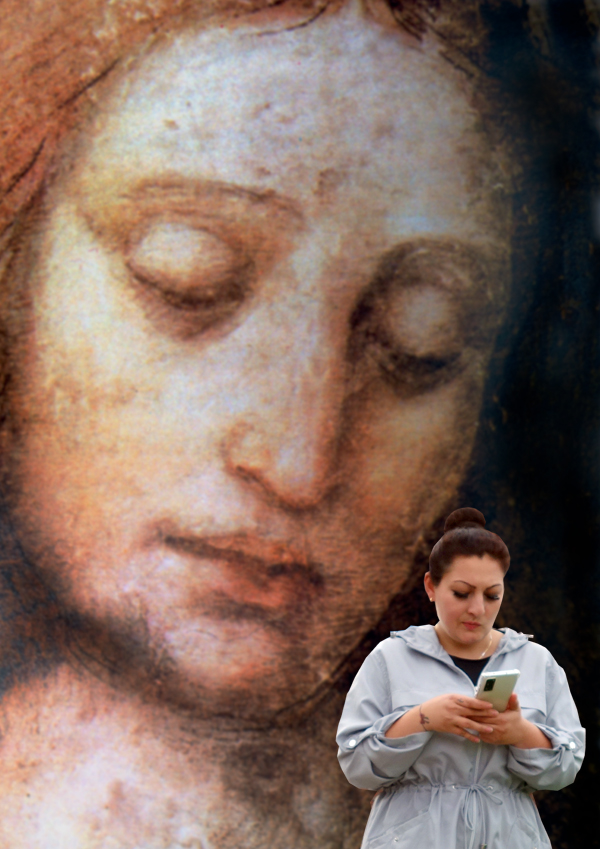
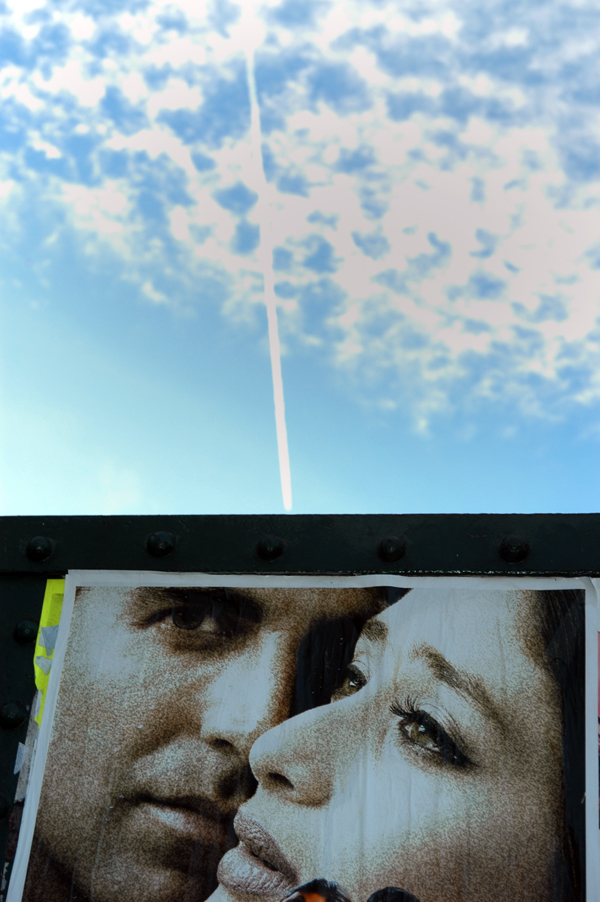
I’ve always thought of myself as a ‘street photographer’. The street is unpredictable and a unique imprint of the community of an area. It’s a place where you will find intriguing juxtapositions of people and events. Capturing a moment in time on a street can be challenging but it holds many rewards for the photographer.Where I live in Whitechapel the street is like an extension of where you live. Many families live in small overcrowded flats so public spaces become a valuable place to meet people and talk. Often you will just bump into an acquaintance or a friend you’ve not seen for a long time and strike up a conversation. I’ve noticed a change in the dynamics of the street since the invention of mobile phones. Now many people cut themselves off from the engaging environment of the street by holding a conversation on their mobile.
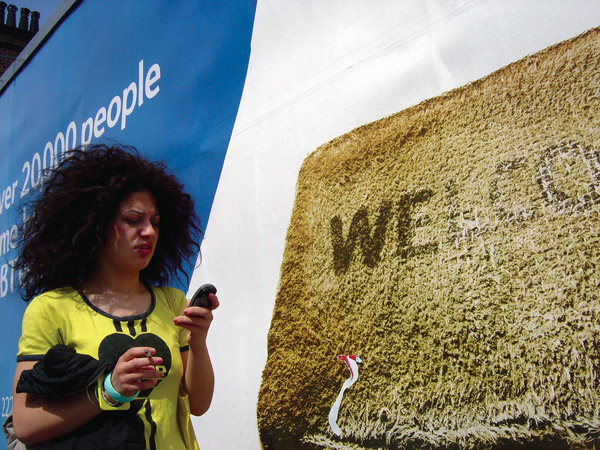
Mobile texting on Vallance Rd, 2004
It seems that some people find it difficult to simply walk and enjoy the ever changing vibe of the street. Its as if this very basic human activity of walking has now been invaded by technology. It’s a revolution that has gone almost unnoticed and even though I’m guilty of answering calls on the street I can’t help thinking that the mobile phone has invaded the pleasures of walking.
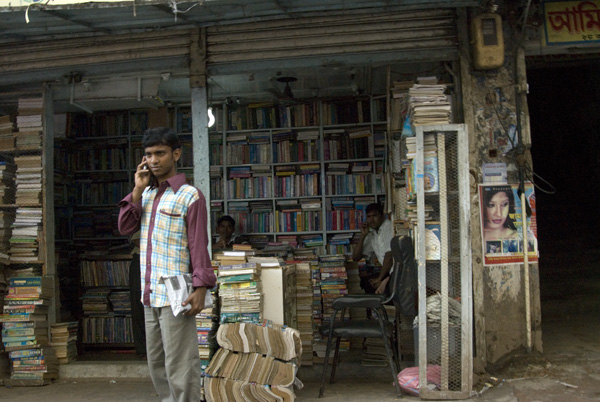
Young man outside a book shop in Dhaka, 2008
Brick Lane bananas

Selling bananas on Brick Lane, 1988
Growing bananas is a big business. It takes months to clear the land, dig holes and put in banana plants. The bananas on display here are going cheap and will be perfectly edible if they are eaten within a couple of days before they begin to rot.

Bananas on Brick Lane
This trader is in his favourite spot by the bridge in Brick Lane. He attracts potential buyers with his loud cries suggesting that they are the best and cheapest bananas in the world.

Bananas grow in clusters, which are known as ‘hands’. A hand consists of 10 to 20 bananas. Here the trader uses his cluster as a prop for his street theatre sale. The man staring at the merchandise appears to be in a trance and is about to make a purchase.

Bananas on Brick Lane
The banana man is supported by strong vocal chords. He can be heard on the opposite side of Brick Lane. It would be very difficult to walk past him without considering a banana purchase. The banana man is a shrewd publicist for his goods. He knows that if he gets someone to stop and listen then he is half way to a sale.

The banana man takes a break and greets a friend
In the 1980’s the banana man was a permanent fixture at the sunday market on Brick Lane. He was a brilliant street performer who turned Brick Lane into his stage.
On the buses

Bus stop at Burdett Rd, 2009
Bus stops are great places for photographic loitering. The accumulation of a wide variety of people at a bus stop provides endless opportunities for portraits and observations of human behavior, fashion and style.

A man with a cap on a route master bus, 1999
I’ve always regarded public transport as a moving studio set up to record people. Invariably I carry a small camera with me to record the environment I pass through. Buses can be difficult in terms of the rapidly changing light. However it’s difficult not to discover an interesting subject. A London bus will always furnish a photographer with a wide range of subjects. This passenger has emerged into the metropolis ready for the cold with his two jumpers, coat and cap.

Man on the lower deck of the 254 bus, 2009
The human landscape is altered each time the bus collects fresh passengers at a stop. This passenger is positioned safely in a seat specially designed for disabled travelers. The routemaster bus had no facilities for disabled passengers.

Leaving a routemaster bus on the East India Dock Road, 2003
This passenger is helped from the bus by the conductor. She steadies herself by touching the advertisement of an idealised woman. Despite the competition from the glossy lady in a swim suit our attention is held by the old lady. The routemaster was withdrawn from service in 2005 partly for health and safety reasons.
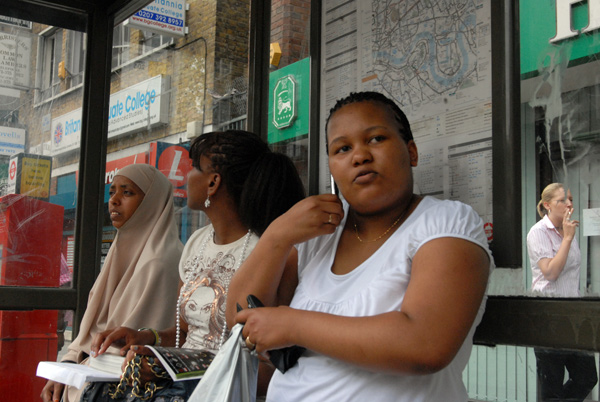
Bus stop, Whitechapel 2009
Before the invention of the mobile phone conversation between waiting passengers was usual at bus stops. At this stop there is no communication between the three women and the woman closest to the camera can’t raise anyone on her phone.
Cat lady of Spitalfields

Cat lady on Brick Lane. Late 1980's.
The woman in this photograph was always dressed in a head scarf and large coat. Usually she would pull a shopping bag on wheels behind her. She was the cat lady of Spitalfields. She knew where every cat and kitten lived in the wild and made it her task to feed them every day. Her bag was full of cat food which she would serve on newspaper at designated spots around Spitalfields.

Cat lady on Brick Lane near the Seven Stars pub
The cat lady pauses for a second near the Seven Stars pub on Brick Lane. She has just left some food in the ‘private road’ for some cats.

Cat lady near Christchurch school on Brick Lane
The cat lady floats past Christchurch school on Brick Lane. With her eyes closed she contemplates the next cat awaiting a delivery.

Cat lady on Cheshire Street with her shopping trolley
The cat lady waits outside her favourite cafe in Cheshire street. Now a trendy boutique, in the 1980’s you could buy a cup of tea and a sandwich for less than a pound at this establishment.

Cat lady in Cheshire street cafe
The cat lady ‘kept herself to herself’ and avoided the company of others.

Cat lady sits alone in her Cheshire Street cafe
It must be about twenty years since I last saw the cat lady of Spitalfields. She devoted her life to feeding the stray cats of the area. I have no idea where she lived and I never saw her talking to another person. She seemed to live in her own separate cat world. Even though I was sitting opposite her when I took this photograph I felt that she had created a barrier and would be reluctant to engage in conversation. It was impossible to make eye contact. I’m pleased I photographed her on the streets and in her Cheshire street cafe. She would not recognise Cheshire street and Brick Lane today.
Liverpool Cathedral

Liverpool cathedral
The Liverpool skyline is dominated by two cathedrals. The Anglican cathedral designed by Giles Gilbert Scott eclipses the modern design of the Catholic cathedral a short distance away. This may be partly due to its position on St James’ Mount which overlooks the city and the river Mersey. Perhaps also the Gothic revival style of the building plus the fact that it is the largest Cathedral in Britain assures its dominance of the skyline.

During the early 1980’s the cathedral was surrounded by urban dereliction. As I photographed inner city Liverpool at this time the building became an anchor for many shots. The juxtaposition of the imposing Gothic structure against acres of urban decay provided an irresistably surreal composition for the photographer.
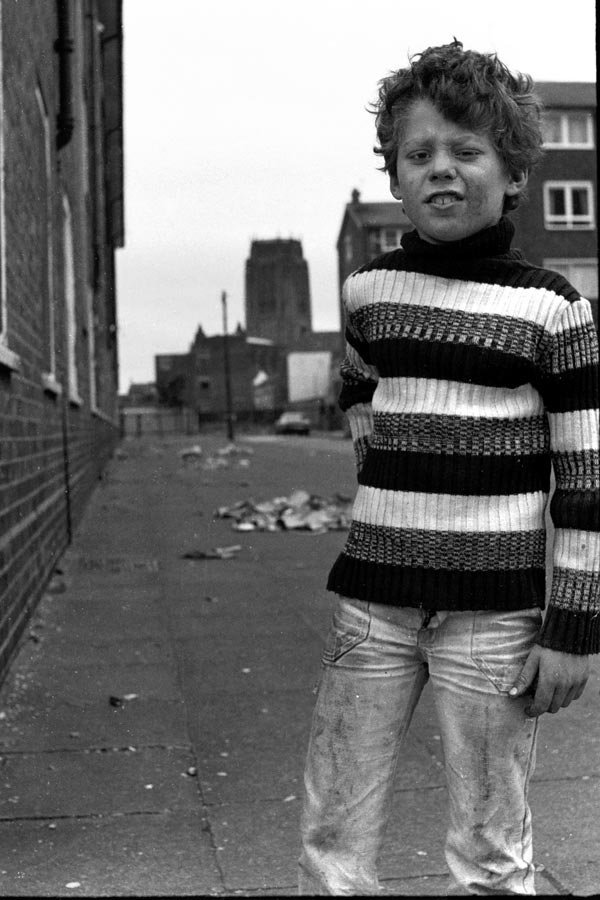
Today the landscape around the cathedral has completely changed following various regeneration schemes.
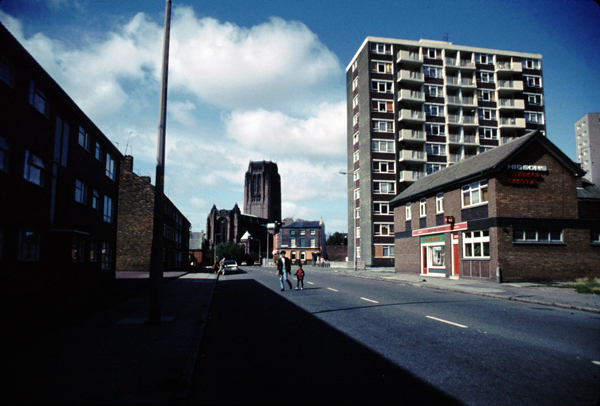
For me the relationship of Scotts iconic design with the old Liverpool captured here had a special resonance which has now disappeared.