The Human Element in London’s Corporate Landscape
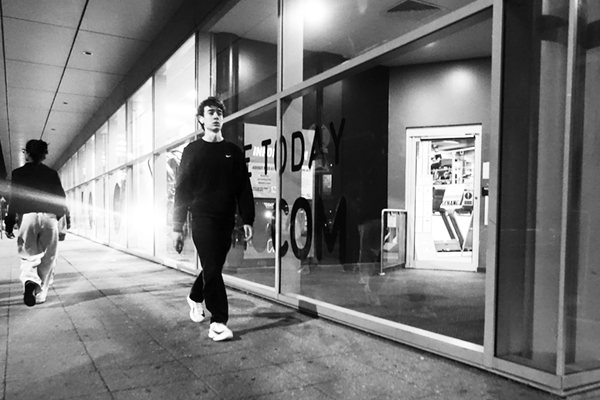
The glass façade dominates this image, reflecting light, geometry and wealth. Yet it isn’t the architecture that holds my attention. It’s the young man walking past the plate glass windows[. He appears self-contained, purposeful and almost anonymous, his dark silhouette briefly interrupting the perfection of the corporate landscape. For a moment, the human presence feels fragile against the scale and certainty of the buildings.
Whenever I walk through Canary Wharf, I find myself asking the same question: who is this place really for?
Everything is immaculate. The plazas are spotless, the glass gleams, and every surface seems designed to project efficiency and success. Yet I rarely feel welcome here. Even walking through one of the shopping arcades, I sometimes catch myself feeling like an intruder, as though my presence is tolerated only because I’m passing through. It is a curious sensation in what is, after all, a city I’ve spent most of my life in.
Perhaps that feeling isn’t accidental. This is architecture that choreographs behaviour. It encourages movement rather than gathering, consumption rather than conversation, circulation rather than community. There are spaces to work, to shop and to invest, but remarkably few places simply to belong. The public realm exists, yet it often feels conditional.
The irony is hard to ignore. Much of the land beneath these towers was once publicly owned before being transferred to private developers on exceptionally favourable terms. What emerged is an extraordinary concentration of wealth and power, wrapped in polished stone and mirrored glass, but one that can leave ordinary citizens feeling like guests in a place that should never have ceased to be theirs.
As I watched the young man disappear into the reflections, I couldn’t help thinking that he looked less like an inhabitant than a passing shadow—present, but never fully claimed by the space around him.
Margaret Thatcher famously declared that “there is no such thing as society.” Canary Wharf can feel like that philosophy made concrete: a landscape where markets have flourished, but where the idea of a shared civic life has become harder to find. The photograph is less about one man walking through a financial district than about the uneasy relationship between people and places that increasingly seem to value capital more than people.