Liverpool : 1972 – 2025 Volume 1

CLICK ON THE COVER IMAGE ABOVE TO BUY
Forty Years Apart: Two East End Streets

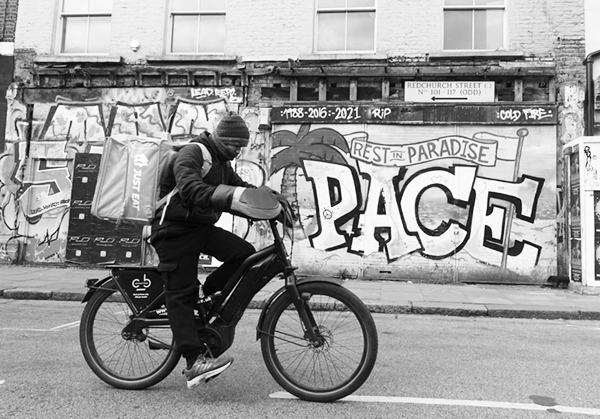
These two photographs, taken forty years apart, invite us to consider not only how the physical environment of the East End has changed, but also how much has remained constant.
The 2024 cyclist is absorbed in his work, seemingly unaware of the camera. Wrapped up against the cold, he moves with a sense of urgency, his attention fixed on the journey ahead. There is something quite solitary about him, almost as if his clothing and the demands of his work have separated him from the street around him.
The man I photographed in Grimsby Street in 1984 was a very different character. He was used to seeing me wandering around Brick Lane with my camera, and we would acknowledge each other when I got a little closer. He was a man of few words, and I often found myself wondering about his past and the stories he might have told. I imagined him as a Second World War veteran who, having lived through such extraordinary times, had perhaps fallen on hard times later in life. I never knew whether that was true, but it was an impression that stayed with me.
He was a familiar figure around the Brick Lane area. In this photograph, he seems relaxed, almost lost in his own world as he walks alongside his bicycle. There is a quietness about him, a sense of someone who belongs to the street and is entirely at ease in his surroundings.
Both men, I think, convey a sense of individual dignity, although in very different ways. The man in 1984 seems to have time on his side, while the delivery cyclist is caught up in the relentless pace of contemporary life. One appears settled in his surroundings; the other is passing through, carrying out a job that demands speed and efficiency.
Looking at these photographs together, I am reminded that the history of the East End is not simply a story of buildings being demolished, industries disappearing or streets becoming fashionable. It is also a story of people adapting to changing circumstances, finding ways to make a living, and continuing to occupy the same urban spaces. The faces and the fashions change, but the street remains a place of work, movement and human encounter.
For me, the character of a street is never determined solely by its architecture or commercial identity. It is created by the people who use it, by the lives they lead and by the everyday experiences that take place within it.
These two photographs, taken forty years apart, are perhaps as much about the people of East London as they are about the streets themselves. They are personal memories, but they are also visual records of a social history that continues to unfold.
East London: A Street Out of Time
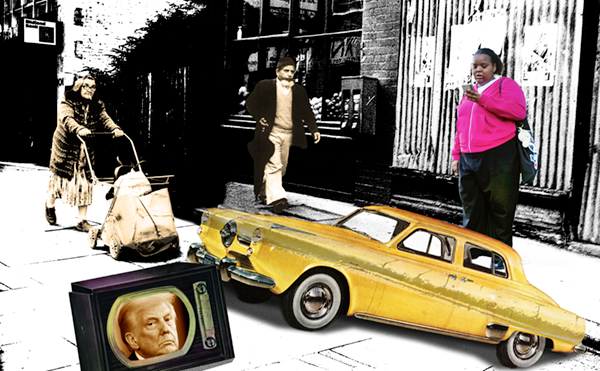
This photomontage brings together different moments in East London’s history to explore time, social change, technology and political power. By combining photographs taken decades apart, I’ve transformed familiar urban street scenes into something surreal, where the past and present collide and different realities occupy the same space.
The image draws on three distinct periods: two people I photographed on Whitechapel Road and Brick Lane in the 1980s, a woman I photographed using her phone in Hackney this month, and an image of Donald Trump. By bringing these separate moments together, I’ve created an imaginary East London street that could never have existed quite like this, yet contains elements of a world I recognise.
For me, the pleasure of photomontage lies in the freedom to move beyond what a photograph originally recorded. I can take images made years apart, remove them from their original context and allow them to tell a different story. Time becomes fluid. Different periods coexist, overlap and influence how we understand the present. Photography, in this instance, is not simply a way of documenting reality; it becomes a way of questioning and reimagining it.
The older woman pushing her shopping trolley and the man walking along the street take me back to an earlier East End. Their presence evokes a more familiar, everyday rhythm of street life, when shopping, walking and stopping for a conversation were integral to the experience of being out and about. I remember how you would almost always meet someone you knew on the street, and a conversation would follow. The street was not simply somewhere to pass through; it was a place to encounter people, exchange news and feel part of a community.
East London has changed enormously since those photographs were taken. Its buildings, businesses, population and social character have all been transformed. Yet, when I walk its streets today, I still recognise something enduring in the way people occupy these shared spaces. Different generations continue to live, work and pass one another, even as the world around them changes.
The woman in the bright pink top introduces a distinctly contemporary presence into this historical setting. Her attention is absorbed by her phone, creating an intriguing contrast with the older figures, whose activities connect them directly to the physical world around them. I’m interested in what this small difference reveals about how everyday life has changed.
The smartphone has transformed the way we communicate, access information and experience public space. We can be physically present on a busy street while mentally somewhere else entirely, connected to an invisible network of people, images and information. The woman’s phone becomes a symbol of this shift: the street remains much the same in principle, but our experience of being in it has changed. I find myself wondering what we have gained through this constant connectivity, and what we might have lost along the way.
The brightly coloured car is another deliberate interruption. Its vivid presence immediately draws the eye, while its position across the lower part of the composition disrupts the recognisable street scene. I took the image from a 1950 issue of National Geographic, which featured a luxury Studebaker Land Cruiser advertised as combining luxury with “an almost unbelievable low cost per mile.”
I was drawn to the image partly for its colour and visual impact, but also for what the car represents. For decades, the motor car has been associated with freedom, status, progress and modernity. At the same time, cars occupy public space, shape our cities and influence how streets are designed and used. Placing this particular vehicle alongside pedestrians and shopping trolleys creates a tension between private mobility and shared urban life. The car belongs to another era, yet the questions it raises about progress, consumption and our relationship with the street remain relevant today.
Then there is Donald Trump, encased in an old television set that appears to have been discarded in the road. His presence introduces a more explicitly political dimension to the montage. I associate Trump with the promotion of fossil fuels and an oil-based economy, making him an uneasy fit within a street assembled from different periods of urban life. The television adds another layer: a familiar medium of mass communication, now seemingly abandoned and reduced to rubbish.
I’ve deliberately left this element open to interpretation. Why is Trump in a discarded television? Has he been thrown out with the old technology, or is he still broadcasting his influence from the roadside? Perhaps the image suggests something else entirely. I’m happy to leave those questions with the viewer rather than provide a definitive answer.
Ultimately, this photomontage reflects my continuing fascination with East London and the way its streets hold traces of different times. The photographs are rooted in real places and experiences, but bringing them together allows me to explore something that a single photograph cannot easily express: the coexistence of memory, change and the present moment.
For me, the imaginary street becomes a meeting place where personal memories, technological shifts, consumer culture and political power collide. By rearranging these fragments of time, I hope to encourage the viewer to look again at the familiar and consider what progress really means, what has been lost or gained, and how the images we encounter shape our understanding of the world.
Perhaps the past is never quite as far behind us as we imagine. Sometimes, all it takes is a different way of looking to bring it back onto the street.
Liverpool’s Industrial Past: A Modern Communication Paradox
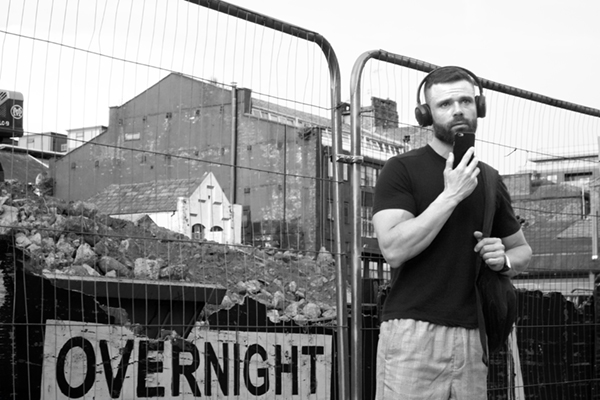
In my photograph On the Phone with Headphones. Liverpool, 2021, I was drawn to the relationship between the man and the fence. I found something compelling about the way he stands behind this tall wire construction barrier, with its grid of horizontal and vertical lines cutting across the entire image. The pattern feels quite aggressive to me, dividing the photograph into small squares and almost trapping the man within it. He is there, physically present, but somehow contained by the structure around him.
What interests me just as much is the way his headphones seem to create another kind of enclosure. The fence surrounds him physically, while the headphones enclose him psychologically. He is standing in a public space, yet he seems to have withdrawn into a private world of his own. I like this contradiction. He is alone, but communicating. He is in the middle of the city, but somehow separate from it. His attention is directed towards someone we cannot see, somewhere at the other end of the conversation. For a moment, the world around him seems to have become irrelevant.
Behind him, the buildings have been demolished. I was struck by the contrast between this landscape of industrial Liverpool, with its associations of factories, warehouses, brick and machinery, and the man with his phone and headphones. The buildings belong to a physical world shaped by labour, industry and place. The man seems to belong to a different world, one in which communication is instant and distance matters much less. He can be connected to someone miles away while standing alone among the remnants of the city’s industrial past.
I think this is what I love most about the photograph. There is something almost futuristic about him, as though he’s stepped out of another time and found himself standing among the ruins of an older world. I don’t think he is necessarily aware of this contrast; he’s simply absorbed in his conversation. But, for me, the fence, the demolished buildings and his headphones come together to suggest something about the way we live now. We can be physically present in a place while our minds and attention are somewhere else entirely.
The more I look at this photograph, the more I am drawn to that tension between being enclosed and being connected. The fence keeps the man within its grid, yet his phone allows him to reach beyond it. He is surrounded by the physical remains of Liverpool’s industrial past, but connected to an invisible world that extends far beyond the frame. I find something quietly poignant in that image of a man alone in the city, both confined by his surroundings and able to escape them.
Watching Liverpool Pass By
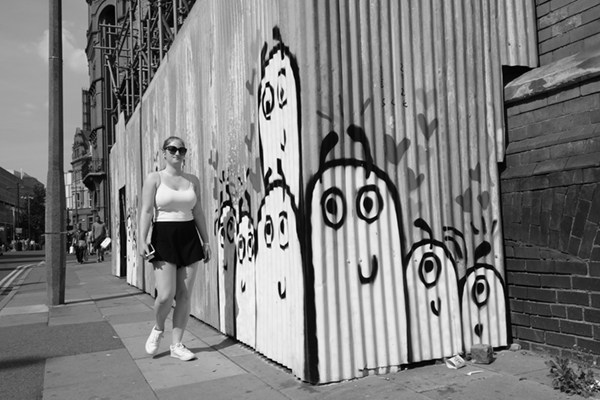
When I first began photographing Liverpool in 1972, corrugated metal hoardings were a familiar feature of the city’s streetscape, concealing bomb-damaged sites, derelict buildings and empty plots awaiting redevelopment. Liverpool was entering a period of profound change. The decline of its traditional port and manufacturing industries was reshaping the city, while the closure of the southern docks in 1972 marked the end of an era. Amid the remnants of the past, demolition and redevelopment were becoming part of everyday life.
Nearly fifty years later, in this 2021 photograph, corrugated metal appears again, but this time it has been transformed into a canvas. A family of elongated, cartoonish creatures, with their wide eyes and curious expressions, stares out from the hoarding. In front of them stands a woman, solid and three-dimensional, caught momentarily in the street.
There is an intriguing contrast between the two. The woman is physically present but temporary; the painted figures are flat, yet they may outlast her. She will walk away, disappearing from the scene, while the characters remain on the metal until the building work moves on and the hoarding itself is removed. The photograph holds these different kinds of existence in a delicate balance: the fleeting presence of a passer-by, the temporary life of a building site, and the uncertain permanence of an image.
Perhaps there is another layer to this encounter. I find myself identifying with those wide-eyed painted creatures, watching Liverpool pass by, observing its transformations and bearing witness to the gradual disappearance of familiar places. Like them, I stand outside the action, looking on as the city continually reinvents itself. My camera, too, takes an ordinary, passing moment and gives it a kind of permanence.
The irony is that nothing in the photograph is truly permanent. The woman moves on; the hoarding will eventually vanish; even the street will change. Only the photograph remains, preserving a moment that can never be repeated.
After nearly half a century of photographing Liverpool, perhaps this is part of what keeps me looking: the knowledge that the everyday world is always slipping away, and that, occasionally, a camera allows us to hold on to a little piece of it.
Exploring Urban Duality: Dhaka Meets New York
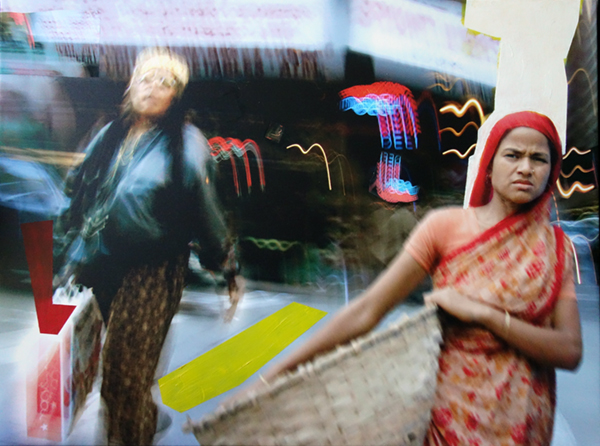
In this mixed-media work, I bring together and juxtapose two worlds: New York and Dhaka. The woman on the right is removed from her original street environment and placed within the urban space shared with the other woman in New York. Painted graphic interventions act as a visual thread, binding the separate photographic sources into a single, unified image.
I use the blurred New York backdrop to evoke the experience of modern urban life: its speed, crowds and transience, and the difficulty of capturing any single moment with certainty.
The work collapses geographical distance. Although the two women are separated by thousands of miles and distinct cultural contexts, they inhabit the same urban space within the finished image. This creates a form of visual globalisation, in which New York’s commercial spectacle and Dhaka’s street economy become part of a shared visual experience.
The work invites us to consider what distinguishes one place from another, and what connects them: movement, labour, commerce, crowds, advertising, transportation and the fleeting encounters between strangers. The resulting image suggests an almost dreamlike vision of the city, in which different places and moments in time coexist.
Through this process, I seek to transform documentary material into a meditation on movement, labour, urban life and the connections between seemingly distant cultures. Rather than treating photographic realism as sacrosanct, I use it as a point of departure, allowing the creative process to reshape, reinterpret and ultimately transcend the original sources.