Save Brick Lane: Art, Community, and a Data Centre
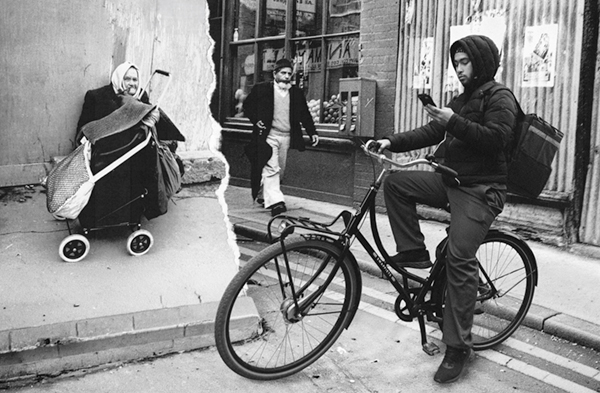
In this photomontage / collage I’ve brought three different images together. Behind the cyclist (taken in Bishopsgate in 2021) are two images from the East End taken in the 1980s.
The bicycle suggests someone who can move forward easily, while the trolley suggests someone carrying the past with them. I’m capturing people who are simply passing through the same place (at different times) but experiencing completely different realities. The two figures from the 1980s are fully aware of their surroundings whereas the young man is absorbed by his phone looking at instructions about where to take the food order. The pace of his life is entirely different from the other subjects and largely shaped by digital technology. The man with the umbrella is walking past a shop in Brick Lane that was demolished a year later.
The government has just approved a massive data centre on the Truman brewery site on Brick Lane. In recent years there’s have been demonstrations and public meetings, including protests specifically demanding ‘homes, not data centres’.
The Save Brick Lane campaign is a grassroots coalition involving residents, community organisations, charities and people with longstanding connections to Spitalfields and Banglatown. It’s been campaigning against the wider Truman redevelopment since 2020. The approved scheme includes a 5,200 m² data centre, while campaigners argue that the land should instead contribute to housing; the wider development provides 44 homes, only six of them social housing, whereas the community-led alternative has focused on hundreds of homes. I know whose side I’m on!
From Ropewalks to Cafés: Bold Street’s Evolution
I’ve walked through Bold Street many times since I first came to Liverpool in 1972.
Bold Street had an interesting history before it became the fashionable commercial street it is today. The area was associated with rope-making. Its long, relatively straight form was suitable for laying out rope, and the wider neighbourhood consequently became known as the Ropewalks. The street was subsequently developed for housing from around the 1780s and was named after Jonas Bold, a wealthy merchant, banker and later Lord Mayor of Liverpool.
Jonas Bold was involved in the sugar trade and in businesses connected with the slave trade; Historic England records his connections with the trade in enslaved Africans. The ropeworks that preceded the development of the street were also associated with merchants involved in slavery.
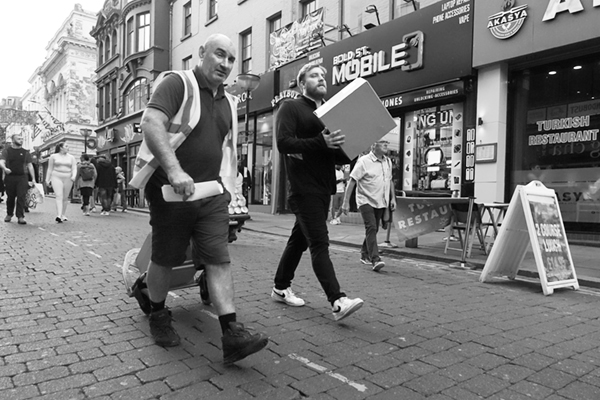
I’m reminded that apparently ordinary streets can contain histories of wealth, exploitation and global trade that are no longer immediately visible. The men carrying equipment in the foreground are contemporary workers, but they occupy a street whose physical development was closely connected with the labour and commerce of the port. The photograph connects present-day urban work with Liverpool’s industrial and maritime past.
It’s an apparently ordinary moment, but I think the image becomes a study of work, movement, commerce, migration, architecture and Liverpool’s layered history. The large man walking towards the camera dominates the left-hand side of the frame. His heavy build, dark clothing and work equipment give him a physical presence that contrasts with the slimmer man behind him, who is carrying a parcel. Both are clearly engaged in work, and both are caught mid-stride. Their bodies and legs create a strong sense of movement across the otherwise static street. No doubt it’s a moment that has been created many times before in the history of the street.
Bold Street today is particularly associated with independent shops, cafés and restaurants and is largely pedestrianised, making it an unusually good setting for observing people. I wouldn’t dream of walking there without my camera!
The ropewalk has disappeared, the merchants and their houses have changed function, and today’s workers carry parcels and supplies for restaurants and shops serving a global city. I hope my black-and-white image freezes one instant in that continuing process of change, making the familiar street appear both contemporary and deeply historical.
Who Benefits from London’s Urban Transformation?
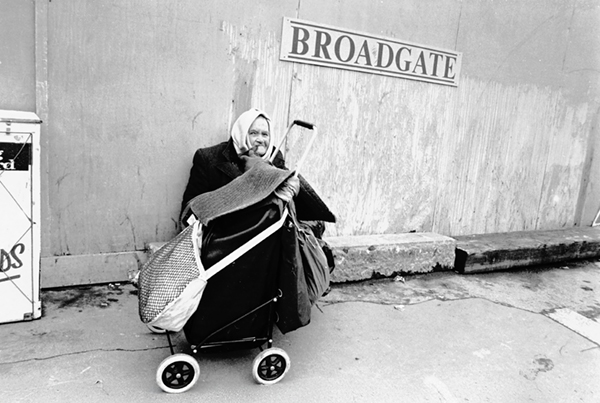
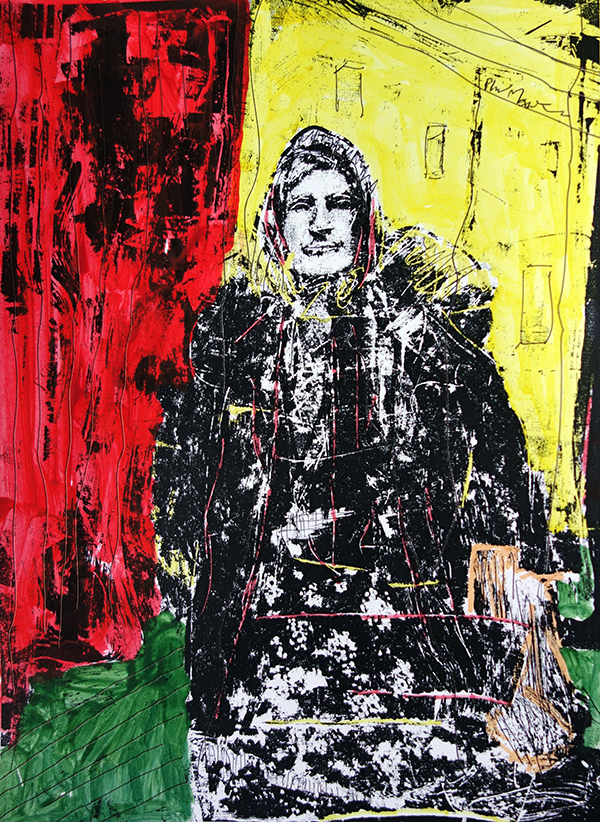
I made this photograph during the redevelopment of Liverpool Street and Bishopsgate. I would often see her along Whitechapel Road, but on this occasion she was in Bishopsgate, in the midst of the enormous changes taking place around her. It was as if she had travelled as far as she could go and had finally been stopped by the developers. Unperturbed, she had decided to use the spot to rest and take in the landscape around her.
My subject is heavily laden with possessions: a large blanket or shawl, bags and a wheeled shopping trolley. Together, they almost form a protective shell around her.
There is an extraordinary contrast between her modest, portable world and the enormous world of corporate redevelopment behind her.
The Broadgate development represented almost precisely the opposite kind of mobility and wealth: large-scale offices, finance, investment and the transformation of former railway land into one of London’s major commercial districts. The first phases were developed from the mid-1980s onwards, on and around the site of the former Broad Street station.
The sign “BROADGATE” is almost comically prominent. It sits above her head like the title of the photograph. She has little connection with the new financial City being created around her. A new city is being rebuilt around an existing population.
Broadgate became one of the great symbols of the City’s transformation during the 1980s. British Rail entered into an agreement with Rosehaugh Stanhope in 1985, and the development ultimately provided hundreds of thousands of square metres of office space. The redevelopment also helped finance the modernisation of Liverpool Street station.
The transformation involved substantial demolition. Broad Street station was demolished, parts of the historic Liverpool Street complex were removed, and new office development was constructed over railway infrastructure. Historic England describes the 1985–92 “remodelling” as a major transformation of the station and its surroundings.
I suppose that, with this image, I am asking a simple question: who is the city being rebuilt for?
Today, much of the office space built during this period is considered obsolete and difficult to let. Yet rough sleeping on the streets of London shows no sign of obsolescence.
Bethnal Green: The City as a Catwalk in Art
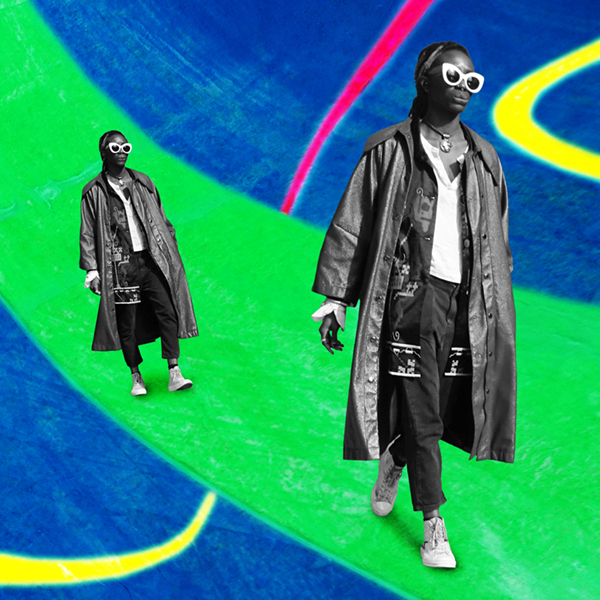
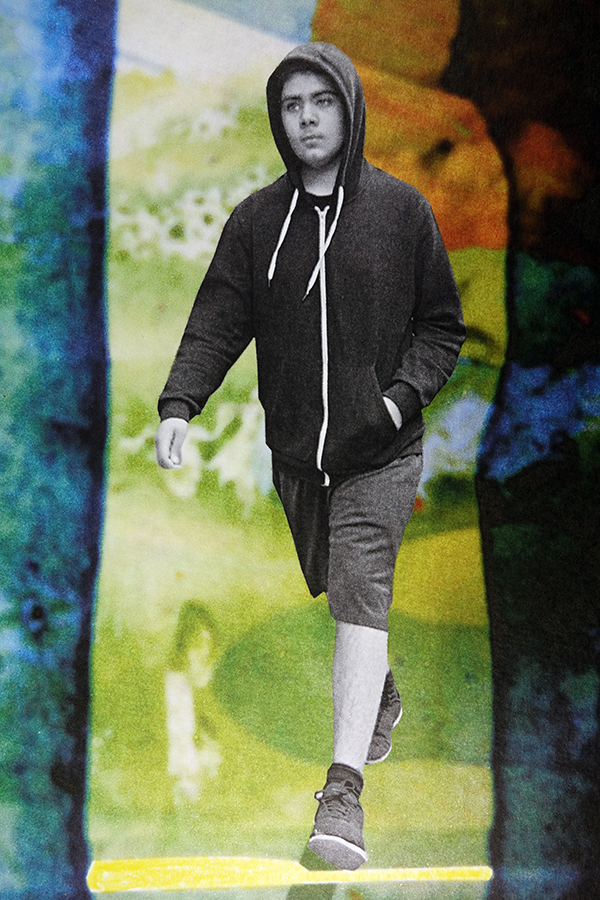
When I was walking along Bethnal Green Road and saw this stylish woman walking towards me, I was immediately reminded of the few occasions when I have photographed models on the catwalk. As drag artist and performer RuPaul says, “The world is your catwalk, so just remember that when you’re out there.”
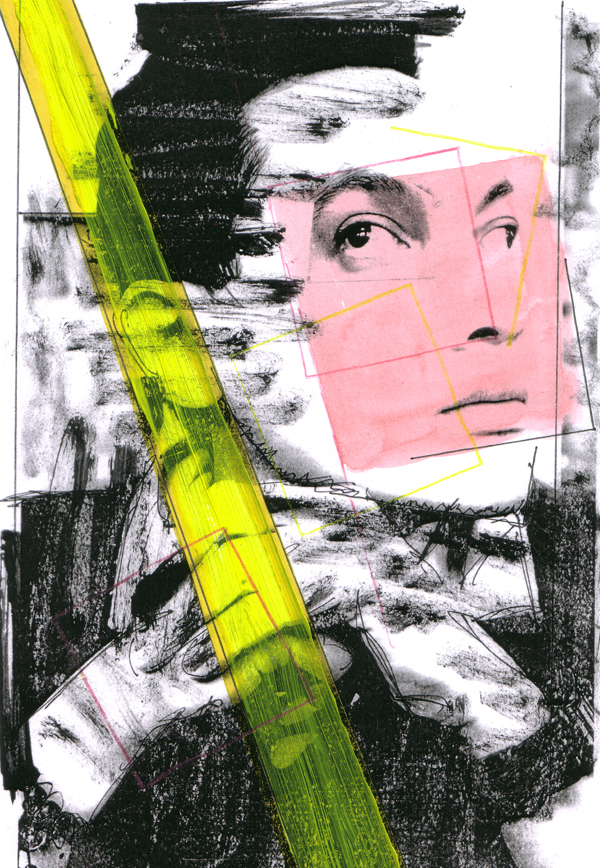
This striking encounter on Bethnal Green Road inspired this hybrid of street photography, collage and graphic abstraction. The work begins with two street photographs made in 2024, but the final image moves well beyond documentary photography into a constructed psychological space. Rather than simply recording a place, it evokes the sensation of moving through a city that has itself become a catwalk.
The vivid electric greens, blues, yellows and magentas bear little relationship to the natural world, yet they could easily belong to a colour scheme created through the lighting and visual design of a fashion show. Here, they function symbolically rather than descriptively. My subject remains grounded in lived reality, while the saturated background becomes an imagined, emotional environment. The contrast between the monochrome figure and the intense colour heightens the tension between observation and invention, reality and fantasy.
I wanted to create an image that feels both rooted in the streets of East London and liberated from them. The work suggests that identity is not fixed, but continually performed, imagined and reconstructed as we move through the urban environment.
Exploring Memory in ‘Whitechapel Night’
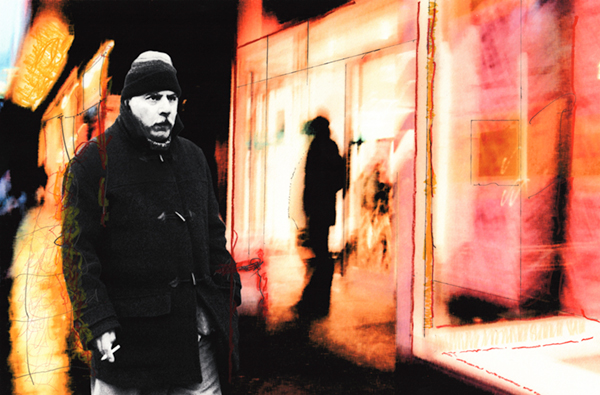
Whitechapel Night is an example of my work moving beyond straight documentary photography into something more painterly, psychological and dreamlike. I’m interested in taking an ordinary urban moment and allowing it to become something less certain; a place that exists somewhere between observation, memory and imagination.
I often return to my archive of photographs from the East End and find myself looking at places that I photographed years ago with very different eyes. Buildings have changed, streets have been redeveloped, and some of the places I remember have disappeared altogether. By reworking these photographs, I can bring those fragments of the past back into the present, but not necessarily as they really were. Instead, they become part of an imagined landscape, a kind of personal dreamscape constructed from memory.
For me, this is where the photograph begins to move away from documentary. Memory is rarely precise. It shifts, fragments and exaggerates. A familiar street can become strangely unfamiliar; colours become more intense, distances change and different moments seem to occupy the same space. I want my mixed-media work to reflect that feeling; to create images that are recognisable as places I have known, but which also feel slightly elusive, as though they belong to a half-remembered dream.
In Whitechapel Night, the photograph of the man with the cigarette is embraced by the colours of night generated by neon and sodium street lighting. Yet the image seems to exist simultaneously in day and night. The saturated oranges, reds and pinks almost overwhelm the architecture, causing Whitechapel to feel unstable, as though the street itself is melting or dissolving into colour.
Against this shifting environment, the man on the left appears reassuringly solid and purposeful. His presence anchors the image. I imagine him having just emerged from the comfort and warmth of a pub, perhaps after a few drinks, and finding himself suddenly in an alien world. He seems completely at home in his own journey, while everything around him has become strange.
That contrast is important to me. The figure belongs to the real, physical world, while the street around him increasingly belongs to memory and imagination. The shadowy figure further into the image almost becomes another version of the same experience—a fleeting presence, already dissolving into the dream.
Perhaps this is what draws me back to the East End archive. I’m not simply trying to preserve the places I photographed; I’m trying to preserve the feeling of them. By transforming the photographs, I can revisit a London that is partly real and partly remembered, allowing the past and present to exist together. Whitechapel Night therefore becomes less a record of a particular street than a portrait of how a place survives in memory—fragmented, atmospheric and constantly changing.