Elisabeth Bridge: A 1960s Engineering Marvel in Budapest
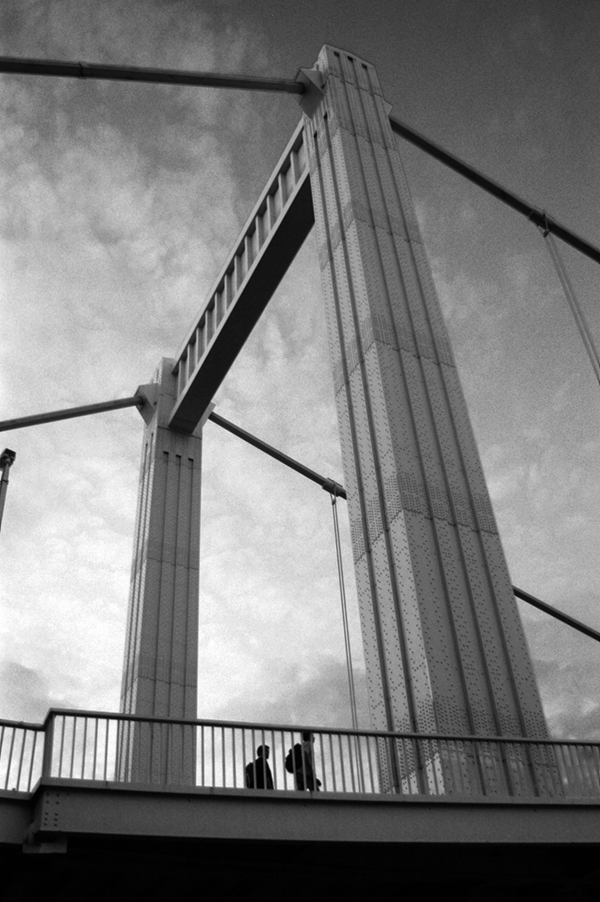
I photographed this impressive bridge over the Danube in Budapest, in 2003. It was designed by engineer Pál Sávoly and opened in 1964.
I liked the wonderful contrast between the scale of the engineering and the two tiny pedestrians. They appear almost as silhouettes behind the railing, providing the human scale that tells us just how massive the structure is. The soft, grainy texture of the sky contrasts with the hard, repetitive geometry of the bridge.
As German forces retreated from Budapest at the end of the Second World War, the city’s Danube bridges were destroyed. Erzsébet Bridge was badly damaged, and unlike the other major pre-war bridges, it was not reconstructed in its original form. Instead of recreating the ornate 1903 structure, post-war Hungary chose a thoroughly modern bridge. Construction began in 1961, and the new bridge opened on 21 November 1964. It retained the approximate location and basic suspension principle of its predecessor, but otherwise represented a new technological and aesthetic era.
So the bridge in this photograph photograph is, in a sense, a 1960s vision of the future, photographed forty years later.
Exploring Budapest’s Underground & Graffiti
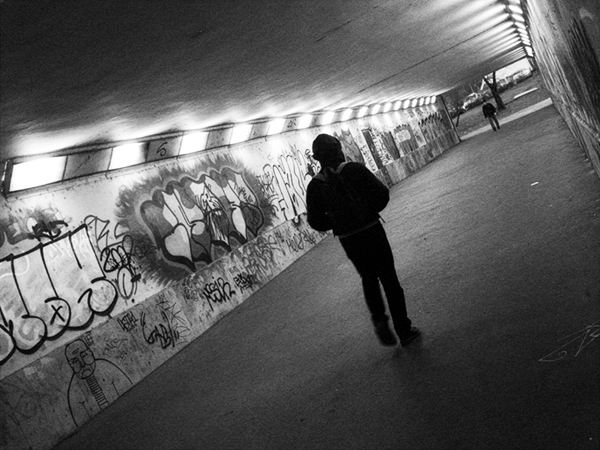
Whenever I visit a city for the first time I’m always looking for something unusual to photograph; here in Budapest I’m working from the level of the pedestrian rather than the tourist: not the grand Budapest of the Danube and historic façades, but the transitional, slightly rough spaces underneath it. I’ve always been fascinated by the lighting of underground spaces and there atmospheric effects.
The photograph is deliberately off-kilter. The horizon isn’t horizontal; the whole passage seems to lean. That gives an ordinary pedestrian tunnel a surprisingly unstable, almost cinematic quality.
The large figure in the middle (my partner Hazuan Hashim) is the anchor. He’s walking away from us and almost swallowed by the tunnel. Then, right at the far end, another tiny figure is visible. The eye naturally follows the first person toward the second.
The graffiti is a crucial part of the composition. It isn’t simply background decoration; it reveals a lot about the character of the city. The subway can be imagined as a lighted gallery for ever changing graffiti. Importantly it’s a gallery without gatekeepers.
The walls are covered with layers of tags and larger pieces, some apparently painted over and repainted. In black and white they become almost as important as the architecture. There’s a particularly interesting contrast and tension between the formal repetition of the tunnel—the windows, lights, concrete panels—and the uncontrolled marks of the graffiti.
It’s almost a collision between two kinds of urban language:
- the city authority: concrete, lighting, circulation, numbered/marked panels;
- the individual: names, tags, drawings and territorial marks.
And the two are literally occupying the same surface.
There is historical substance behind that. Budapest’s metro infrastructure became an important part of the city’s graffiti culture during the 1990s. One account of Budapest’s M3 graffiti scene records work appearing at the Fehér úti depot in 1994 and subsequently at the K?ér Street depot; some work by the graffiti artist known as “Dise” survived until 2003.
It was cold and wet when we visited Budapest in 2003 and there was melting snow outside the subway. It’s really a memory of being in that city. I’ve visited it many times since. Budapest is a place that draws you back because there’s always something new to see and experience.
Life in Dhaka: A Glimpse of 1980s Child Labour
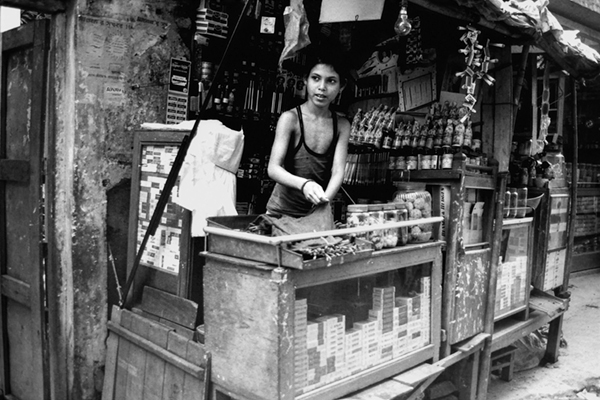
This photograph of a street stall in a back street in Dhaka records an ordinary moment of working life. The stall itself is extremely small, crowded and improvised, with goods packed into every available space. Behind the boy are shelves filled with bottles and other products, while the foreground contains boxes and packets. The density of objects communicates the cramped conditions of the informal marketplace.
Contemporary evidence shows that child labour was widespread in Bangladesh during the 1980s. A 1986 US Department of State report, citing Bangladesh Bureau of Statistics estimates, put the number of child labourers at around 3 million, compared with 2.5 million in 1981. It also reported that 70% of manual labourers surveyed in Dhaka’s markets were aged between 7 and 15, with children working in transport, carrying loads, construction and other occupations.
The photograph captures more than an individual shop: it records an economic system in which small family businesses and informal work were essential to urban survival; it depicts precisely the kind of informal urban marketplace where children’s labour could occur.
I made this photograph as I was driving slowly past in the passenger seat of a Rickshaw.
Documentary Photography: Moments at a Bus Stop

I’ve always loved the photographic opportunities provided by bus stops. This photograph has a documentary character, but its composition gives the encounter between the two men an almost theatrical quality. I was sitting down at the bus stop at the time and pointed my camera upwards to capture this happy moment when two friends bumped into each other at the bus stop. Their warm handshake is energetic and purposeful.
A bus stop is a wonderfully democratic photographic setting: strangers, friends, commuters, elderly people, shoppers and workers all temporarily occupy the same small piece of civic space. Actually this photo was taken at a tram stop.
For me, the real subject is the momentary intimacy of public life. I’ve captured two people who happen to meet while everyone else waits for transportation. The bus stop becomes a small stage, and the handshake supplies the decisive moment.
Tension Between Reality and Digital Disconnection
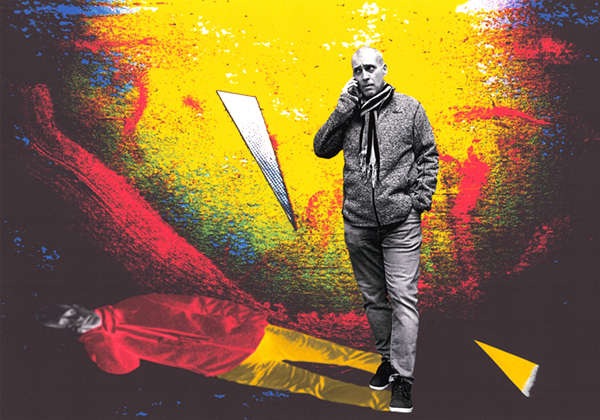
In this mixed media piece I’ve attempted to explore tension between stillness and movement, gravity and suspension, reality and imagination. The man on the phone is represented twice, as a positive and negative image. He’s in an intensive conversation but not really connected to his environment. I’ve observed thousands of people walking the streets in different countries either speaking on the phone or gazing into it. They’re largely unaware of the world around them and more connected to a dreamlike digital wilderness. They’re not in the real world.
The positive man contrasts sharply with the almost abstract environment around him. He looks as though he has been extracted from an ordinary street photograph and inserted into a different psychological universe. He’s in a wilderness; a man trying to navigate an increasingly unstable world.