Justice?
This week, the UK Court of Appeal upheld the Labour government’s decision to proscribe Palestine Action, rejecting comparisons with the suffragettes and describing Elbit Systems, Israel’s largest weapons manufacturer, as a company engaged in a “lawful business.”
Yet the suffragettes were far from exclusively peaceful campaigners. Alongside civil disobedience, they smashed windows, planted bombs, set fire to buildings, and carried out acts of sabotage in pursuit of political change.
Palestine Action has targeted weapons factories and military equipment on the grounds that companies such as Elbit profit from and facilitate Israel’s genocide in Gaza.
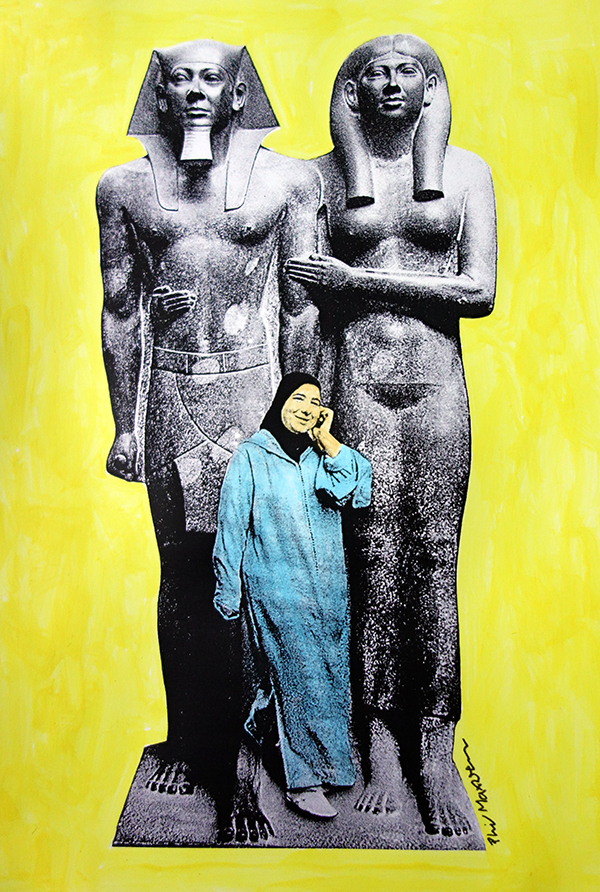
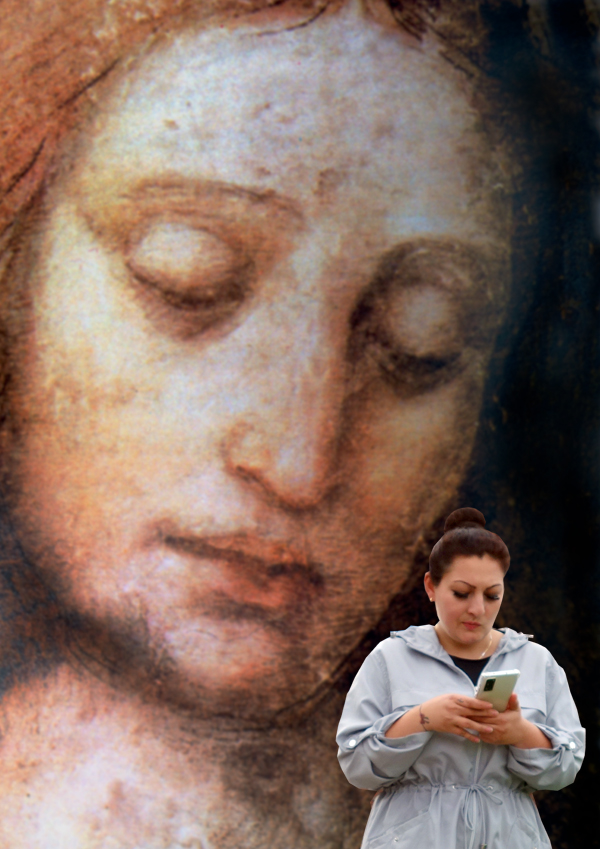
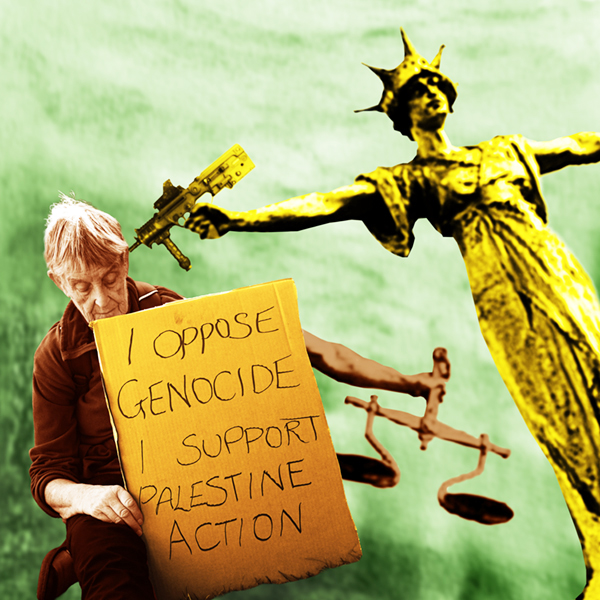
In response to this ruling, I wanted to create a photomontage as a symbolic and explicitly political piece of visual commentary. The work reflects a prevalent view that the British legal system is protecting arms manufacturers while suppressing anti-war protest.
I photographed the protester outside the Labour Party Conference shortly before her arrest in September 2025. There was a striking serenity about her that I hope the image captures. She is juxtaposed with a representation of the golden female figure that stands atop London’s Old Bailey (the Central Criminal Court), commonly known as Lady Justice.
Traditionally, Lady Justice symbolises fairness, impartiality, and the rule of law. Here, however, she is depicted holding an IDF-issued gun to the protester’s head, deliberately inverting that symbolism. Rather than embodying justice, she becomes an instrument of coercion and intimidation.
The image expresses my belief that today’s legal system is increasingly being used against those who protest injustice. Justice itself appears compromised, subordinated to political and economic power. That is why the scales of justice emerge from the protester’s left arm: they no longer belong to the institution that claims to uphold them, but to those who resist.
It is, unapologetically, a piece of political art.
Gentrification and Housing Affordability in East London
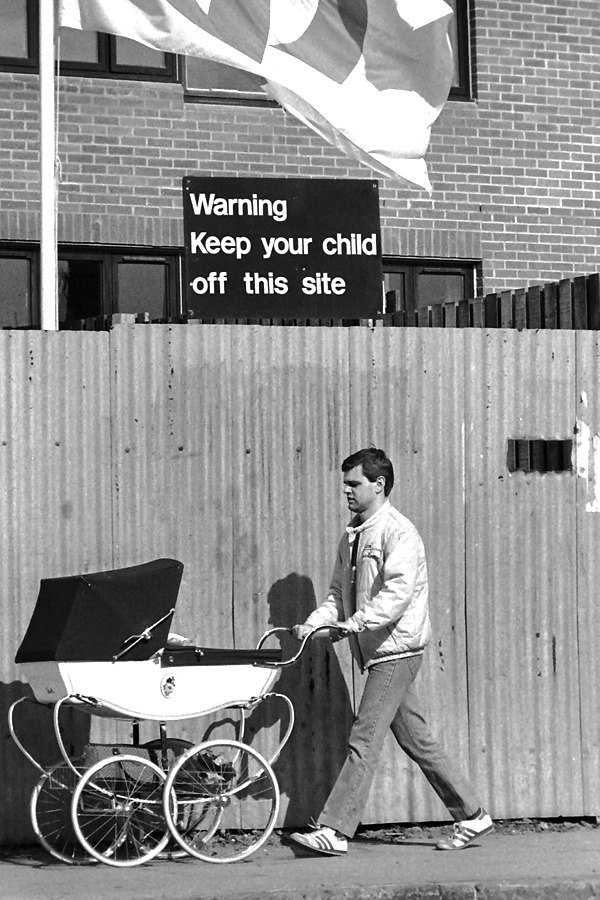
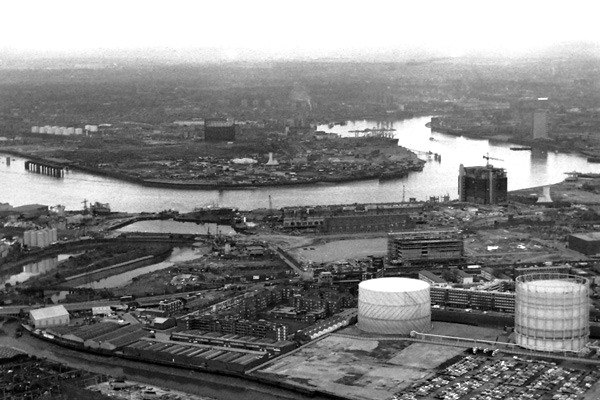
When I took this photograph in 1986, the Isle of Dogs was undergoing one of the most dramatic urban transformations in Britain.
Following the decline of London’s docks during the 1960s and 1970s, the area experienced severe unemployment and economic decline. In 1981, the London Docklands Development Corporation was established by the Thatcher government to attract private investment into the Docklands. Vast tracts of valuable land were transferred to developers, paving the way for new housing schemes and, ultimately, Canary Wharf.
The first signs of redevelopment appeared in the form of new housing estates, preceding the skyscrapers and financial towers that would later come to define the area. Many local residents saw these developments as being designed for incoming professionals rather than the established working-class communities who had lived there for generations.
In this context, the photograph came to symbolise exclusion as much as opportunity. The man with the pram becomes a representative figure of the existing community, passing developments that were physically within his neighbourhood but economically beyond his reach.
Today, the image reads almost as an early photograph of gentrification. By contemporary standards these houses do not appear especially luxurious, yet in the mid-1980s they represented a new housing market largely disconnected from local incomes and circumstances.
The photograph documents the beginning of a process that would eventually transform the Isle of Dogs from one of London’s poorest districts into an area with some of the highest property values in the country.
Viewed forty years later, the image has acquired an additional significance. It now appears almost prophetic. The issues it hints at—housing affordability, regeneration, displacement and social inequality—remain central to debates about the Isle of Dogs and many other parts of London.
The continuing relevance of these questions is reflected in today’s housing crisis. The housing charity Shelter reports that more than 1.3 million households are currently on waiting lists for social housing in England, while only 12,198 new social homes were built by councils, housing associations and private developers last year. At that rate, there are approximately 110 households waiting for every new social home delivered, and it would take well over a century to clear existing waiting lists.
As a result, the photograph functions both as a record of a specific moment in 1986 and as a lasting commentary on the social consequences of urban redevelopment. What began as a local story about the transformation of the Docklands now resonates as part of a much wider conversation about who benefits from regeneration and who is left behind.



Roman Road: A Fusion of Memory and Modernity
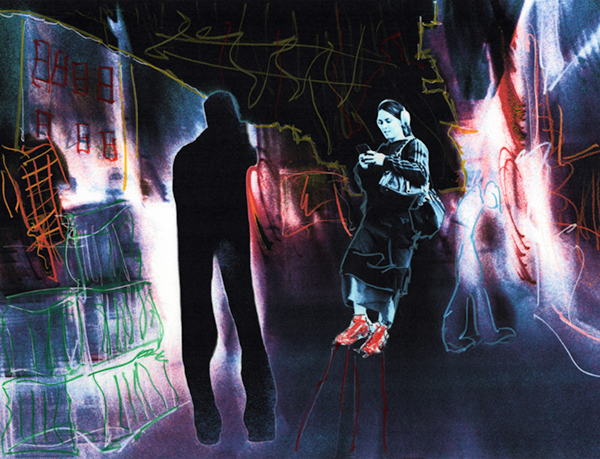
This photomontage combines two images: a photograph of Roman Road, London, taken in 2009, and a photograph of a woman using her phone in the East End, taken in 2025. Photography, drawing, and digital manipulation are fused into a single psychological image.
I wanted to create a work that feels simultaneously documentary and dreamlike, where the city becomes a layered field of perception, memory, and social interaction. The original photograph of a busy market day on Roman Road has been inverted, transforming day into night, while the woman on her phone appears suspended above the street in daylight. This juxtaposition reflects my experience of walking through the East End distracted by thoughts, memories, advertisements, lights, and passing strangers, recalling journeys home after visits to a local pub in Whitechapel.
The woman on her phone embodies a familiar contemporary condition: being physically present in public while mentally elsewhere. The work attempts to construct a mental landscape in which observation, distraction, technology, memory, and anonymous human encounters overlap and coexist. Like the floating figure, neon-like scribbles, glowing outlines, and gestural marks drift across the scene, disrupting any straightforward photographic reading.
The image occupies a space between documentation and imagination. It can be understood as a photograph of a dream.
Exploring East London’s Street Life in the 1980s
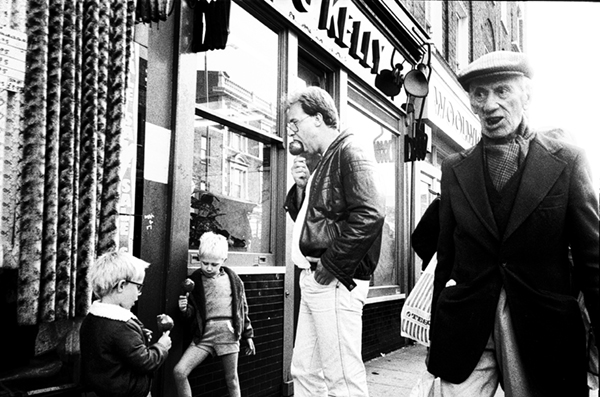
In 1985, Bethnal Green Road was lined with independent shops, and Saturdays in particular were always busy. There was a constant flow of people and plenty of opportunities for street photography.
In this photograph, the elderly man dominates the right foreground. His face is sharp and expressive, yet he is not obviously connected to the children. Behind him, an adult and two children create a quieter, more intimate scene. The eye moves naturally back and forth between these groups. What appeals to me is the way different generations coexist within a few feet of one another. The children are free to occupy the edge of the pavement, while adults and children share the public space in an easy, unselfconscious way.
The image captures a form of street life that has become less common as traffic, redevelopment and changing social habits have altered Bethnal Green Road quite dramatically over the years. I doubt whether toffee apples can still be bought there today.
The older man in the foreground is a crucial part of the composition. His animated expression brings humour and unpredictability to the photograph, injecting life into an otherwise quiet scene. Had he passed by a second earlier or later, the image would have felt very different.
The following day I was probably wandering around the Brick Lane Sunday market, looking for the next picture.
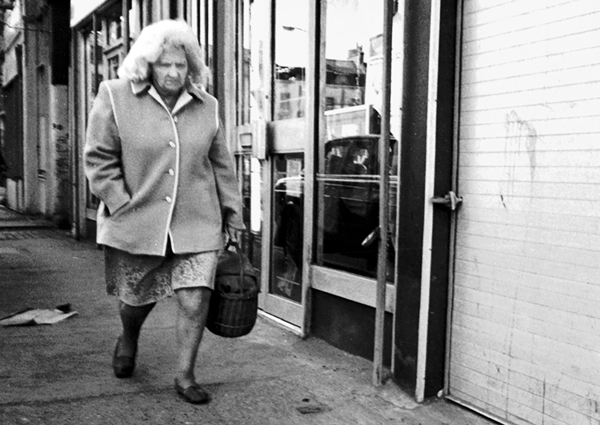
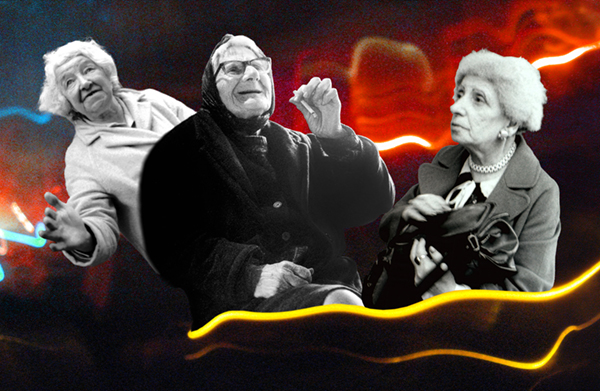
I photographed the three remarkable women featured in this photomontage on different occasions while wandering through London’s East End over several decades, my camera loaded with black-and-white film.
Although elderly, these women are anything but passive. Their gestures and expressions are animated, distinctive, and full of character. The figure on the left leans backwards in surprise and laughter, captured on Brick Lane. At the centre, a woman raises her cigarette in greeting as she smiles towards the landlady of the Golden Heart pub in Spitalfields. On the right, a woman clutches her handbag protectively while waiting for a bus on Mile End Road. Together, they challenge stereotypical portrayals of old age as static, diminished, or invisible.
In this work, I have combined documentary-style portraiture with surreal, cinematic visual effects. I have always been resistant to photographic representations of older people that rely on sentimentality. These women are not fragile victims; they are complex individuals whose presence commands attention. My aim was to give them both theatrical power and psychological depth.
The glowing light trails that envelop the figures suggest movement, vitality, and the passage of time, creating a scene that feels simultaneously documentary, symbolic, and dreamlike. Old age exists within the same fast-moving contemporary world that visual culture so often associates with youth. This photomontage is a tribute to lives fully lived, often, perhaps, under challenging circumstances, and to the resilience, humour, and individuality that endure throughout them.